Alaqua Lakes, Longwood, Florida  ·  A Local History

The Paradise That Had Everything but Its Own Power


In the Markham woods west of I-4, a developer laid a Tom Fazio golf course, a string of man-made lakes, and a gated town of custom homes over old Florida pine and citrus land. Every green blade and still pond of it runs on electricity — and twice in thirteen years, the county around it went dark for a week.

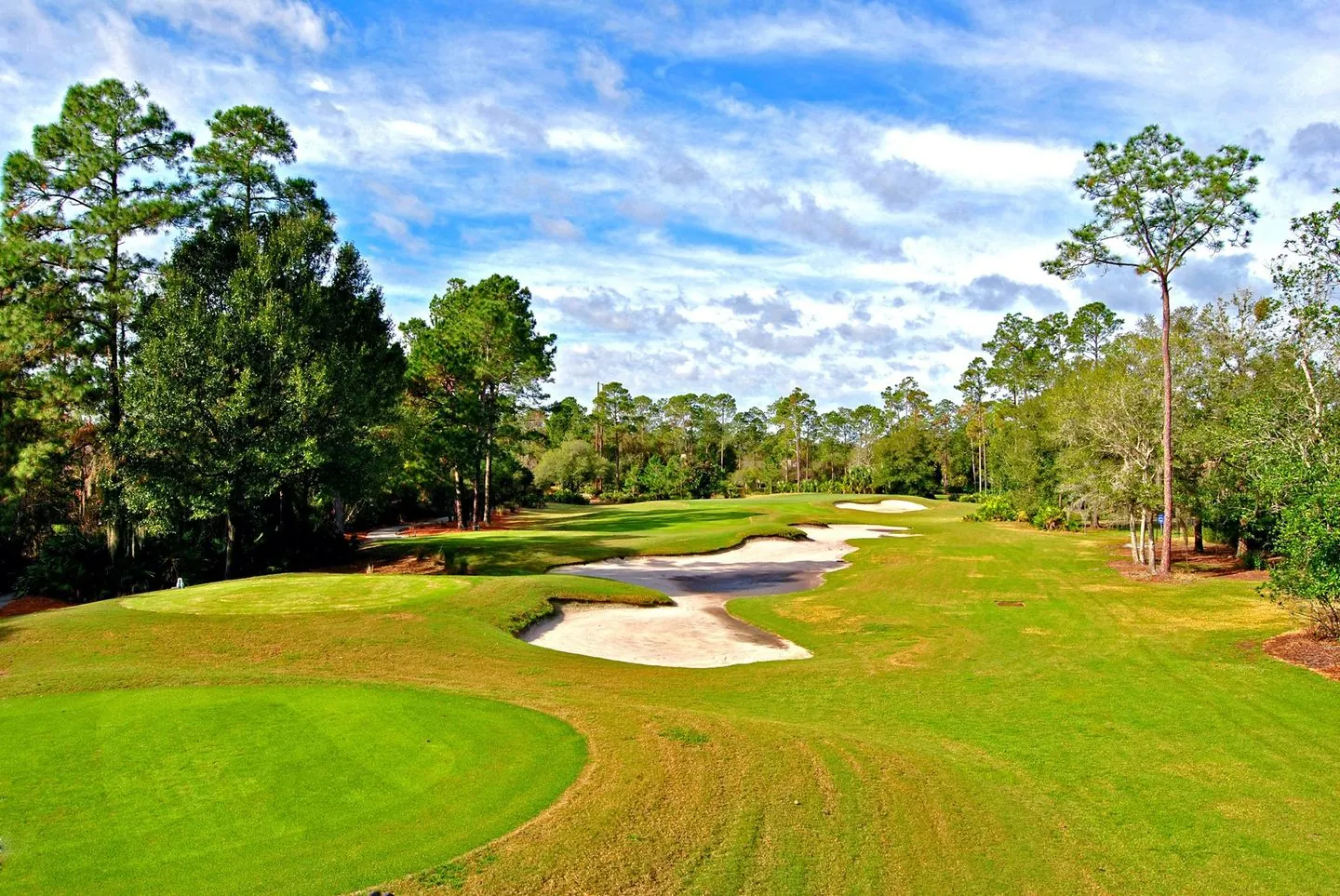
A manicured golf hole at the Legacy Club at Alaqua Lakes: a wide green fairway and putting green edged by bright white sand bunkers, ringed by tall Florida pines under a blue sky with scattered clouds.
Every blade of it, green on purpose
A hole at the Legacy Club at Alaqua Lakes. Tom Fazio laid out this course in 1998 on old pine-and-pasture land in southwest Seminole County. The emerald fairways you see are a full-time act of will — mowed, fed, and watered by pumps that only run with the power on. Photograph via the Legacy Club at Alaqua Lakes listing on GolfPass.

A golf fairway in Central Florida is not a natural thing. Left alone for a single wet summer, that velvet green would go back to sandspur, palmetto and pine inside a season. Every inch of what makes Alaqua Lakes beautiful — the Fazio greens, the still lakes it was named for, the hedges behind the gate — is kept that way on purpose, against the pull of the Florida it was built on top of. And almost all of that upkeep, in the end, runs on electricity.

Which makes the place a quiet little experiment. Here is about as controlled an environment as money builds in Seminole County: gated, planned, manicured, climate-conditioned. The one thing nobody inside the gate can manufacture is the current that keeps it all running — and that arrives from somewhere else entirely, on a line of poles walking in through the woods.

Before it was a paradise, it was woods

The land here is the old Markham country, the piney stretch west of I-4 that gave Markham Woods Road its name — a route that once linked Longwood to a vanished little settlement called Markham. In the 1870s and 1880s this corner of Seminole County was orange groves, lumber mills and cattle. Settlers came to West Longwood, just up the road, because the sandy soil was good for citrus.

And then Florida did the thing Florida does. It reminded everyone who was actually in charge.

A black-and-white photograph of a bare orange grove after a hard freeze: leafless trees standing in rows over a ground littered with fallen, frost-killed leaves.
What the cold left of the groves — 1894
An orange grove killed by cold, Bartow, Florida, 1894. The Great Freeze of 1894–95 stripped Central Florida’s citrus to bare wood in two back-to-back cold snaps and ended the first citrus boom. West Longwood, a short way from today’s Alaqua Lakes, was hit hard. Louise Frisbie Collection, State Archives of Florida (Florida Memory).

Over the winter of 1894 and 1895, two freezes a few weeks apart dropped down the peninsula and took the groves to the ground. Trees that had been loaded with fruit were bare sticks by February. Growers who thought they had tamed this place into neat rows of oranges learned that the warmth they were banking on was only on loan. The citrus boom that built towns like Longwood collapsed, and the industry crept south to start over where the cold couldn’t reach.

That is the older lesson buried under the fairways: you can lay whatever you like over this land, but Florida keeps a vote, and it tends to cast it on its own schedule.

The town they conjured out of the pines

A century after the freeze, a different kind of ambition arrived. In the late 1990s the developer Taylor Woodrow began building Alaqua Lakes — a gated, luxury community of custom and semi-custom homes wrapped around a brand-new Tom Fazio golf course, the Legacy Club, which opened in 1998. The houses went up in waves from 1998 into the 2010s, until there were something like five hundred of them behind the gate.

The lakes, like the greens, were an act of design. This is a place named for its water, and the water is shaped, held, and kept moving on purpose — the ponds that mirror the Fazio holes, the fountains that keep them from going stagnant in the heat. On a still evening it is genuinely lovely, and none of it is an accident.

A golf green beside a calm lake at dusk, the pink-and-purple twilight sky and silhouetted trees mirrored in the still water, a single white sand bunker catching the last light.
The lakes it was named for, at the end of a day
A Legacy Club green at dusk. The man-made lakes are the community’s signature — and keeping them bright, aerated and mosquito-free, like keeping the greens green, is a job that runs on electricity. Photograph via the Legacy Club at Alaqua Lakes listing on GolfPass.

It was, and is, a convincing version of control. Behind one gate you have your own golf, your own water, your own cooled and quiet streets — a pocket of Florida bent entirely to how its residents want it to look and feel.

The one thing you can’t landscape

Except the current. You can dig the lakes and shape the greens and raise the gate, but you cannot make your own electricity. It comes in from outside, along the utility lines that cross the same open country the groves once stood in — and everything that makes the place the place is downstream of those wires.

A rolling golf green at the Legacy Club edged by sand bunkers, with a lake visible at the left and pines beyond, under a soft overcast morning sky.
Greens stay green only while the pumps run
Another hole at the Legacy Club. Irrigation pumps, lake aerators, the gate motor, and the air conditioning in five hundred homes are all the same kind of thing — conveniences that quietly assume the power will be there. Photograph via the Legacy Club at Alaqua Lakes listing on GolfPass.

You can build a place to feel completely self-contained and still depend, utterly, on a line of poles marching in from the outside world.

In Central Florida that dependency has a season. Every summer the afternoon storms stack up into some of the tallest thunderheads in the country, and the lightning that comes with them finds the wires. Most years it is an hour’s flicker and nothing more. But every so often something far bigger comes up the peninsula to find out how much of that control was ever real.

2004: the summer the lights went out for good

It came in 2004. Hurricane Charley crossed the state in August and passed close enough to Seminole County to be, by local accounts, the strongest storm the area had on record — gusts clocked past 90 miles an hour, well inland, in a region that likes to think of itself as safe from that sort of thing.

A NASA satellite image of Hurricane Charley in 2004 as a tight white spiral with a clear eye, set against the blue of the Gulf and the green of the Florida peninsula.
Charley over Florida — August 2004
Hurricane Charley, August 2004. A compact, violent Category 4 at the coast, Charley turned up the middle of the state and tracked across Orange and Seminole counties. Three more storms would brush or cross Central Florida before the season ended. NASA satellite image, via Wikimedia Commons.

And it didn’t come alone. Over the following six weeks, Frances and then Jeanne crossed the peninsula as well — three hurricanes in a season, a sequence people here still measure other years against. When the wind was done, the damage that mattered most to daily life was the same everywhere: the wires were on the ground.

Seminole County later put its own three-storm bill at roughly $54.9 million. And the dark lasted. In Altamonte Springs, the next town over, some neighborhoods had no power for as long as twelve days. A gated community’s greens do not stay green through twelve days without irrigation in August, and its air conditioning does not run on good planning.

Looking up at a lineman in a hard hat working from a bucket truck high on a storm-damaged wooden utility pole beside a palm tree, under a bright blue sky.
The only thing that ends an outage
A line crew on the poles, Florida, 2004. After the 2004 storms, getting the power back was not a design problem a developer could solve in advance — it was crews in bucket trucks, one pole at a time, spread thin across a whole state hit again and again. FEMA photo, via Wikimedia Commons.

There was nothing a resident could do about it but wait for a truck to reach their street. The most carefully controlled address in the county was, in that stretch, exactly as powerless as the oldest house on the oldest road — because they were both waiting on the same line down the same road.

2017: and then it happened again

If 2004 could be filed away as a freak season, Hurricane Irma reopened the file thirteen years later. In September 2017 Irma raked the length of the state and knocked out power to millions; the local utility called it the most significant storm ever to hit its Florida territory, touching all thirty-five counties it serves.

A satellite image of Hurricane Irma in September 2017, an enormous white spiral with a distinct eye covering much of the Florida peninsula and the waters around it.
Irma, thirteen years later — September 2017
Hurricane Irma over Florida, September 2017. Irma was wide enough to put the whole state under warning at once. In Seminole County, thousands of homes were still dark a week after it passed. NASA/NOAA satellite image, via Wikimedia Commons.

A week after Irma, around fifteen thousand homes in Seminole County were still without power. In one subdivision next door in Altamonte Springs, a resident was still dark about nine days in — while crews, by the utility’s own admission, were sometimes sent to the wrong neighborhoods, and some customers were told their power was back when it wasn’t. Being newer, nicer, or behind a gate bought nothing in that line. The grid doesn’t read the plat map.

The vote Florida keeps

Stand at the edge of one of those lakes on an ordinary evening — the fountain working, the green holding its color, the gate swinging shut behind the last car home — and Alaqua Lakes looks like a place that thought of everything. It very nearly did. The lakes, the greens, the gate, the cool air: all of it designed, built, and maintained exactly as intended, right up until the power stops.

That is the thread that ties the bare groves of 1894 to the dark streets of 2004 and 2017. A hundred years apart, the same quiet fact: you can lay a paradise over this corner of Florida, but you are renting the conditions that keep it one. The freeze took the fruit. The storms take the current. And the one input the whole beautiful place can’t manufacture for itself is the one Florida is most willing to switch off.

A present-day note · GENERasic

Alaqua Lakes could build the lakes, the greens and the gate. The one thing no amount of design erases is that the power comes in from outside — and a storm can put it on the ground for a week or more.

Twice in thirteen years, the honest answer for this county was “days for some, over a week for others” — because getting a storm-wrecked grid back came down to how fast a crew could reach your particular street. In 2004 that meant up to twelve days in the next town over; after Irma in 2017, around fifteen thousand Seminole County homes were still dark a week on. That part was never in a resident’s hands.

A single home runs on electricity exactly the way that community does. Cooling, clean water, refrigeration, a CPAP at night, medical equipment — nearly everything that keeps a house livable needs power, and in a storm the grid is the first thing to go. In Florida that’s a when, not an if. No amount of money, planning, or new construction keeps the lights on when the line down the street is lying in the yard.

A standby generator is the one piece of that you can decide ahead of time. It doesn’t wait on a bucket truck working its way across the county — it starts itself the moment the power drops, whether anyone’s home or not. In a Florida outage, here’s what it’s actually holding up:

An enclosed residential standby generator on a concrete pad beside a building, with trees behind it.
The fallback, wired before you need it
A residential standby generator (representative photograph, not Alaqua Lakes equipment) — wired to start on its own the moment the grid drops. Via Wikimedia Commons.

Which of those actually apply to your address — your medical needs, how your house is fed, well or city water — is worth pinning down for your own home rather than guessing. That part is yours to check.

You can get an address-specific installed price for standby power — the whole turnkey number, not a callback and a maybe — in one sitting.

Get your installed price for this address→
Sources & Photo Credits

On the history

Note on the chosen lens and on uncertainties

This page was built with a “power resilience” lens for GENERasic. Alaqua Lakes is a planned, gated golf community built since the late 1990s, so it has no deep archive of its own; the strongest true, power-centered story is the collision between a built-from-scratch paradise of water and grass — every bit of it dependent on electricity — and a Central Florida grid that has gone down for a week or more twice in a generation (the 2004 hurricane season and Hurricane Irma in 2017). A few points are stated carefully. Developer and dates: Taylor Woodrow as developer, the 1998 Fazio course opening, and the ~500-home, 1998–2010s build span are developer-, real-estate- and golf-directory-sourced rather than from an independent archive, and are described that way. The name “Alaqua”: it is sometimes said to come from a Native American word for the sweetgum tree, but that etymology rests only on popular name references and is not well documented, so the page does not assert it. Charley’s strength locally: “strongest on record for the area” and the “gusts above 90 mph” figure come from local news reporting, not a formal station record, and are given as regional. Outage durations: the 12-day (2004, Altamonte Springs) and ~9-day / ~15,000-customer (2017, Seminole County) figures are from contemporary coverage and county/utility statements and are given as neighboring-city and county-level figures — no Alaqua-Lakes-specific outage duration is claimed, because none was independently verified. The 1894 freeze photograph is labeled as Bartow, not Longwood; the Charley and Irma images are satellite views of the storms, not of this community; the line-crew photo is labeled as general 2004 Florida restoration; and the standby generator is explicitly a representative image, not Alaqua Lakes equipment.

Photographs

  1. Legacy Club at Alaqua Lakes — fairway and bunkers (hero, modern) — a Fazio hole with green, white sand bunkers and pines. Via the Legacy Club at Alaqua Lakes listing on GolfPass. File: legacy-club-alaqua-lakes-golf-a. golfpass.com
  2. Legacy Club green at dusk (modern) — a green beside a lake at twilight, the sky mirrored in still water. Via the Legacy Club at Alaqua Lakes listing on GolfPass. File: legacy-club-alaqua-lakes-golf-c. golfpass.com
  3. Legacy Club green with lake (modern) — a rolling green edged by bunkers with a lake and pines beyond. Via the Legacy Club at Alaqua Lakes listing on GolfPass. File: legacy-club-alaqua-lakes-golf-b. golfpass.com
  4. Orange grove killed by cold, Bartow, Florida, 1894 — bare, frost-stripped citrus trees after the Great Freeze. Louise Frisbie Collection, State Archives of Florida (public domain, §257.35(6), Fla. Stat.). File: great-freeze-1894-orange-grove-bartow. floridamemory.com — item 117876 · Wikimedia Commons
  5. Hurricane Charley over Florida, 2004 — NASA satellite image of the storm’s spiral near Florida (public domain). File: hurricane-charley-2004-satellite. Wikimedia Commons
  6. Line crew repairing poles, Florida, 2004 — a lineman in a bucket truck on a storm-damaged pole. FEMA photo (public domain). File: power-crew-florida-2004. Wikimedia Commons
  7. Hurricane Irma over Florida, September 10, 2017 — NASA/NOAA satellite image of Irma on the peninsula (public domain). File: hurricane-irma-2017-over-florida. Wikimedia Commons
  8. Standby generator (representative — not Alaqua Lakes equipment) — an enclosed residential standby generator on a pad. Via Wikimedia Commons. File: standby-generator-set-representative.

The 1894 freeze photograph is a public-domain State Archives of Florida work; the Charley and Irma satellite images and the 2004 FEMA line-crew photo are public-domain U.S. government / NASA works. The three Legacy Club photographs come from the course’s own GolfPass listing and show the real Alaqua Lakes course. No image’s factual content was altered — the Polaroid frames and handwritten notes are CSS added around the photographs, never onto them. Original downloads and a full research record are kept alongside this page in assets/images/originals/ and source-record.md. Any owner who wants an image removed need only ask.