Baldwin Park, Orlando, Florida  ·  A Local History

The Reactor School
Under the Front Porches


For twenty-two years, the ground under Baldwin Park’s front porches was a Navy school that trained sailors to run nuclear reactors — the one kind of power that is never allowed to quit. Then the base closed, and the neighborhood that replaced it went back on the same grid that blinks out every Florida storm.

Walk down New Broad Street in Baldwin Park on an ordinary afternoon and it is about the most peaceable place in Orlando: brick crossings, shaded shopfronts, people on second-floor porches, a lake at the end of the street. It looks like it was always here. It was not. Twenty-five years ago this was a fenced military base — and one of the things the Navy did on this exact ground was teach sailors the physics of power that cannot be allowed to fail.

That is the odd thing about Baldwin Park. A neighborhood that now loses its lights in every hurricane season was built on top of a school obsessed with power that doesn’t.
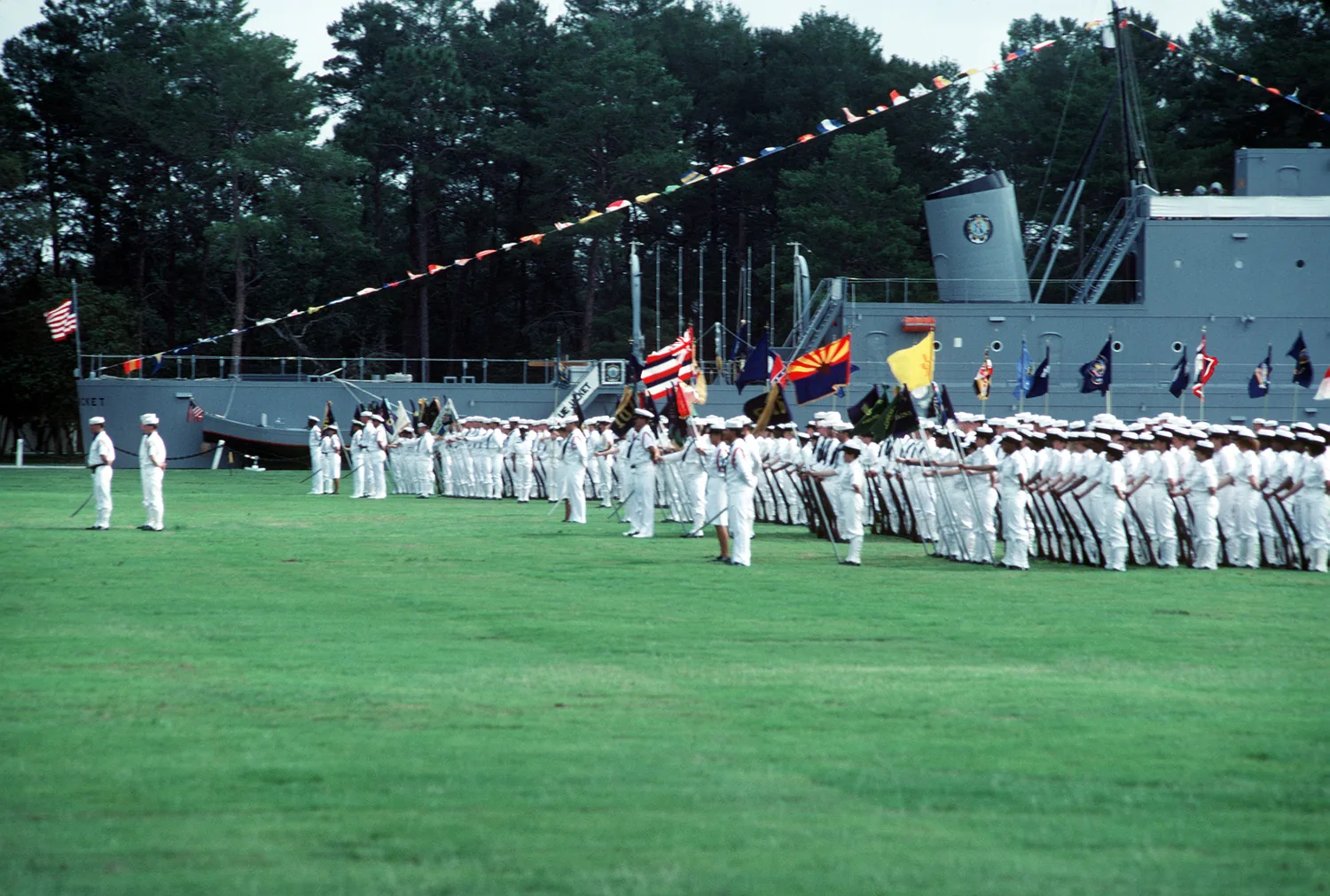
Rows of Navy recruits in dress uniform stand at parade rest on a paved field in front of a large land-based building shaped like a ship's superstructure, with masts and signal flags, during a graduation ceremony.
Graduation on the grinder — 1989
Recruits at parade rest in front of the landlocked training ship Bluejacket during boot-camp graduation at Naval Training Center Orlando, June 1989 — the drill field that is now a public park. U.S. Department of Defense photo (public domain).

An airfield, then a boot camp

The land started out in uniform. In 1940 the Army built an air base here, on the flatwoods northeast of downtown Orlando, and flew out of it through the Second World War and into the Cold War as an Air Force installation. In 1968 the Air Force handed it to the Navy, which stood up Naval Training Center Orlando — the country’s third boot camp — on the first of July that year.

A low concrete building constructed to look like the gray superstructure of a warship, complete with masts, railings and a hull-shaped base, sitting on dry land.
A ship that never touched water
The Bluejacket, NTC Orlando’s drill ship — a full-size warship mock-up built on dry land so recruits could learn shipboard life without leaving Florida. Circa 1968. U.S. Navy photo (public domain).

For the next twenty-six years this was where the Navy made sailors. More than 650,000 recruits came through before it closed — marched across a concrete drill field they called the grinder, and sent to sea from a warship that sat, bizarrely, on dry land. The Bluejacket was a full-size ship’s superstructure poured in concrete so recruits could learn the deck of a vessel a thousand miles from the ocean.

A round embroidered Navy insignia reading 'Naval Training Center Orlando Florida' around an eagle, anchor and shield.
NTC Orlando
The insignia of Naval Training Center Orlando. U.S. Navy (public domain).

Recruits were only part of it. The base held a hospital, a service-school command, and — starting in 1976 — the hardest classroom in the entire Navy.

The school for power that can’t quit

In 1976 the Navy moved its Nuclear Power School to Orlando. Its job was to turn ordinary enlisted sailors and young officers into people who could run the reactor on a submarine or an aircraft carrier — six months of college-level physics, thermodynamics, reactor theory and chemistry, taught at a pace that washed people out by the dozen.

Think about what that reactor is for. A submarine underwater cannot plug into anything. Its power plant has to make its own electricity, its own air, its own fresh water, and run for years without refueling, because the alternative to the power staying on is not darkness — it is drowning. Orlando’s school existed to produce the people who keep that kind of power from ever going out.

A black-and-white archival photograph of an empty reactor control room: a curved wall of instrument gauges and switch panels facing a freestanding operator's console, archival documentation markings along the border.
The controls — out in Idaho
A reactor control room at the National Reactor Testing Station in the Idaho desert (the Engineering Test Reactor). The Navy ran its live training reactors at this same remote complex — not in Orlando. Historic American Engineering Record, Library of Congress (public domain).

Here is the twist most people miss: no reactor ever ran in Orlando. There was nothing nuclear humming under the Florida grass. The school taught the minds; the actual reactors were a continent away, at a cluster of prototype plants out in the Idaho desert and at sites in upstate New York and Connecticut, where graduates went next to put their hands on the real thing. Orlando was the part where you learned why it worked before you were allowed near one.

On this ground, the whole point was power that never stops. A mile of classrooms taught it; not one watt of it was ever generated here.

The order to close

In 1993 a federal commission put NTC Orlando on the list of bases the country no longer needed. The shutdown came in waves: the boot camp and hospital first, then the service schools, and last of all the nuclear command. The final class of nuclear students in Orlando, class 9806, finished at the end of 1998, and the school packed up and moved to Charleston, South Carolina, by January 1999.

The Navy left behind thirteen hundred acres of drill fields, barracks, classrooms and a concrete ship, five minutes from downtown Orlando, with nothing to do.

Tearing down a base to build a town

What happened next was unusually ambitious. Rather than sell the base off in pieces, the city and a master developer wiped most of it away and started over. More than 250 buildings came down. The concrete and masonry weren’t hauled to a landfill — they were crushed on site and reused as fill and road base, which the project reckoned saved roughly 30,000 dump-truck trips off Orlando’s roads.

A modern wide photograph of a landscaped public square in Baldwin Park: a tiered stone fountain, white pergolas, flowering shrubs and townhouses under a clear blue sky.
Where the barracks were
A public square in Baldwin Park today (modern photograph), built over the footprint of the demolished base. Photo by Freeholdman12, 2024, CC BY 4.0.

In its place went down 25 miles of new streets and about 200 miles of utilities — and, from the first day, the lines went in underground. Then came the thing the base never was: a town. Planners laid out Baldwin Park on New Urbanist lines — narrow walkable streets, shops under apartments, houses pushed up near the sidewalk with porches facing it, all wrapped around the old base’s lake. The reuse was clean enough that the federal government later handed the project a national award for turning a shut military site back into something a city could use.

A large white two-story house with a metal roof, a square cupola tower and a deep columned porch, set behind a green lawn in Baldwin Park.
A house on the old base
A Baldwin Park house, of the sort built across the former training center after 1999. Photo by Simonhardt93, 2015, CC BY-SA 4.0.

Within a few years, families were living on streets named for the base that used to be there. The grinder where recruits once graduated became a park with a lake and a lawn.

Back on the ordinary grid

And here the story quietly turns back on itself. For all that it was built on the Navy’s monument to unfailing power, Baldwin Park gets its electricity the same way every other Orlando neighborhood does — from the local grid, one utility, one set of lines. The lines are newer and buried, which helps. But buried lines still feed from poles and substations out in the weather, and Central Florida is hurricane country.

When Charley, Frances and Jeanne crossed the state in 2004, when Irma came through in 2017, when Milton raked Orlando in 2024, the lights went out across the region — and Baldwin Park sat in the dark with everyone else. The ground that trained the Navy’s reactor operators has, as a neighborhood, exactly the resilience of any other suburb: good until the storm, then a candle and a cooler like the rest of us.

A modern Baldwin Park shopping street lined with palms, cars parked along the curb and three-story buildings with shops below and balconies above; one storefront sign reads 'Blue Jacket Gastropub', and the street ends at a lake.
“Blue Jacket” is still on the sign
New Broad Street, Baldwin Park’s main street (modern photograph) — the shopfront at right reads Blue Jacket Gastropub, one of the places the old base’s name still lives on. Photo by Freeholdman12, 2024, CC BY 4.0.

What you can still see

The base hides in plain sight. The lake the Navy drilled around is now Lake Baldwin, with a park named after the training ship on its shore — where a pair of statues and a wall of history panels are about all that mark what stood here. Dig in the right drainage swale and the crushed concrete of the demolished buildings is still down there. And the name keeps surfacing on the signs: Bluejacket on a park, Blue Jacket on a gastropub, a street grid that remembers a drill field.

A modern Baldwin Park street corner with a brick crossing, a four-way stop sign, mixed-use buildings with ground-floor shops and upper-floor apartments, and palm trees casting shadows on the pavement.
An ordinary afternoon
A Baldwin Park street corner (modern photograph) — shops, apartments and a quiet brick crossing on the former base. Photo by Dclemens1971, 2026, CC BY 4.0.

Stand on one of those porches the next time a hurricane knocks the power out and the whole neighborhood goes quiet and dark around you. There is a real irony in it, and it’s worth feeling for a second: this was the one patch of Orlando where the United States Navy taught people, in exacting detail, how to make sure the power never, ever goes out — and today it keeps its lights on exactly as well as the subdivision down the road.

A present-day note · GENERasic

The Navy taught one rule here: the power is not allowed to quit. For a house, there’s exactly one way to keep it.

A submarine reactor is the extreme version of an idea anyone on the Baldwin Park grid can use at a much smaller scale: make your own power, on site, so that when the line from the street goes dead, your house doesn’t. For a single home that isn’t a reactor — it’s a standby generator, wired to switch on by itself the moment the grid drops, whether you’re home or not.

In a Florida outage, what it’s really protecting is worth being plain about:

Which of those actually apply to your address — your medical needs, how your house is fed, well or city water — is worth pinning down for your own home rather than guessing. That part is yours to check.

And in a neighborhood like Baldwin Park, with front-loaded houses and an active HOA, a generator has to be sited and screened to the street’s standard, not just dropped on a pad by the AC — worth building into the plan from the start.

You can get an address-specific installed price for standby power — the whole turnkey number, not a callback and a maybe — in one sitting.

Get your installed price for this address→
Sources & Photo Credits

On the history

Photographs & documents

  1. Recruits at parade rest in front of the training-ship mock-up Bluejacket (hero) — boot-camp graduation at Naval Training Center Orlando, June 9, 1989. U.S. Department of Defense / Defense Visual Information Center; public domain, via DPLA / Wikimedia Commons. File: ntc-orlando-recruits-blue-jacket-1989. Commons
  2. The Bluejacket landlocked training ship at NTC Orlando — circa 1968. U.S. Navy; public domain, via Wikimedia Commons. File: ntc-orlando-blue-jacket-training-ship-c1968. Commons
  3. Insignia of Naval Training Center Orlando — U.S. Navy; public domain, via Wikimedia Commons. File: ntc-orlando-patch. Commons
  4. Reactor control room, National Reactor Testing Station, Idaho (Engineering Test Reactor control building) — shown to represent the live reactor plants that Nuclear Power School graduates trained on; this is Idaho, not Orlando, and the Navy’s prototype reactors were at this same desert complex. Historic American Engineering Record (HAER ID-33-G-132), Library of Congress; public domain, via Wikimedia Commons. File: idaho-reactor-control-room-1960s. Commons
  5. A public square in Baldwin Park — modern photograph by Freeholdman12, 2024; CC BY 4.0, via Wikimedia Commons. File: baldwin-park-panorama-2024. Commons
  6. A Baldwin Park house — modern photograph by Simonhardt93, 2015; CC BY-SA 4.0, via Wikimedia Commons. File: baldwin-park-house-2015. Commons
  7. New Broad Street with “Blue Jacket Gastropub” — modern photograph by Freeholdman12, 2024; CC BY 4.0, via Wikimedia Commons. File: baldwin-park-village-center-2024. Commons
  8. A Baldwin Park street corner — modern photograph by Dclemens1971, 2026; CC BY 4.0, via Wikimedia Commons. File: baldwin-park-street-2026. Commons

Modern photographs are clearly identified as modern, and the one reactor photograph is clearly identified as Idaho, not Orlando. Original downloads and a full research record are kept alongside this page in assets/images/originals/ and source-record.md. No image’s factual content was altered — the frames and handwritten notes are CSS added around the photographs, never onto them. Any owner who wants an image removed need only ask.