Bay Hill, Orlando, Florida  ·  A Local History

The Ground Too Poor to Grow Oranges


The citrus king of Orange County looked at this sandy shelf on the Butler Chain of Lakes and passed — it wouldn't grow fruit. A golf course took it instead, and Arnold Palmer made it his. Like every green acre in Florida, it runs on a wire it doesn't own.

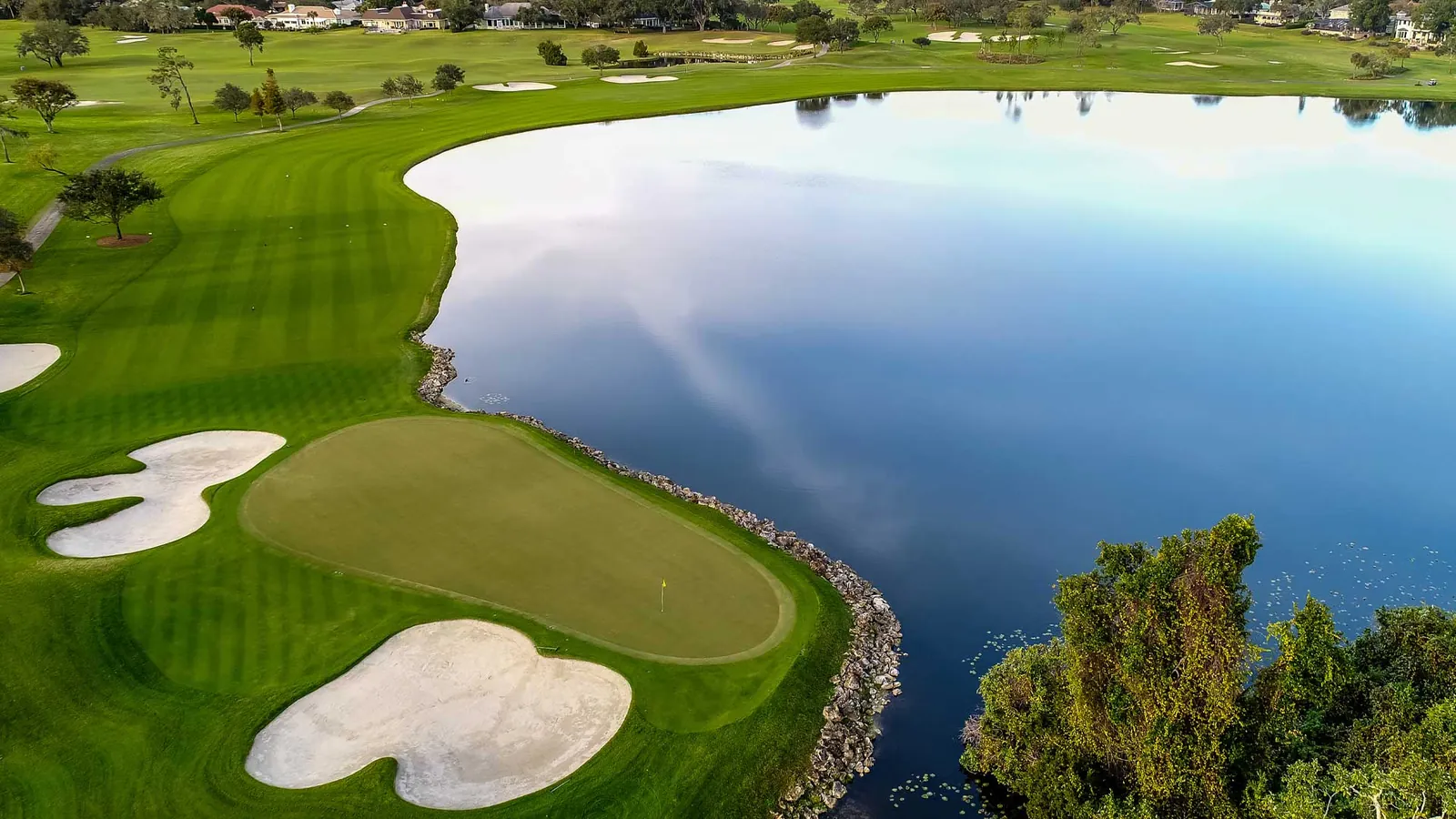
Aerial view of a Bay Hill golf green jutting into a large blue lake, ringed by white sand bunkers and a rock seawall, with homes lining the far shore.
Green on the water — where the oranges wouldn't grow
A lakeside green at Bay Hill Club & Lodge, on the Butler Chain of Lakes. The ground here was once dismissed as useless for citrus. A golf course saw the same sand and water and found exactly what it wanted. Every blade of it is mowed, fed, and watered by pumps that only run with the power on. Photograph via Bay Hill Club & Lodge.

Dr. Philip Phillips grew more oranges than almost anyone alive. By the 1920s his groves and packinghouses had made him the citrus king of Orange County, Florida — the man whose name the whole district southwest of Orlando still carries. And when the land that is now Bay Hill came across his books, the citrus king passed on it. By the account of the people who later built there, the sandy shelf along the Butler Chain of Lakes was no good for oranges: too poor in nutrients, too quick to let the water drain away.

So for a long time it grew almost nothing. Then this rejected patch of grove country became one of the most famous addresses in American golf, the winter home of the man they called the King — and, like every square foot of manufactured Florida paradise, a place that lives and dies on a line it does not own.

The land even the citrus king couldn't use

A vintage color postcard captioned 'Orange Grove, Orlando, Fla.' showing two long rows of orange trees heavy with fruit, receding toward a bright sky.
The crop the ground here refused to grow
An orange grove near Orlando, on an early-1900s postcard. This was the fortune Dr. P. Phillips built — rows of fruit, and a constant low worry about a freeze. The Bay Hill land couldn't manage even this. Postcard, Orange Grove, Orlando, Florida (public domain).

Phillips ran an empire of citrus across Central Florida. When he eventually sold most of his holdings — much of it to Granada Groves, a Minute Maid subsidiary — he kept back the raw, unplanted ground, the pieces the groves had never taken. The Bay Hill tract was one of those pieces.

It wasn't ugly. It had natural rises and hollows, lakes, and streams feeding the Butler Chain. It simply would not do the one thing Orange County measured land by. In a county that was, at the time, essentially one enormous orange grove, this was ground with no obvious purpose.

Which is the quiet joke under everything that came after: the very qualities that made it worthless for citrus — the rolling sand, the standing water — are the exact things a golf architect dreams about.

A golf course goes where the oranges wouldn't

In 1959 two out-of-state men, Tom Barnes and Tom Dore, took an option on the land and set out to build a championship course on it. In September 1960 a group of businessmen from Nashville came in behind them, and construction began. In late 1961 the course opened.

Dick Wilson drew the first eighteen holes; Bob Simmons built them, laying down Tifway Bermuda across roughly 270 acres between the new community of Bay Hill and the Butler Chain water. The scrub that couldn't feed a single orange tree now held one of the most ambitious new golf courses in the state. It just needed someone to notice it.

The day the King shot 66

A black-and-white photograph of two men on a golf course: an older man in a light shirt points as a younger man in golf clothes bends over a club, gripping it to hit a shot.
Arnold and his father, Deacon — the grip
Arnold Palmer with his father, Deacon. Deacon, a club professional, taught his son the grip he never changed. By 1965 that grip had made Palmer the most famous golfer alive — and brought him, almost by accident, to an unknown course outside Orlando. Photograph via Bay Hill Club & Lodge.

In 1965, promoters put together an exhibition match on the little-known Bay Hill course and invited the biggest names they could get: Arnold Palmer, Jack Nicklaus, Don Cherry, and Dave Ragan. Back then Sand Lake Road was still two lanes, and orange groves ran up to the edges of the property.

Palmer, the story goes, shot a 66 that afternoon — seven strokes clear of the field — and fell for the place on the spot. He liked the way it fit his eye: rugged, a little wild, quiet, full of water and birds. He was, by then, the first true superstar of television golf, a man whose whole appeal was command. He had found a course he wanted to command.

He had to have it

Wanting it and owning it took a while. In 1970 Palmer signed a five-year lease with an option to buy. In 1974 that option became ownership — some accounts say he had full control by 1975 — at a price reported just under five million dollars. He brought in the architect Ed Seay and reworked much of Dick Wilson's original design until most everyone simply called it a Palmer course.

A Bay Hill golf hole at golden hour: a manicured green and fairway beside a rock-edged pond, framed by palms and moss-draped oaks under a clear evening sky.
Built, fed, and lit — a paradise on a loan
Bay Hill at dusk. Palmer expanded the club and lodge, and from 1979 the course hosted a PGA Tour event — today the Arnold Palmer Invitational, every March. The oranges never came; the fairways stayed. Photograph via Bay Hill Club & Lodge.

What he built was a convincing version of control. Behind the gate: his own course, his own lodge, his own cooled and watered green world on the water, with his name over the whole of it. For a man who had spent his life bending golf courses to his will, Bay Hill was the last and largest of them — a place arranged, down to the grass, exactly the way he wanted it.

The one thing the King couldn't command

Except the current. Palmer could reshape a green, buy the club, raise the gate, and put his name on the sign. He could not make the place's electricity. It comes in from outside, along poles that cross the same flat country his course sits on — and everything that makes Bay Hill Bay Hill is downstream of those wires. The pumps. The irrigation. The air conditioning. The lights in the lodge.

The citrus king's bet was that the warmth would hold. The King of golf's was that the power would. In Central Florida, both are loans — and the weather keeps the right to call them in.

August 13, 2004

A satellite image of Hurricane Charley as a tight white spiral with a visible eye sitting directly over the Florida peninsula, the state's coastline traced beneath the clouds.
Charley over the peninsula — Aug. 13, 2004
Hurricane Charley crossing Florida, August 13, 2004. Charley came ashore on the Gulf coast and drove northeast across the middle of the state, straight at Orlando. Satellite image, NASA/MODIS.

On the afternoon of August 13, 2004, the forecast tracks moved Hurricane Charley's eye right over Orlando. Orange County's chairman, Richard Crotty, put it plainly to his own residents: “We are the center of the bullseye.” The storm tore across the state and went through East Orlando still carrying wind gusts near 106 miles an hour.

When it passed, more than two million Florida customers were in the dark — about 502,000 of them served by Progress Energy alone. Across metro Orlando the outages ran for days; some communities nearby, like Altamonte Springs, went without power for as long as twelve days. Utilities warned that in the hardest-hit counties, restoration could take the rest of the month.

Two utility workers in hard hats repair electrical lines on a wooden power pole after a storm, one reaching up toward the crossarm against a bright sky.
The only thing that ends an outage
A line crew restoring power in Florida after the 2004 storms. After a hurricane the power comes back the one slow way it always has — crews on the poles, one at a time, across a wrecked region. FEMA photo by Mark Wolfe, Fort Pierce, September 2004 (general 2004 Florida restoration, not Charley specifically).

Palmer was seventy-four that summer, alive and still the owner of the place with his name on the gate. And the grid does not read the gate. Getting the lights back was not a problem any amount of money or design could solve ahead of time — it was crews on poles, spread thin across a broken region, and the most carefully built address behind the Bay Hill guardhouse waited on the same line as the oldest house on the oldest road nearby.

What's still here

Palmer died in 2016. The club passed to his daughter Amy and her husband, Roy Saunders, and the tournament still fills the course every March. The surrounding district is still called Dr. Phillips, after the citrus king — though the oranges he was famous for are long gone from it, chased out by development and freezes decades ago.

So two men made two bets on this corner of Florida. The citrus king bet the ground would grow fruit, and lost; he kept the useless piece and let it sit. The King of golf bet he could build a paradise on that same useless piece and run it on his own terms — and mostly won, except for the one thing neither of them could command. The land too poor for oranges is green now, greener than any grove. It is just still renting the one thing that keeps it that way.

A present-day note · GENERasic

Arnold Palmer could build the gate, the course, and the lodge. The one thing no amount of design erases is that the power comes in from outside — and a storm can put it on the ground for days.

When Hurricane Charley crossed Orange County in 2004, the honest answer for this area was “days for most, longer for some” — more than two million Floridians lost power, and some communities near Orlando stayed dark for up to twelve days. That part was never in a resident's hands; it came down to how fast a crew could reach each particular street.

A single home runs on electricity exactly the way that community does. Cooling, clean water, refrigeration, a CPAP at night, medical equipment — nearly everything that keeps a house livable needs power, and in a storm the grid is the first thing to go. In Florida that's a when, not an if. No amount of money, planning, or new construction keeps the lights on when the line down the street is lying in the yard.

A standby generator is the one piece of that you can decide ahead of time. It doesn't wait on a bucket truck working its way across the county — it starts itself the moment the power drops, whether anyone's home or not. In a Florida outage, here's what it's actually holding up:

An enclosed residential standby generator on a concrete pad beside a house, next to a white picket fence and garden bed.
The fallback, wired before you need it
A residential standby generator (representative photograph, not Bay Hill equipment) — wired to start on its own the moment the grid drops. Via Cummins.

Which of those actually apply to your address — your medical needs, how your house is fed, well or city water — is worth pinning down for your own home rather than guessing. That part is yours to check.

You can get an address-specific installed price for standby power — the whole turnkey number, not a callback and a maybe — in one sitting.

Get your installed price for this address→
Sources & Photo Credits

On the history

Note on the chosen lens and on uncertainties

This page was built with a “power resilience” lens for GENERasic. Bay Hill is a mid-century golf club and planned community, not a place with a deep public archive; the strongest true, power-centered story is the arc from a patch of Dr. Phillips's citrus country too poor to grow oranges, to the golf course that took it, to Arnold Palmer's manufactured paradise — a built, gated, green world that depends entirely on grid electricity, in a county whose grid went dark for days when Hurricane Charley crossed it in 2004. A few points are stated carefully. The “unsuitable for citrus” detail and the development timeline come from a local-history account of the course and are described as such. Palmer's 1965 score of 66 is from widely repeated secondary golf sources, not a contemporary record, and is framed that way. The purchase year is given as 1974 by the club and Wikipedia, with some local accounts saying 1975; the reported price (“just under $5 million”) is secondary. Image geography: the orange-grove image is a generic early-1900s Orlando postcard, not the Bay Hill land; the Charley image is a satellite view of the storm, not of this community; the line-crew photo is a 2004 FEMA image from Fort Pierce used as general Florida storm restoration, not Charley at Bay Hill; and the standby generator is explicitly a representative image, not Bay Hill equipment. No Bay-Hill-specific outage figure is claimed — the Charley numbers are statewide and metro-Orlando.

Photographs

  1. Lakeside green at Bay Hill (hero, modern) — an aerial of a green beside the Butler Chain water with bunkers and a rock seawall. Via the Bay Hill Club & Lodge image library. File: bay-hill-signature-6th-hole-water. bayhill.com
  2. Orange grove near Orlando (early-1900s postcard) — rows of orange trees in fruit, captioned “Orange Grove, Orlando, Fla.” Public-domain postcard. File: orange-groves-orlando-florida-historic. Wikimedia Commons
  3. Arnold Palmer with his father, Deacon (historical) — a black-and-white photo of Palmer gripping a club as his father looks on. Via the Bay Hill Club & Lodge image library. File: palmer-deacon-grip. bayhill.com
  4. Bay Hill at dusk (modern) — a green and pond framed by palms and oaks at golden hour. Via a golf-course directory listing for Bay Hill (Challenger/Champion). File: bay-hill-course-lake-wide. top100golfcourses.com
  5. Hurricane Charley approaching/over Florida, August 13, 2004 — a satellite image of the storm's spiral over the peninsula. NASA/MODIS (public domain). File: hurricane-charley-satellite-2004-08-13. Wikimedia Commons
  6. Line crew restoring power, Florida, September 2004 — utility workers repairing a storm-damaged pole. FEMA photo by Mark Wolfe, Fort Pierce (public domain); used as general 2004 Florida storm restoration, not Charley at Bay Hill. File: power-line-crew-florida-restoration. Wikimedia Commons
  7. Residential standby generator (representative — not Bay Hill equipment) — an enclosed home standby generator on a pad beside a house. Via Cummins. File: home-standby-generator-representative.

The Orlando orange-grove postcard and the NASA/MODIS and FEMA images are public-domain works. The two Bay Hill course photographs and the Palmer-and-Deacon photograph come from the Bay Hill Club & Lodge image library and a golf-course directory listing, and show the real Bay Hill course and Arnold Palmer. No image's factual content was altered — the Polaroid frames and handwritten notes are CSS added around the photographs, never onto them. Original downloads and a full research record are kept alongside this page in assets/images/originals/ and source-record.md. Any owner who wants an image removed need only ask.