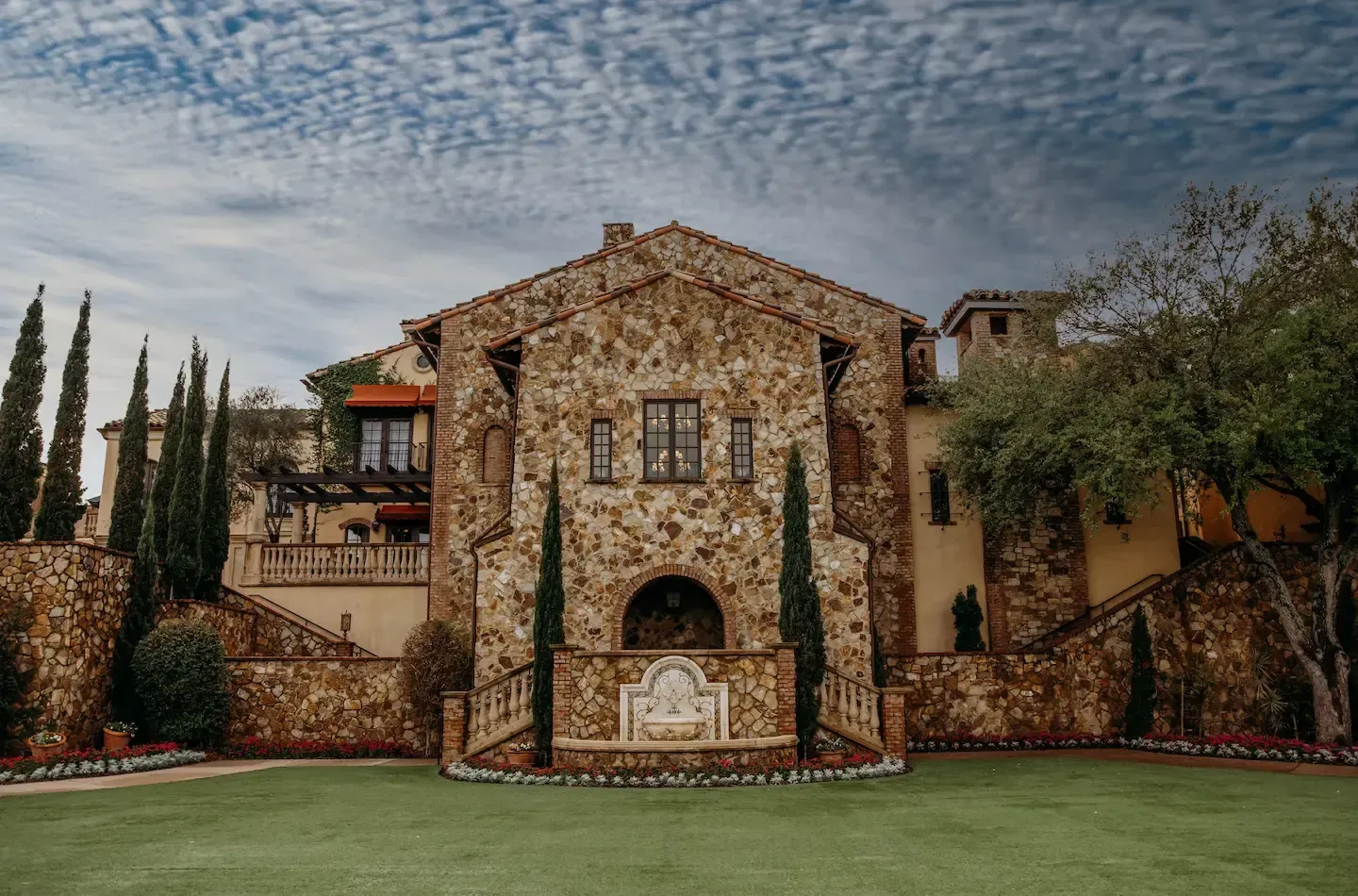
Stand on the grand lawn at Bella Collina and the building in front of you looks like it has stood there for six hundred years. Stone the color of old bread, a bell tower, cypress trees lined up like exclamation points, a fountain worn soft at the edges. It is exactly the kind of place that has outlasted wars, plagues, and the rise and fall of whole families. It has, in fact, outlasted almost nothing. The stone was distressed on purpose, the hill it sits on is in Lake County, Florida, and the whole village is younger than many of the people moving into it.
It was built to feel permanent — stone, towers, cypress, the entire vocabulary of a place too old and too solid to ever be in danger. And in its first decade it came within a whisper of not surviving a single bad year.
Florida's one honest hill

Start with the one part that isn't a trick: the hills. Most of Florida is famously, stubbornly flat. Montverde is not. The town sits on the Lake Wales Ridge, a spine of ancient sand dunes running down the center of the peninsula. A few miles away, Sugarloaf Mountain tops out at 312 feet — the highest point on the whole Florida peninsula — rising roughly 246 feet above the dark water of Lake Apopka.
By Florida standards, this is mountain country. So when a developer went looking for somewhere to pretend to be Tuscany, this is where he came. Here, for once, the land actually rolls.
A village ordered off the plans

In the middle of the 2000s housing boom, the developer Bobby Ginn and the Philadelphia private-equity firm Lubert-Adler set out to build an entire Italian hill town on roughly 1,900 acres above the lake. Not a few themed houses — a whole village, complete.
The plan called for more than 800 multimillion-dollar homesites, a championship golf course drawn by Sir Nick Faldo running over 7,500 yards through the sand hills, and a stone clubhouse of some 75,000 square feet set, the marketing said, atop one of Florida's highest points. Everything would look as though it had aged for centuries. None of it had aged at all.

And it sold. At the height of the boom, lots inside the gate changed hands for a million dollars, two million, more — buyers lining up to own a piece of instant old Europe on a Florida hilltop. For a few years, the fantasy ran exactly to plan.
Four years

Then the money vanished. The 2008 financial crisis froze the whole project solid. Bobby Ginn's wider empire came apart — he defaulted on a $675 million note to Credit Suisse — and at Bella Collina the buyers simply stopped coming.
By 2012, only about forty homes stood on those eight hundred-plus lots. Most of the lots went through foreclosure. The village built to look six hundred years old had made it roughly four before it came within reach of becoming what it feared most: a grid of empty streets and streetlights, waiting for houses that weren't on the way.
Bought for ten million

In 2012 a West Palm Beach firm, DCS Investment Holdings, bought what was left. Lake County records show it paid $3,750,000 to Ginn-LA Pine Island for the remaining developer-owned lots and $6,250,000 for the golf course and clubhouse — roughly ten million dollars for an Italian hill town. DCS is tied to Dwight Schar, the founder of the national homebuilder NVR; his son Spencer, one of Bella Collina's original developers, runs the club today.
And it worked. The fantasy that nearly died is now one of the most expensive addresses in Central Florida — production homes starting around two million dollars, custom estates at five and six, national builders selling inside the gate, a new 102-home neighborhood going in, and a proposed $66.9 million hotel on the lake. The stone looks exactly as old as it did the day it nearly went under.
The one thing nobody can order off the plans
Which leaves the thing the whole illusion rests on and cannot fake: the current. Bella Collina can buy the stone, age it, light it, gate it, and put a tower over the top of it. It cannot make its own electricity.
Everything that makes the place the place — the pumps that keep the fairways and the imported-looking gardens green, the air conditioning, the fountains, the lights strung over that ivy courtyard, the water coming out of the taps — is downstream of a wire that comes in from outside, along poles crossing the same flat country the hills rise out of.
A place can be built to look like it survived six centuries, and still go dark on an ordinary summer afternoon.
August 13, 2004

Central Florida had already shown what that looks like. On the afternoon of August 13, 2004 — the year before the first stones went up — Hurricane Charley came ashore near Punta Gorda and drove northeast across the middle of the state, straight through the Orlando region that Lake County sits on the edge of.

More than two million Florida customers lost power. Across metro Orlando the outages ran for days, and in the hardest-hit spots utilities warned restoration could take weeks. The grid does not read the guardhouse. Getting the lights back behind the most expensive wall in Lake County is the same slow work as getting them back on the oldest road nearby: crews on poles, one at a time, spread thin across a broken region.
What's actually old here
So Bella Collina sells age it doesn't have and permanence it has already lost once. The stone is distressed on purpose; the hills are the one genuine thing; the village is about twenty years old and has survived exactly one financial panic and whatever weather has come since.
It stays green, and cool, and lit for a single reason — that the wire from outside is still standing. The oldest-looking thing in Lake County runs on the newest and most fragile thing in it.


