Celebration, Florida  ·  A Local History

Walt Disney Planned a City That Would Run Itself. Disney Built Celebration Instead.


In October 1966 Walt Disney unveiled EPCOT — a climate-controlled city of 20,000 with its roads, power and plumbing buried underground, built to control its own environment. He died ten weeks later and the city was never built. Thirty years on, the company finally put a real town on that Florida land. They called it Celebration — and when a hurricane crosses the state, it goes dark like any other place.

Ride the PeopleMover through Tomorrowland at Walt Disney World and, for about thirty seconds, the track carries you through a dark room where a tiny city glows below the rail. Towers lit from inside, little monorails threading between them, a model skyline burning in the dark. Almost nobody on the train knows they are looking at the most ambitious thing Walt Disney ever tried to build — and the one piece of it that ever got built at all.
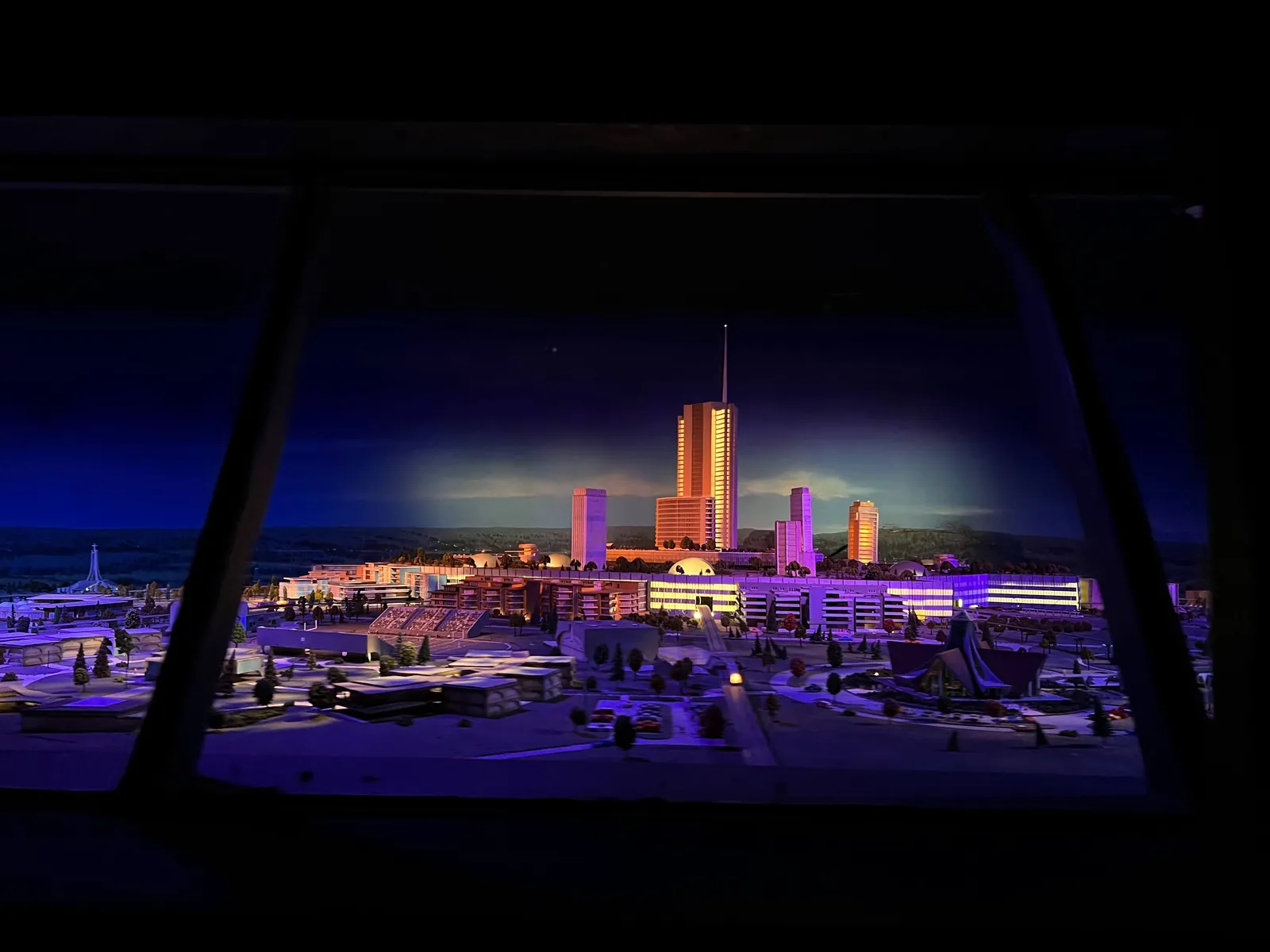
A glowing scale model of a futuristic city seen in a darkened room from an elevated ride vehicle: lit high-rise towers, a central orange-and-pink skyscraper, and tiny buildings spreading out into the dark.
The city that only exists in miniature
The “Progress City” model — the surviving scale model of Walt Disney’s planned EPCOT city, still on display from the PeopleMover at the Magic Kingdom (modern photograph). Photo by Windyshadow32, 2022; CC BY 4.0.

The last thing Walt filmed

On October 27, 1966, Walt Disney stood in a room full of models and renderings and recorded a twenty-five-minute film about what he meant to do with the 27,000 acres his company had quietly bought in central Florida. Most of it wasn’t going to be a theme park. The centerpiece was a real city, and he called it EPCOT — the Experimental Prototype Community of Tomorrow.

A black-and-white portrait of Walt Disney in a suit, smiling slightly, with a thin mustache.
Walt, a decade before the film
Walt Disney in 1954. Twelve years later he would spend his last on-camera appearance pitching a working city, not a ride. Portrait cropped from a NASA photograph, 1954; public domain.

It was not a modest plan. Twenty thousand residents. A downtown core enclosed and climate-controlled, so Florida’s heat and rain never reached the shops. Monorails and an electric PeopleMover to move everyone around. And underneath all of it, a whole hidden layer: the cars, the delivery trucks, the power, the plumbing, the services — all tucked below the streets, out of sight, so the surface could stay perfect. The entire idea was a place that controlled its own environment instead of being at the mercy of it.

EPCOT wasn’t sold as a prettier suburb. It was sold as a city that answered to no weather and depended on nobody — a place engineered to run itself.

Walt Disney died on December 15, 1966, ten weeks after he filmed it. And the city went with him. Nobody left at the company had the appetite to run an actual town — with actual residents, actual voters, and actual responsibility for the water and the lights. What opened in 1971 was a theme park. When the name “EPCOT” finally appeared on something in 1982, it was another park, not a town. The community of tomorrow that Walt promised would “never be completed, but will always be introducing and testing and demonstrating new materials and systems” never got past that glowing model.

Thirty years later, they built it anyway

Then, in the 1990s, Disney went back to the land. Not to build Walt’s domed city — that dream was dead — but to build a real town, on a patch of flat pasture and wetland in Osceola County just south of the parks. Michael Eisner, running the company by then, pushed his people to make something worthy of the Disney name and its old EPCOT ambitions. They broke ground in 1994. The first family moved in on June 18, 1996. They named it Celebration.

A downtown street of pastel multi-story buildings — teal, cream and terracotta — with awnings, shopfronts, palm trees and a red car parked at the curb under a blue sky.
Downtown Celebration — the town that got built
Downtown Celebration, the pastel Main Street Disney built in place of the city of tomorrow (modern photograph). Photo by “traveljunction,” 2010; CC BY-SA 2.0.

It was lovely, and it was serious work. Disney hired the architect Robert A. M. Stern and the firm Cooper, Robertson & Partners to lay out the town, then handed individual landmarks to some of the most famous architects alive: a post office by Michael Graves, a welcome center by Philip Johnson, a bank by Robert Venturi, a movie theater by César Pelli. The result was a storybook American small town — front porches, a walkable Main Street, a lake in the middle — assembled all at once, by committee, for about $2.5 billion.

A streamlined Art Deco movie theater with a tall vertical 'CELEBRATION' sign and a curved marquee reading AMC, set among low-rise buildings under a blue sky.
Pelli’s cinema — a landmark by a famous hand
The Celebration movie theater, designed by the architect César Pelli (modern photograph) — one of several landmarks Disney commissioned from star architects. Photo by “traveljunction,” 2010; CC BY-SA 2.0.

And it kept one real piece of Walt’s idea: the perfect surface. There are almost no power poles in Celebration. The wires, the phone and data lines, the whole nervous system of the town was buried, the way EPCOT’s was meant to be — and in the early years the town even drew its electricity and its fiber from Disney’s own in-house utilities, not the public company most Floridians deal with. No overhead tangle to spoil the view, and genuinely less for a storm to rip down.

A quiet Celebration street of cream and terracotta buildings with palm trees and parked cars along a brick-paved roadway — and no overhead power lines anywhere in view.
No poles, no wires overhead — by design
A Celebration street in 2017: look up and there are no power lines — the town’s wiring runs underground, the one piece of Walt’s buried-services idea that survived. Photo by Michael Rivera, 2017; CC BY-SA 4.0.

What it quietly dropped

But burying the wires is not the same as what Walt actually promised. His city made its own electricity, cooled its own air, held its own water — it depended on nobody. Celebration makes none of its own power. Those tidy buried lines don’t end at the town; they run out past its edge and connect to the same transformers, substations and transmission towers as everyone else, standing out in the open Florida weather. The town is wired like a stage set. The power behind the curtain comes from the regional grid, exactly like Kissimmee and Orlando next door.

A residential Celebration street corner with a crosswalk, two-story houses set behind lawns, and a dense canopy of oak branches arching over the road.
The houses ride the same grid as everyone
A residential street in Celebration (modern photograph) — buried lines and a shady canopy, but the power still arrives from the regional grid that feeds the whole metro. Photo by Connor J. Williams, 2025; CC BY 3.0.

You can see how committed the town is to the feeling of control every December. On Market Street, machines mounted on the lampposts blow fine soap foam into the air at six, seven, eight and nine o’clock each evening, and it drifts down and gathers on the ground like snow — in a place that is roughly the temperature of a warm bath. Celebration can summon winter on a schedule. It cannot keep the lights on in a hurricane.

A town-center plaza with a ground fountain shooting arcs of water over a compass-star inlay in the pavement, ringed by lampposts and palm trees under a blue sky.
A town built to feel effortless
The fountain in Celebration’s town center (modern photograph) — the carefully managed, effortless surface the town was designed to project. Photo by Mx. Granger, 2023; CC0 (public-domain dedication).

The weather Florida actually sends

Because Florida keeps exactly one promise, reliably: sooner or later a storm crosses the state and knocks the power out for days. In 2004 three hurricanes — Charley, Frances and Jeanne — raked central Florida within weeks of each other. In 2017, Hurricane Irma left about 6.5 million Florida customers without power, some of them for well over a week. Milton came through the Orlando area in 2024. Each time, the outage swept across the whole region, and the city of the future sat in the dark inside it.

At dusk, a lineworker stands in the raised bucket of a utility truck beside a power pole and overhead wires, restoring electric service after a storm.
After the storm — the ordinary way power comes back
Crews restoring power in Florida after the 2004 hurricane season (regional image — not Celebration). Buried town wiring still waits on the open-air grid that feeds it. Photo by Jocelyn Augustino / FEMA, September 2004; public domain.

The buried lines genuinely help — less wind damage inside the town, and often a faster recovery once crews reach the neighborhood. But “faster” is not “never.” When the regional grid goes down, the pretty streets with no poles go as dark as the trailer park down the highway, and the soap-snow machines on Market Street go quiet with everything else.

Disney itself let the dream loosen its grip. In January 2004 the company sold downtown Celebration to a private investor, and the model town started aging like a real one. By 2016, owners of the Town Center condominiums were in court over leaking roofs, separating balconies and mold, and a repair bill in the millions that had been put off for a decade. The perfect surface, it turned out, needed someone to keep paying for it.

A narrow landscaped waterway in Celebration lined with flowering plants, mown grass and a double row of tall sycamore trees, with houses and parked cars along both banks.
A real town now, aging in real weather
A landscaped waterway in Celebration (modern photograph) — thirty years on, a genuine neighborhood living under the same Florida sky as its neighbors. Photo by Mx. Granger, 2023; CC0 (public-domain dedication).

So the two halves of the story never quite meet. A mile or two from Celebration’s lake, the little EPCOT model still glows on the PeopleMover, every window lit, never losing power — because it is a model, in a park with its own backup, pretending to be a city that runs itself. The actual town named for that dream sits out in the open, wired beautifully and fed from somewhere else, waiting out the storm with the rest of Florida. The most futuristic idea Walt ever had was a place that never had to depend on anyone. What finally got built is lovely, and ordinary, and — when the wind comes — just as dependent as everywhere else.

A tan enclosed standby generator mounted on a concrete pad beside a lawn and trees.
Walt’s idea, shrunk to fit one house
A standby generator of the kind that makes power on site when the grid drops (representative image) — the one piece of “a place that runs itself” a homeowner can actually buy. Photo by Gregsedits, 2011; CC BY-SA 3.0.

A present-day note · GENERasic

Walt wanted a city that never had to depend on the grid. For one house, that’s a single generator beside the air conditioner.

EPCOT was the industrial dream version: a whole city making its own power so the weather outside never mattered. The home version is far simpler — one standby generator, wired to start itself the moment the grid drops, whether you’re home or not. It’s the only part of “a place that runs itself” you can actually put in your own yard.

In a Florida outage, what it’s really protecting is worth being plain about:

Which of those actually apply to your address — your medical needs, how your house is fed, well or city water — is worth pinning down for your own home rather than guessing. That part is yours to check.

And in a town like Celebration, with its buried lines and its HOA, a generator has to be sited and screened to the street’s standard, not just dropped on a pad — worth building into the plan from the start.

You can get an address-specific installed price for standby power — the whole turnkey number, not a callback and a maybe — in one sitting.

Get your installed price for this address→
Sources & Photo Credits

On the history

Photographs

  1. “Progress City” EPCOT model on the PeopleMover (hero) — the surviving scale model of Walt Disney’s planned EPCOT city, Magic Kingdom; modern photograph by Windyshadow32, 2022; CC BY 4.0, via Wikimedia Commons. File: epcot-progress-city-model. Commons
  2. Walt Disney, 1954 — portrait cropped from a NASA photograph; public domain, via Wikimedia Commons. File: walt-disney-portrait-1954. Commons
  3. Downtown Celebration Main Street — modern photograph by “traveljunction” (Flickr), 2010; CC BY-SA 2.0, via Wikimedia Commons. File: celebration-main-street-2010. Commons
  4. Celebration movie theater (César Pelli) — modern photograph by “traveljunction” (Flickr), 2010; CC BY-SA 2.0, via Wikimedia Commons. File: celebration-cinema-pelli-2010. Commons
  5. Celebration street with no overhead wires — modern photograph by Michael Rivera, 2017; CC BY-SA 4.0, via Wikimedia Commons. File: celebration-market-street-2017. Commons
  6. Celebration residential street under its oak canopy — modern photograph by Connor J. Williams, 2025; CC BY 3.0, via Wikimedia Commons. File: celebration-residential-street-canopy-2025. Commons
  7. Fountain in Celebration’s town center — modern photograph by Mx. Granger, 2023; CC0 (public-domain dedication), via Wikimedia Commons. File: celebration-fountain-town-center-2023. Commons
  8. Utility crews restoring Florida power after the 2004 hurricanes (regional — not Celebration) — by Jocelyn Augustino / FEMA, September 20, 2004; public domain, via Wikimedia Commons. File: florida-2004-hurricane-power-restoration. Commons
  9. Landscaped waterway in Celebration — modern photograph by Mx. Granger, 2023; CC0 (public-domain dedication), via Wikimedia Commons. File: celebration-water-street-park-2023. Commons
  10. Commercial diesel standby generator (representative — not Celebration equipment) — by Gregsedits, 2011; CC BY-SA 3.0, via Wikimedia Commons. File: standby-generator-set-representative. Commons

Every Celebration photograph here is a modern photograph and is identified as such; the 2004 storm-restoration photograph and the standby-generator photograph are clearly labeled as regional/representative and are not Celebration equipment; the hero is the EPCOT concept model on display at the Magic Kingdom, not a real city. Original downloads and a full research record are kept alongside this page in assets/images/originals/ and source-record.md. No image’s factual content was altered — the frames and handwritten notes are CSS added around the photographs, never onto them. Any owner who wants an image removed need only ask.