Somewhere inside Walt Disney World, a homeowner wants to repaint the front of the house and resurface the pool. To do it, they pull a building permit — and the permit comes from Orange County, the same ordinary county government that stamps the paperwork for a tract house in Pine Hills twenty miles up the road. Nothing about that should be possible. This house sits behind a gate inside the most tightly controlled private property in Florida, a short golf-cart ride from Cinderella Castle, a few hundred yards from the largest Four Seasons ever built.
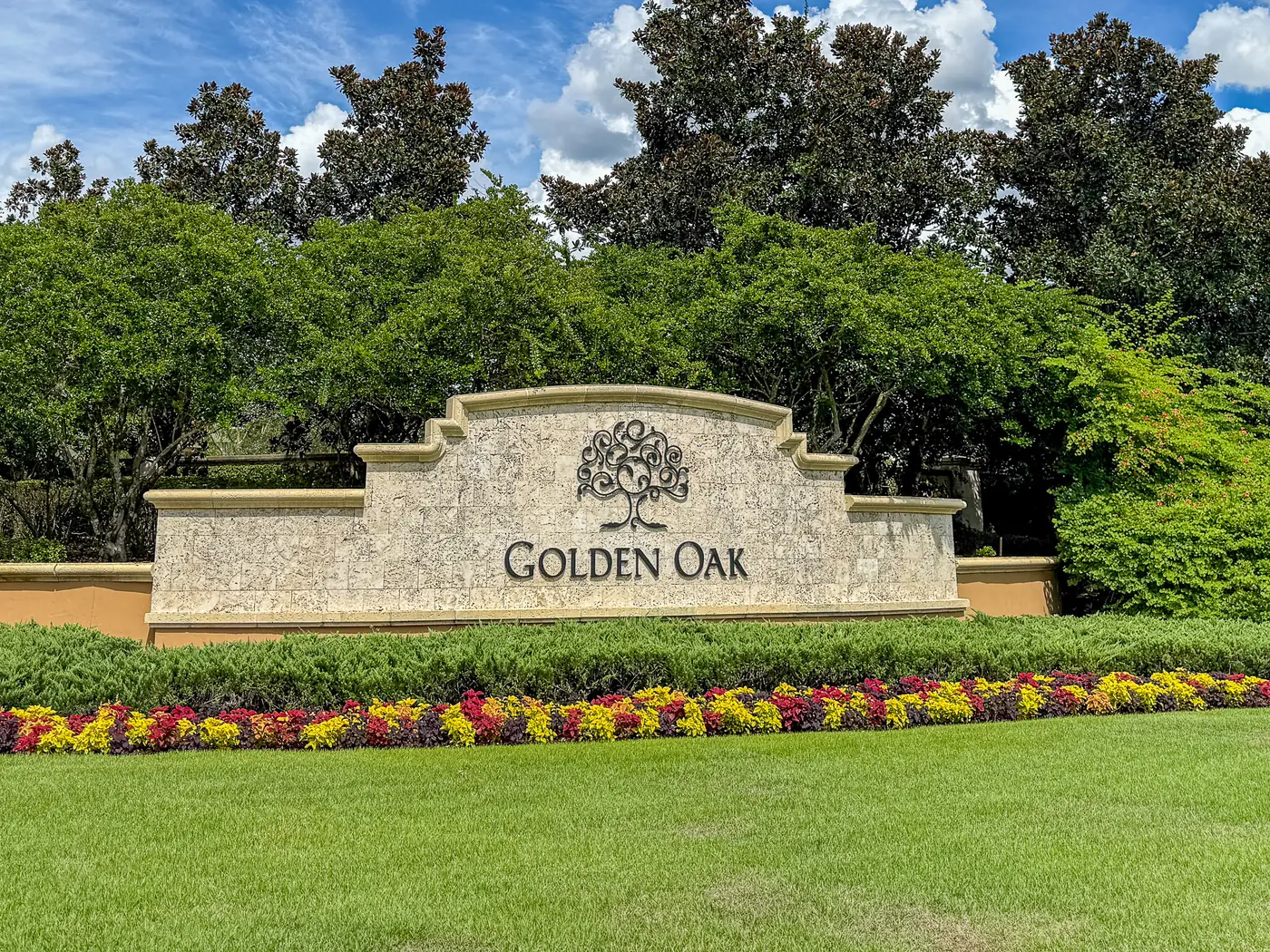
That permit is the whole story. Of all the land Disney bought and turned into a kingdom it governs almost entirely by itself, this one neighborhood — Golden Oak — is the piece the company deliberately handed back.
What Disney actually bought
Start with the ground itself. In the mid-1960s this corner of Central Florida was not a kingdom or a golf course or anything at all. It was pine flatwoods, palmetto scrub, cypress and swamp — cattle country, cheap and empty, the kind of land people drove past on the way to somewhere else.

Beginning in 1964, buyers started quietly snapping it up. They had tongue-in-cheek names — the Reedy Creek Ranch Corporation, the Latin-American Development and Management Corporation, the Ayefour Corporation — and they were fronts, set up by Disney's lawyers so that no one would realize a single company was assembling an empire and run the price up. The first recorded purchase, in May 1965, was about 8,380 acres bought from a Florida cattle baron and state senator named Irlo Bronson. By the time the buying stopped, the fronts had quietly gathered some 27,000 acres — roughly the size of San Francisco.
The secret held until October 24, 1965, when the Orlando Sentinel ran the line everyone had been circling: the mystery buyer was Disney. A few weeks later Walt stood in front of the Florida press and the governor and said it out loud.

A government built around a swamp
Disney did not want to build a park in Florida so much as it wanted to build without anyone able to tell it no. So in 1967 the company got the state to hand it something no theme park had ever had: its own government.

The Reedy Creek Improvement Act, signed in May 1967, created a special district with roughly the powers of a county — it could run its own building codes, its own fire department, its own utilities, its own inspections — plus two tiny municipalities, Bay Lake and Lake Buena Vista, whose entire populations were, in practice, Disney. Inside this district, Disney approved Disney's plans. That was the point.
There was only one thing the arrangement couldn't survive: ordinary residents. A special district works beautifully when almost nobody lives in it. But people who live somewhere can register to vote, and enough of them can start electing the board and writing the rules — which is exactly the control Disney had built the whole machine to keep. When the company built its town of Celebration in the 1990s, it eventually cut the place loose from the district and its control, rather than let a town full of voters sit inside it.

So they did it backwards
Golden Oak was announced in 2010 as something Disney had never tried on this ground: not a hotel, not a timeshare, but a neighborhood of a few hundred custom estates that people would own outright and live in, full-time if they liked. Which meant it would be full of exactly the thing the private district couldn't have — residents. Voters.
So before a single foundation was poured, Disney did it in the other order. It carved Golden Oak out of the Reedy Creek district first, and dropped it into plain, unincorporated Orange County. The homeowners here would be Orange County residents, with no vote over Disney's district at all — and the ordinary machinery of county government would run their street. Building permits, inspections, the property-tax bill: all Orange County's. In 2014, with only about a tenth of the homes finished, Golden Oak was already sending roughly $2.3 million a year in property taxes to the county, like any other subdivision.
The most exclusive address in Florida is, on paper, an ordinary Orange County subdivision — by Disney's own deliberate design.
The name came from California
Here is the thing people assume and get wrong. The neighborhood is wrapped in live oaks and Spanish moss, so you'd think the name grew out of the trees. It didn't. “Golden Oak” is borrowed from the Golden Oak Ranch in the hills north of Los Angeles — an 890-acre spread Disney bought in 1959 and has used as a film location ever since, itself named for a flake of gold once found under an oak there, years before the Gold Rush. Disney also ties the name to the oak Walt supposedly daydreamed under as a boy in Missouri. It is a Disney reference first, a tree second.

But the oaks under the name turned out to be real. This corner of Florida is genuine live-oak country — the low, wide, moss-draped canopy that says “old Florida” better than almost anything else — and the design leaned all the way into it.

When Disney built the Four Seasons at the heart of the community, the landscape crew dug up nearly fifty mature live oaks — crowns spreading more than thirty feet — from the old golf course next door and replanted them whole, so the grounds would look a century old the day they opened. Because that is what was here before the mansions: a golf course. The land spent two decades as Disney's Bonnet Creek courses, Eagle Pines and Osprey Ridge, until they closed in 2007 and the fairways were handed to the estates and the resort.
The crown in the middle
At the center of all this stands the Four Seasons Resort Orlando, opened in August 2014: seventeen stories and 443 rooms, the largest Four Seasons the company had ever built. Its golf course, Tranquilo, is the old Osprey Ridge layout made over. From the top-floor steakhouse you can watch the Magic Kingdom fireworks go up at night — a luxury hotel sitting inside the park's own private world, which is a sentence that only makes sense here.


Clay tile, copper gutters, and a gas line
Owning here does not mean doing whatever you please with your own house. Every exterior change — a new color, a pool, a wall, a tree — runs past the community's architectural review before it happens, and new homes have to be built by a short, approved list of builders. The standards are unusually literal: where a facade calls for stone, it must be real stone, not veneer; roof tiles are real clay; gutters are copper. The look is held in place on purpose, house by house.

And then there is the one genuinely rare thing the money bought, the kind of detail only a developer with its own utility history would bother with. Most of Central Florida has no residential natural gas at all — if you want to cook or heat with a flame out here, you haul in a propane tank and bury it in the yard. Golden Oak didn't accept that. Disney had pressurized natural gas piped to every single home. On estates where the neighbors a few miles away are still metering a buried propane tank, that quiet line in the ground is its own kind of luxury.

The grandest address that chose to be nobody
So go back to that permit. The grandest place to live in all of Florida — gated inside Walt Disney World, crowned by the biggest Four Seasons on earth, wired for natural gas nobody else out here can get — chose, on paper, to be nothing special at all. An Orange County subdivision that pays county taxes and pulls county permits, exactly like the tract house up the road.
Disney spent the 1960s doing everything it could to never answer to an outside government. Golden Oak is the one place it looked at all that machinery and, on purpose, let go — because the alternative was letting a few hundred homeowners vote on the kingdom. The oaks it moved here will outlive the mansions. The gate will keep saying you've entered somewhere unlike anywhere else. And the paperwork, quietly, will keep saying the opposite.


