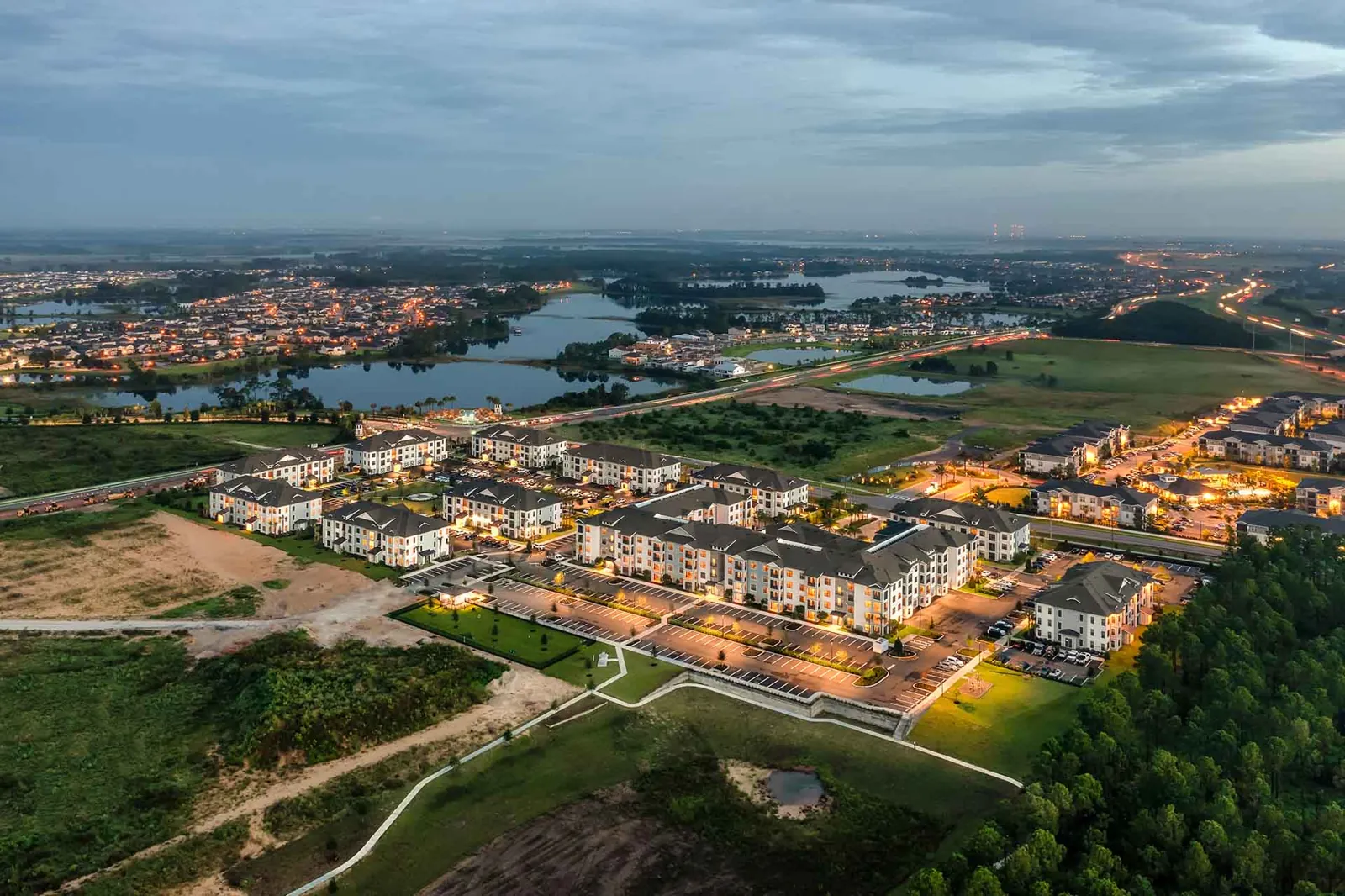
Settle into a reclining leather seat at the Cinépolis in Hamlin on a weeknight — waiter service, a full bar, a ten-screen luxury cinema — and you are sitting almost exactly where, within living memory, there were rows of orange trees and nothing else. Walk out to the lake and there's a Publix, apartments fronting the water, families on the lakewalk, a whole downtown that did not exist when this century began. The place is named Hamlin, after an orange. And the orange it's named for is famous for one specific trick: ripening early enough to get off the tree before the hard cold comes. The groves that actually stood on this ground never managed it.
That's the quiet joke buried in the name. Hamlin is the lakeside heart of Horizon West, a planned “new town” on the southwest edge of Orange County, and it is one of the fastest-growing communities in the United States. It is also built, directly, on top of citrus groves that a run of Florida freezes killed outright. To understand why a brand-new town took the name of a fruit, you have to start with the fruit.
The orange that outran the cold

The Hamlin orange started as an accident: one seedling in a grove near Glenwood, over by DeLand, planted about 1879. It was named for the man who owned the grove, Arthur George Hamlin — a Massachusetts-trained attorney who'd come to Florida in the 1880s and, like half the ambitious men in the state then, kept citrus on the side.
What made his orange matter was timing. The Hamlin ripens very early, well ahead of most varieties — and in Florida, early is everything. After the catastrophic Great Freeze of 1894–95 wiped out groves across the center of the state, growers wanted a tree whose fruit was already picked and shipped by the time the worst cold arrived. The Hamlin was exactly that. It spread until it became one of the principal early oranges in Florida, at times roughly half the state's entire orange crop. Its whole reputation rests on a single idea: beat the freeze by being done before it gets here.
Keep that idea in your pocket. It comes back.
Grove country

For most of the twentieth century, west Orange County was citrus. Not as a backdrop — as the economy, the horizon, the smell of the place in bloom. Towns like Winter Garden and Ocoee packed and shipped the fruit; the groves ran for miles in every direction, including across the gently rolling ground that would one day be Horizon West. Hundreds of acres of it, right here.

A grove, it's worth noticing, asked almost nothing of the modern world. Sun, rain, sandy ground, cold-sensitive trees, and people with ladders. No power lines feeding it, no pumps it couldn't live without, no wire running in from a road. It was vulnerable to exactly one thing, and it was the one thing nobody could switch on or off.
Three freezes in seven years

Then the cold came, and it kept coming. The 1980s brought a brutal run of freezes to Central Florida — hard ones in 1983 and 1985, and a decisive Christmas-weekend freeze in 1989 that finished the job. These weren't one-bad-season freezes. They were cold enough to kill the trees themselves, and after the third one in seven years, a lot of grove owners simply stopped. The commercial citrus belt pulled south, out of Orange County, chasing warmer winters, and the groves west of Orlando were left standing dead.
One of the men who lived it, the west-Orange citrus figure Jerry Chicone Jr., put the surrender plainly: after three freezes in seven years, he said, he was going to take off his white hat and put on his developer's hat. That line is the hinge of the whole story. The freeze didn't just end the fruit. It handed thousands of acres of ruined grove land to whoever could imagine something else on it.
The orange was named for beating the freeze. The groves it grew in did not — and the town that replaced them is named for the orange anyway.
A town drawn on purpose

What came next was unusually deliberate for Florida. In late 1992, some of those ruined grove owners started meeting over breakfast to figure out what their dead land could become. They formed a nonprofit, Horizon West Inc., in 1993, and brought in a former county planning director to shape a concept. Instead of letting the acreage dissolve into ordinary subdivisions, in 1995 Orange County adopted a whole new land-use category for it: the “village.”
The plan drew straight from New Urbanism — a cluster of distinct villages, each with a walkable town center, schools, parks, and trails, laced together by green space instead of blurring into one another. Lakeside, the first village, won approval in January 1997. Hamlin was designated as the commercial heart of the whole thing, the shared downtown the villages would drive to, set on the shore of Lake Hancock.
The heart on the lake


And then it simply appeared. A Walmart Supercenter opened at Hamlin in November 2016; a Publix followed in 2017; the Lakewalk at Hamlin apartments, hundreds of units fronting Lake Hancock, filled in around the same time. The Cinépolis luxury cinema opened in 2018. A proton-therapy center and an Orlando Health hospital came after. In the span of about five years, a downtown materialized on ground that had grown oranges.

It's a genuinely nice place — that's not the point. The point is what kind of place it is: not a grove that tolerates a dry week, but a dense, engineered town where the pool pumps, the elevators, the gates, the medical equipment, the air conditioning that makes a Florida summer survivable — all of it — is downstream of a power line coming in from the road.
From zero to fifty-eight thousand

The numbers are almost hard to believe. Horizon West had about 14,000 residents at the 2010 census. By 2020 it had 58,101 — a 315 percent jump in ten years, among the fastest growth of any master-planned community in the country. The groves were empty for maybe fifteen years; what replaced them filled up faster than almost anywhere in America.
And every one of those tens of thousands of homes draws on the same grid, in the same place, at the same time. A grove spread its risk across the weather. A town like this concentrates its risk onto a single wire — which, in Central Florida, is precisely the wire a hurricane comes for first.
The bill the land kept
Here's the part the brochures leave out, and it's the oldest thing about this very new place. You can freeze out the groves, clear the dead trees, and raise a luxury downtown on the cleared ground — but you can't move it out of the hurricane belt. Central Florida is where the power goes down. In 2004, three hurricanes crossed the state in six weeks and left parts of the Orlando area dark for close to two weeks. The grid that keeps an engineered town alive is the first thing a storm takes and the last thing to come back.
So the land ended up with two different ways to be killed, a century apart. The cold took the groves. The storms take the power. The orange on the sign earned its fame by outrunning the first one — getting the fruit off the tree before the freeze. The town that borrowed its name has no such trick for the second. When the wire goes down, the newest, densest corner of Orange County waits in the dark on the same terms as the grove it replaced — except a grove in the dark is just a grove, and a town of fifty-eight thousand all-electric homes in the dark is something else.

