Come up Interstate 4 north of Orlando and you’ll pass a green highway sign for an exit called Heathrow. Take it, and inside a mile you reach a guard gate, a fountain in an oval lake, and some of the priciest houses in Seminole County, laid out along fairways. It is about as manicured as Florida gets. What the gate doesn’t tell you is what the ground used to grow — or that the whole place was built by a man who made his first fortune putting Chinese dinners in a can.
The town that only exists because of a freeze
To understand why there was a celery field here at all, you have to go back to two terrible winters. In the 1880s the land around Sanford, just north of where Heathrow sits, was orange country — grove after grove of citrus running down to Lake Monroe.

Then came the Great Freeze of 1894–95. Temperatures dropped near 18°F and held there, and over two winters the cold killed the citrus trees to the ground. A lot of growers who had bet everything on oranges were simply wiped out. But the farmers who stayed noticed something about the low, wet, black-muck land along the lake: it was almost perfect for a crop that liked its feet wet. In 1896 a grower planted the first celery in Sanford, using seed brought down from Kalamazoo, Michigan.
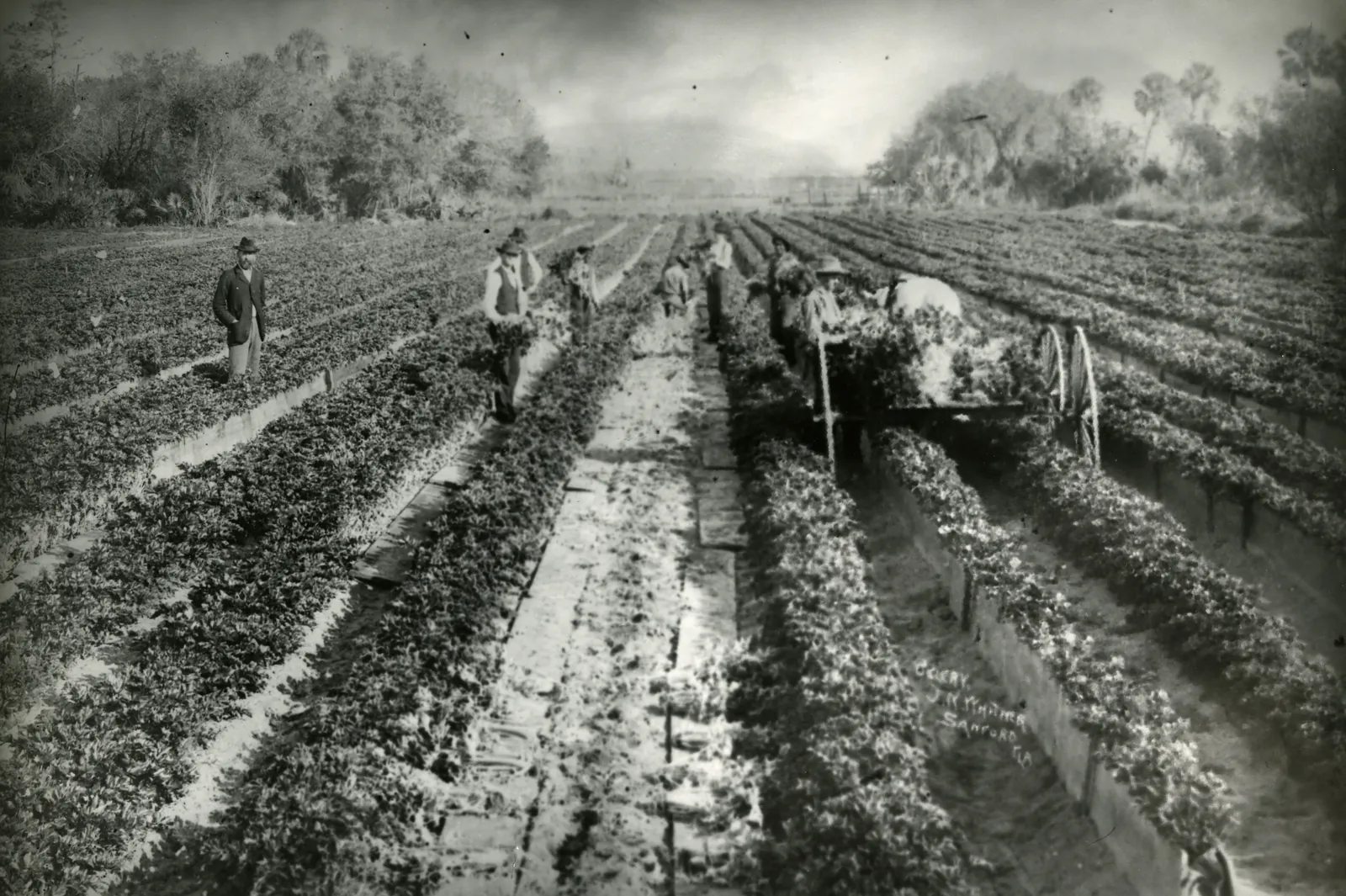
It took. Within a few years Sanford was calling itself “Celery City,” and it meant it — by the early 1900s the muck fields of Seminole County were shipping celery north by the trainload. The crop that replaced the oranges is the reason there was anything but scrub out where Heathrow stands today.

Celery was green and tidy on a postcard and brutal in the row. It had to be hand-planted, hand-cut, washed, sorted and packed, mostly by Black and migrant laborers working for pennies. You don’t have to imagine the pennies — a federal photographer wrote them down.

Twenty cents an hour at the top, twelve at the bottom, in the middle of the Depression. That was the economy of the muck: a demanding, low-paid crop that nonetheless fed a region for half a century. Hold onto that humble stalk of celery. It’s about to turn up two thousand miles away, inside a can.
The peddler from the Iron Range
Luigino Francesco Paulucci — everybody called him Jeno — was born in 1918 in Aurora, Minnesota, an iron-mining town on the Mesabi Range. His parents had come over from a hamlet in the Marche region of Italy; his father worked the mine. Jeno called himself “a peddler from the Iron Range,” and he started as exactly that, hustling groceries out of the family store through the Great Depression.

What he figured out, in the 1940s, was a genuinely odd idea: canned Chinese food for Americans who had never been near a Chinese restaurant. He mixed bean sprouts grown by Japanese-American farmers with Italian spices and — this is the part that matters here — celery. His very first product, canned chow mein, used leftover celery trimmings. He called the company Chun King.
An Italian kid from a Minnesota mining town, selling canned Chinese dinners to the whole country, with Florida celery in the recipe. It should not have worked. It worked enormously.
Chop suey in a can, and then the pizza roll

By the early 1960s Chun King was selling roughly half of all the canned Chinese food in America, around thirty million dollars’ worth a year. Paulucci ran it with a showman’s touch — he was one of the first to put ethnic food in splashy television spots — and in 1966 he sold the whole thing to R. J. Reynolds, the tobacco company, for sixty-three million dollars.

He wasn’t done. He still had a machine he’d built to wrap Chun King egg rolls, and somebody looked at it and wondered what else you could stuff in a crispy little pocket. The answer — pizza filling — became Jeno’s Pizza Rolls, one of the great junk-food inventions of the American freezer aisle.

Credit where it’s due, which is a thing people usually get wrong about this snack: Paulucci didn’t invent the pizza roll himself. A product developer named Beatrice Ojakangas did, for his company, by swapping pizza filling into that egg-roll wrapper. Paulucci’s gift was selling it. He built Jeno’s into a giant and sold the brand to Pillsbury in 1985 for well over a hundred million dollars; a few years later it was renamed Totino’s, which is what’s still in the freezer today.
He bought the farm. Literally.
Here is where the celery and the chop suey finally meet the golf course. Paulucci’s food empire had kept an interest in Central Florida farmland — the muck around Sanford had been, among other things, a source of the celery that went into his Chun King foods. So when he went looking for one last big thing to build, he already owned the ground: a stretch of old Seminole County farm fields a few miles south of Lake Monroe.
In 1985, the same year he sold the pizza rolls, he started turning that farmland into a town. He called it Heathrow.

Why “Heathrow”? The story usually told is that the name was borrowed from London’s Heathrow Airport — a little imported British polish for a luxury address being pitched as an exclusive enclave. It’s a good story, and it’s repeated everywhere, but nobody has pinned down Paulucci’s exact reasoning, and he doesn’t seem to have left it on the record. What’s certain is the result: a private, gated community of around two thousand homes, a country club, an office park, and eventually the national headquarters of AAA, all on a name that means “the strip of land by the heath” in a village outside London that most Heathrow residents will never see.
What’s left of the field

Nothing about Heathrow today says celery. The muck that grew it is under the fairways and the cul-de-sacs; the hand-cutting and the twenty-cent wages are gone with the growers. Paulucci himself died in 2011, at ninety-three, a very long way from the Iron Range grocery store. The development changed hands more than once after him. The crop that saved Sanford after the freeze doesn’t grow here anymore at all.
And yet the whole chain is still readable if you know to look. A freeze that killed the oranges made room for the celery. The celery helped make a poor miner’s son rich enough to buy the field. And the field, when he was done with everything else, became a gated town with a name borrowed from an airport on the other side of the ocean. Next time you pass that green sign on I-4, you can tell whoever’s in the car that the exclusive golf community just past it started as a chop-suey ingredient — and be exactly right.


