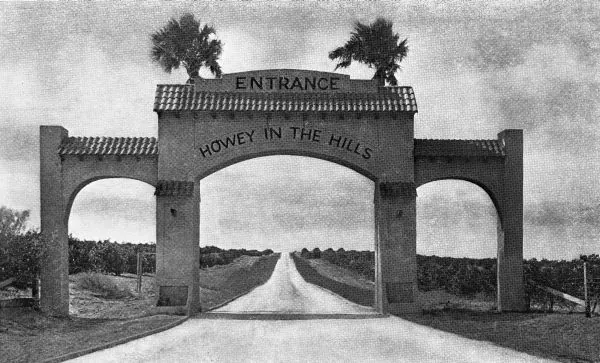
Somewhere around 1920, a visitor to the sandy hills of Lake County, Florida, could drive under a concrete arch that read HOWEY IN THE HILLS and into the middle of a sales pitch. On both sides, orderly rows of young orange trees. In front, a man named William J. Howey telling you that you could own a slice of this — a working citrus grove — without ever picking up a shovel, and that the oranges would quietly pay you back, with interest, on a schedule he was happy to put in writing.
He was very good at it. So good that, a quarter-century later, nine justices of the United States Supreme Court would sit down in Washington and use his orange-grove sales plan to define, for the entire country, what counts as a “security.” The test they wrote still runs the modern financial world. It is why two questions sit uneasily side by side in this little town: how did a Florida orange grove end up making federal law — and whatever happened to the oranges?
The man who built a town to sell it

Howey came to Florida from Illinois and, by about 1920, controlled some 60,000 acres of Lake County. The land itself was the first thing he sold: a ridge of rolling sand hills, unusual in a state famous for being flat. He renamed it “The Florida Alps” and set out to plant it with citrus.
The method was simple and relentless. Buy raw land for around ten dollars an acre, plant it into groves, and resell it — by the acre — for eight hundred to two thousand. He platted a town to serve as the empire's shipping and commercial hub, incorporated it as “Howey” in 1925, and in 1927 renamed it Howey-in-the-Hills. He was its first mayor. In 1921 he built what the town remembers as the first citrus juice plant in Florida, canning juice under the brand name “Lifeguard.”

But the real product was the arrangement, not the acre. Howey didn't just sell you a grove; he sold you a contract to run it for you. His company would tend the trees, pick the fruit, pack it, ship it, and send you a check. The buyers were mostly out-of-state — Chicago businessmen, Northern retirees — people who had no intention of ever pruning an orange tree. He brought them down by the trainload, put them up in style, and let the hills do the rest.
That is what the Floridan Hotel was for. Before it opened in 1924, visiting prospects slept in a tent city by the shore of Little Lake Harris. Afterward, they were wined and sold inside a Mediterranean hotel at the edge of a citrus kingdom. Howey even ran for governor on the strength of it all — twice, as a Republican, losing in 1928 and again in 1932.

The promise becomes the law
Howey died of a heart attack in 1938, at sixty-two. His company kept selling groves the same way. And that is when the arrangement he'd perfected ran into the federal government.
After the 1929 crash, Congress had passed the Securities Act of 1933 to make anyone selling an “investment” register it and tell buyers the truth. The Securities and Exchange Commission looked at the Howey model — a deed to a strip of grove, plus a service contract where the company did everything and the buyer just waited for profit — and said: that's an investment, and you never registered it.

In 1946 the case reached the Supreme Court, and the Court agreed. In SEC v. W. J. Howey Co., it ruled that an investment contract exists wherever a person puts money into a common enterprise and is led to expect profit from the work of someone else. Those four elements — money, a common enterprise, an expectation of profit, profit from the efforts of others — became the “Howey Test.”
It never stopped being used. Eight decades later, when courts argue over whether a cryptocurrency token is a security, they reach for the same four questions a Florida citrus salesman's contracts forced the country to answer. The man is long dead, the groves are mostly gone, and his name is still read aloud in federal courtrooms about things he could never have imagined.
He sold a guarantee on Florida sunshine. The courts turned it into the law of the land — and the cold proved there was no such thing.
The one thing no contract covered

Here is the part the sales brochures never dwelt on. A grove is only an investment if the oranges live. And in Central Florida, the thing that kills oranges is not the market or the paperwork. It is a cold night.
Florida citrus had been fleeing freezes for generations — the great freeze of 1894–95 had already pushed the industry south once. Howey's hills sat on the northern edge of where oranges could safely grow, which was exactly what made the land cheap enough to flip. It also made it exposed.
The reckoning came in the 1980s. A run of freezes from 1981 through 1989 is still ranked as the worst agricultural disaster in Florida's history, and the Christmas freeze of December 1989 finished the job. By the time it was over, something like nine of every ten citrus trees north of Interstate 4 were dead. Lake County's groves — the ones Howey had sold as a sure thing — largely never came back. Where the orderly rows had rolled over the hills, subdivisions went in instead.
What keeps the lights on now

The growers who stayed learned to fight the cold with water. On a freezing night they run overhead sprinklers all night long; as the water turns to ice on the trees it gives off a little heat, holding the surface right at the freezing point and keeping the living wood just warm enough to survive. It works — and it only works as long as the pumps keep running.
Which is the quiet truth under everything that replaced the groves. The sprinklers run on power. So do the wells, the air conditioning, the refrigerators, and the pumps in every subdivision that grew up where the orange trees used to be. The town traded a crop it couldn't guarantee for a way of life that depends, completely, on a wire coming in from outside — across the same flat Central Florida the hills rise out of, through the same storms that knock it down.
What's left on the hills

The props of the empire went out in strange ways. The Floridan Hotel — where Howey had closed his deals — became the heart of a school, Howey Academy, and then, in 1994, was rigged with explosives and blown up in a fireball for an episode of a Hulk Hogan television series called Thunder in Paradise. The hotel that had sold a kingdom ended as a stunt.

Howey's own mansion did better. The twenty-room Mediterranean Revival house he built in 1925 slid into decades of neglect after he died, passing through foreclosure and nearly falling apart, before new owners bought it, poured more than a million dollars into a careful restoration, and reopened it in 2018. It stands on the hill where it always did, hosting weddings now instead of grove buyers.
And the town is still there — about sixteen hundred people on the rolling sand above Little Lake Harris, in the hills a salesman once called the Florida Alps. Howey promised the one thing Florida never actually offers: a sure thing. The country took him so seriously it made his name a permanent test for every promise like it. The oranges, which were the whole point, couldn't survive a cold night.


