Independence & Horizon West  ·  Winter Garden, Florida  ·  A Local History

The Neighborhood Sent Out First


A brick clock tower and a 512-foot reflecting pond went up on frozen-out orange groves before a single family moved in — because the whole experiment needed one neighborhood to prove anyone would come.

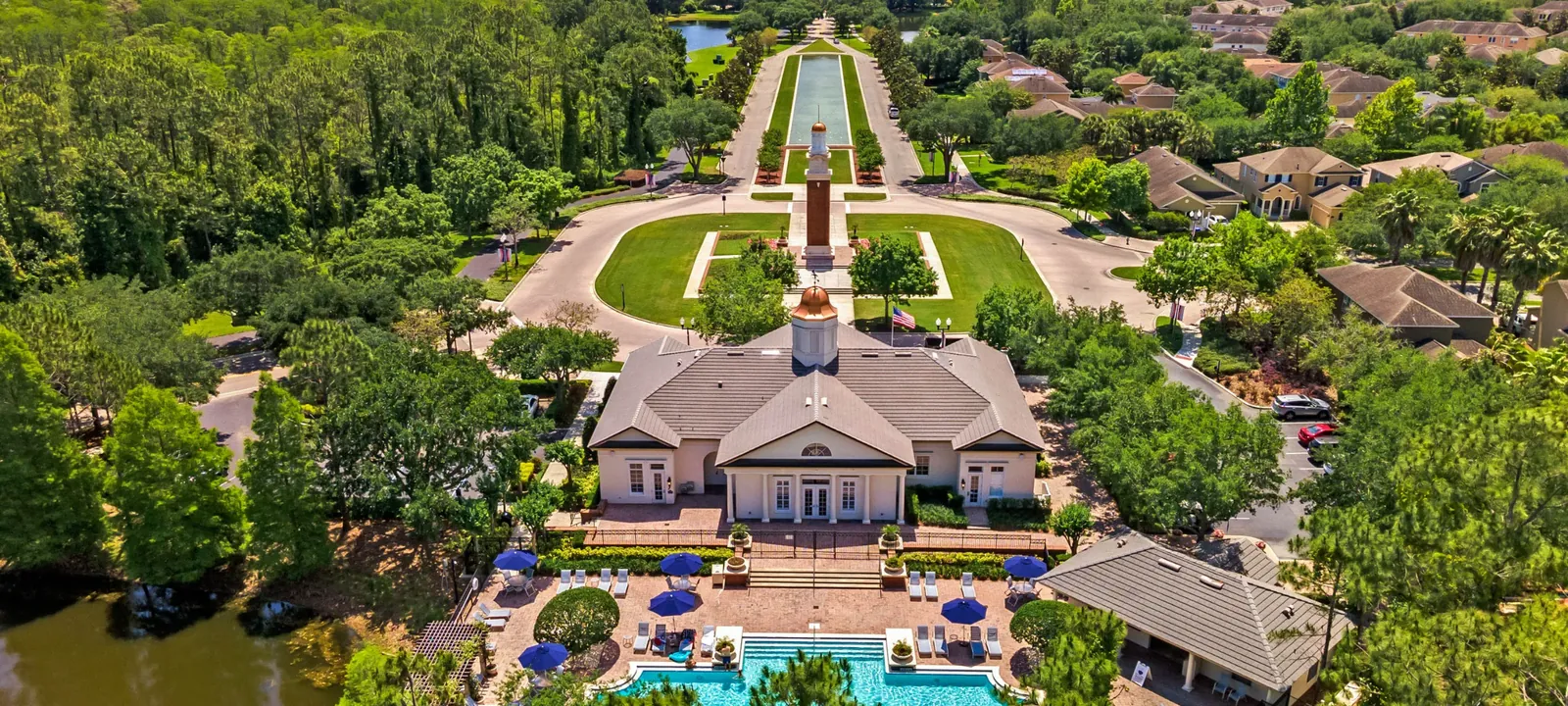
An aerial view of Independence: a brick clock tower on a central axis with a long rectangular reflecting pond stretching away between walls of pine trees, a Georgian clubhouse and pool in the foreground, and rows of tile-roofed houses to one side.
The Mall — Independence, built first
The clock tower, reflecting pond and clubhouse at the heart of Independence, Winter Garden. The formal axis was finished before most of the houses around it — a town square built to sell a town that didn’t exist yet. Twenty years earlier this was citrus to the tree line.

Stand at the center of Independence, a neighborhood on the far southwest edge of Orange County, and you are looking down something no ordinary subdivision has: a 512-foot reflecting pond running dead straight to a 50-foot brick clock tower, with a ten-thousand-square-foot Georgian clubhouse beside it. It is a formal, almost civic piece of design — the kind of thing a town builds after a hundred years of pride. Independence didn’t have a hundred years. When that tower went up, around 2003, there were barely any houses here at all. There was the tower, the pond, the clubhouse, and a great deal of cleared ground where orange trees used to be.

So the obvious question is the right one: who builds a monument at the center of a neighborhood before the neighborhood exists? The answer is that it wasn’t really built for the people who live here now. It was built as an argument — and Independence was the neighborhood sent out first to make it.

A town square for a town nobody had seen

A ground-level view across a long manicured lawn toward the brick clock tower and the Georgian clubhouse behind it, flanked by crape myrtles and park benches.
The tower that went up before the houses
Looking up the green toward the Independence clock tower. Benches, crape myrtles, a swept brick plaza — the civic furniture of an old town, installed new, all at once, as the first thing on the site.

Developers call a showpiece like this an amenity, but that undersells what it was doing. A buyer in 2003 driving out past the last of Orlando’s sprawl, onto two-lane roads with dead groves on both sides, had no reason to believe a real community was coming. There were no schools yet, no stores, no neighbors. The clock tower and the reflecting pond were there to answer the doubt before a salesperson had to: this is permanent, this is planned, somebody serious is building something here that will still be standing in fifty years.

It’s a surprisingly old trick, dressed up new. Put the courthouse square in first, and the town tends to follow. But to understand why anyone needed to pull that trick on this particular patch of ground, you have to know what the ground had just been through.

Grove country

A vintage colored postcard of a sand road running between two walls of orange trees heavy with fruit, a small car in the distance.
West Orange County, before
“Motoring through an Orange Grove, Florida” — a vintage Florida postcard. For most of a century the land southwest of Orlando was exactly this: sand roads between endless citrus rows. Representative period illustration, not Independence specifically.

For generations, southwest Orange County was citrus — not as scenery but as the economy. The rolling sand ridges that now hold Independence, Hamlin, Bridgewater and the rest of Horizon West grew oranges, grapefruit and tangerines, shipped out through the packing houses of Winter Garden and Ocoee. The groves ran to the horizon in every direction, and the families who owned them had owned them for a long time — in some cases for sixty years and three or four generations.

A black-and-white photograph of a large crowd of orange pickers with tall ladders working among heavily laden citrus trees.
The work the land used to hold
Pickers and ladders in a Florida orange grove. A grove asked nothing of the modern world — no power lines, no pumps, no wire running in from the road. It needed sun, sandy ground, and hands. Representative historical Florida citrus scene.

A grove, it’s worth noticing, is almost completely independent of the things a modern house can’t live without. No electric line fed it. No pump it couldn’t survive the loss of. No grid connection stood between the trees and another season. The groves were vulnerable to exactly one thing — and it was the one thing nobody could switch on or off.

Three freezes and a surrender

A single orange still on the branch, encased in clear freeze ice with icicles hanging beneath it.
What ended the groves — the 1980s
An orange sheathed in freeze ice. A hard enough freeze doesn’t just ruin a season — it kills the trees, and replanting takes years a grower may not get to finish before the next one. Representative Florida-freeze image.

The cold came in a run. A brutal sequence of freezes crossed Central Florida in the 1980s — hard ones in 1983 and 1985, and a decisive Christmas-weekend freeze in 1989 that killed the trees people had just finished replanting. These weren’t single bad seasons. Three times in seven years the cold reached deep enough to kill the wood, and after the third, a lot of grove owners simply stopped. The commercial citrus belt retreated south, out of Orange County, chasing winters it could trust. The groves out here were left standing dead.

One of the men who lived through it was Jerry Chicone Jr., a multi-generational west-Orange grower whose family had held grove land for sixty years. He put the surrender plainly: after the freezes, he said, he was going to take off his white hat and put on his developer’s hat. That line is the hinge of everything that followed. The freeze didn’t just end the fruit. It handed thousands of acres of ruined grove to whoever could imagine something else on it.

The clock tower went up before the houses did — a 512-foot promise that people would come. They did. The grid they all plugged into is the part no one planned around.

A town drawn on purpose

A color map of Horizon West showing its villages — Town Center, Bridgewater, Lakeside Village and others — color-coded between Lake Hancock, Lake Speer and the 429 expressway, with Winter Garden labeled to the north.
Six villages drawn on dead grove land
Horizon West, laid out as a set of walkable “villages.” Each with its own center and clustered around the lakes — Independence sits on the citrus ridge between Lake Hancock and Lake Speer. Map courtesy Horizon West Happenings.

What happened next was unusually deliberate for Florida. Rather than let the dead acreage dissolve into ordinary subdivisions, a handful of ruined grove owners decided to plan it. The pivotal meeting was an ordinary one — breakfast at the Ranch House Restaurant, in November 1992, with a broker, a couple of second- and fourth-generation growers, and a real-estate attorney at the table. They brought in Jim Sellen, a land planner who had been Orange County’s planning director back in the 1970s, and formed a nonprofit, Horizon West Inc., to carry the idea.

The plan Sellen shaped drew straight from New Urbanism: not a sea of cul-de-sacs but a cluster of distinct “villages,” each with a walkable center, schools, parks and trails, laced together by greenbelts instead of blurring into one another. In 1995 Orange County adopted a whole new land-use category to allow it, and in January 1997 it approved the first village. On paper, it was visionary. On the ground, it was still thousands of acres of dead orange trees and a promise. Somebody had to build the first piece and find out whether families would actually come.

Independence goes first

A dusk aerial of the Independence clubhouse and clock tower, with formal flower beds planted in red, white and blue blocks around the base of the tower, ringed by dark pine woods.
Red, white & blue beds — why “Independence”
The clubhouse and clock tower at dusk, with the formal beds planted in red, white and blue. The developer gave the village a colonial-American theme — streets named for the old country’s explorers, artists and trades, and a name to match.

That first piece was platted as Signature Lakes and sold under a new name: Independence. Ground broke in 2003, and the showpiece came first — the clock tower, the reflecting pond, the Georgian clubhouse — precisely so there would be something permanent to stand in front of a buyer who was, otherwise, being asked to bet on a cornfield of dead citrus. The developer leaned the whole identity into early America: streets named for colonial explorers, authors, artists and old agricultural trades, formal beds planted in red, white and blue, and, every summer since, a full fireworks show on the Fourth of July.

A nighttime fireworks burst over a crowd silhouetted in lawn chairs on a dark field.
The 4th of July, every year
A Fourth of July fireworks show over a West Orange community. The holiday is built into Independence’s identity — a manufactured tradition for a manufactured town, and a genuinely loved one. Representative West Orange July 4th scene.

It worked, and fast. In the stretch of 2004 and 2005, roughly 800 homes sold in about eighteen months — a sellout quick enough to settle the question the whole experiment hung on. People would drive out past the edge of everything and buy a house on a dead grove, as long as it came with a square, a name, and the look of a place that meant to last. Independence was the proof of concept, and the proof held.

The bet comes off

A modest single-story home with a deep columned front porch, clipped hedges out front and pine woods close behind it.
Where the first families moved, 2004–05
A front-porch home in Independence. The colonial theme ran down to the floor plans — deep porches set close to the sidewalk, built to the New-Urbanism idea that a street should feel like a street.

Once Independence proved it, Horizon West stopped being a drawing and became one of the fastest-filling places in the country. The villages went up one after another on the old grove ridges; the census that counted about 14,000 people here in 2010 counted 58,101 by 2020 — a jump of more than 300 percent in a single decade. A hospital came, then a luxury cinema, then apartment towers on the lakes. The dead groves were empty for maybe fifteen years. What replaced them is denser than almost anything that stood in Orange County before.

And that is where the old independence of the land quietly reversed itself. The grove needed nothing from the grid. Everything that replaced it needs the grid for almost everything.

What they actually built

A resort-style community pool with a brick deck, white lounge chairs, pergolas and umbrellas, backed by trees.
All of it runs on the wire
One of Independence’s resort pools. Pumps, filters, lighting, the clubhouse air conditioning, the fitness room, the gates — the whole way of living here is engineered, and none of it runs on sun and rain the way the grove did.

Independence is a genuinely pleasant place — that isn’t the point. The point is what kind of place it is. Not a grove that shrugs off a dry week, but an engineered community where the pool pumps, the irrigation, the electric gates, the well and septic systems on the larger lots, and above all the air conditioning that makes a Central Florida summer survivable are every one of them downstream of a single power line coming in from the road. Twelve hundred acres of it. Nearly nineteen hundred homes.

A grove spread its risk across the weather. A place like this concentrates its risk onto one wire — which, in Central Florida, is exactly the wire a hurricane comes for first.

The second cold

Here is the part the brochures leave out, and it’s the oldest thing about this very new place. You can freeze out the groves, clear the dead trees, raise a clock tower and a thousand houses on the cleared ground — but you cannot move the ground out of the hurricane belt. Central Florida is where the power goes down. In 2004, the same year Independence was selling out its first homes, three hurricanes crossed the state in six weeks and left parts of the Orlando area dark for close to two weeks. The grid that keeps an engineered town alive is the first thing a storm takes and the last thing to come back.

So the land ended up with two different ways to be killed, a generation apart. The cold took the groves. The storms take the power. Independence was sent out first to prove that people would build a permanent place on ground the freeze had emptied — and they did, and the clock tower still keeps time over the reflecting pond to prove it. But a clock tower in an outage is just a clock tower. A grove in the dark is only a grove waiting for morning; nineteen hundred all-electric homes in the dark, in July, is something else entirely.

A present-day note · GENERasic

Independence went first to prove a place could last here. The grid is the one part of that promise a homeowner still has to back up themselves.

The whole history of this corner of Orange County is about who depends on what. The grove depended on nothing but the weather, and the cold killed it anyway. The town that replaced it depends on the grid for everything — and the grid, here, goes down in the storms. The one move a homeowner gets to make ahead of time, before the next hurricane walks across the county, is to stop depending entirely on a wire the storm is going to drop.

Because in a Florida outage, here’s what that wire is actually holding up — and it’s a when, not an if:

A utility bucket truck with its boom raised to power lines at dusk, a crew restoring electricity beside a roadside billboard.
After the 2004 storms — Florida
A line crew restoring power in Florida after the 2004 hurricane season. When the grid goes down across the region, bringing it back is slow, manual work — and every all-electric house waits in the dark until the truck reaches your road. Jocelyn Augustino / FEMA.

A standby generator is the part you get to decide in advance. It doesn’t wait on a crew working its way across the county — it starts itself the moment the power drops, whether anyone’s home or not. It’s the modern version of the oldest thing about this land: being able to stand on your own ground when the thing you can’t control arrives.

An enclosed residential standby generator on a pad beside a house, next to a white picket fence and garden bed.
Wired before you need it
A residential standby generator (representative photograph, not Independence equipment) — wired to start on its own the moment the grid drops. Via Cummins.

Which of those actually apply to your address — your medical needs, whether your lot is on a well or city water — is worth pinning down for your own home rather than guessing. That part is yours to check.

You can get an address-specific installed price for standby power — the whole turnkey number, not a callback and a maybe — in one sitting.

Get your installed price for this address→
Sources & Photo Credits

On the history

Note on the chosen lens and on uncertainties

This page was built with a “power resilience” lens for GENERasic. The honest, documented connection is structural: Independence and the rest of Horizon West are an entirely engineered place — a dense, all-electric community conjured onto frozen-out citrus land in barely two decades — sitting in a region that loses grid power to hurricanes. A few points are stated carefully. Independence is the marketing name for the community platted as Signature Lakes; most sources call it the first community developed in Horizon West (ground 2003). The county’s first approved village was Lakeside (January 1997); sources do not cleanly equate the two names, so this page keeps the planning milestone (Lakeside approved) separate from the building milestone (Independence/Signature Lakes built first) rather than claiming they are the same parcel. The reason for the name “Independence” is not documented; only the colonial theme is. Freeze years (1983, 1985, 1989) and the Chicone quotation follow a local Horizon West history and are attributed as such; no photograph of him is used. Image geography: the clock-tower, reflecting-pond, clubhouse, pool, home and dusk-aerial photographs are modern and of the real Independence; the villages map is a modern reference map; the grove postcard, historical pickers and the freeze photograph are representative Florida citrus images, labeled as such; the July 4th photograph is a representative West Orange scene; the 2004 line-crew photograph and the standby generator are explicitly labeled representative, not Independence equipment.

Photographs

  1. Independence clock tower, reflecting pond & clubhouse, aerial (hero, modern) — the central axis with the 512-foot reflecting pond. Source: realtyinorlando.com. File: independence-reflecting-pond-clocktower-aerial.
  2. Independence clock tower from the green (modern) — ground-level view across the lawn to the tower and clubhouse. Source: independencefl.com. File: independence-clocktower-mall.
  3. “Motoring through an Orange Grove, Florida” (vintage postcard, representative) — a sand road between heavy citrus rows; representative of Central Florida grove country, not Independence. Source: Pinterest-hosted scan. File: florida-orange-grove-postcard.
  4. Florida orange pickers (representative historical) — pickers and ladders in a citrus grove. Source: local-history scan (smushcdn-hosted). File: florida-orange-pickers-historical.
  5. Orange sheathed in freeze ice (representative — labeled) — stands for the freezes that ended the groves. Source: a web copy of a Florida-freeze news image. File: florida-citrus-freeze-ice-on-oranges.
  6. Horizon West villages map (modern reference) — the villages color-coded between Lake Hancock, Lake Speer and the 429. Source: Horizon West Happenings (horizonwesthappenings.com). File: horizon-west-villages-map.
  7. Independence clubhouse & clock tower at dusk, aerial (modern) — red/white/blue formal beds at the tower base. Source: Independence resident portal (connectresident.com); bears a small “Independence, Orlando FL” watermark. File: independence-clubhouse-clocktower-dusk-aerial.
  8. Fourth of July fireworks (representative West Orange) — a holiday fireworks show over a West Orange community crowd. Source: Orange Observer / yourobserver.com. File: west-orange-july4-fireworks.
  9. Front-porch home in Independence (modern) — a single-story porch home close to the sidewalk. Source: lakehomes.com (StellarMLS listing photo). File: independence-front-porch-home.
  10. Independence resort pool (modern) — a community pool with brick deck and pergolas. Source: realgeeks.media (Tony David Sells). File: independence-resort-pool.
  11. Power restoration after the 2004 hurricanes (Florida, representative — labeled) — a line crew restoring electricity. Jocelyn Augustino / FEMA, public domain. File: florida-2004-hurricane-power-restoration.
  12. Residential standby generator (representative — not Independence equipment) — an enclosed home standby generator on a pad. Via Cummins. File: home-standby-generator-representative.

The modern photographs are of the real Independence / Horizon West locations; the grove, pickers and freeze images are representative Florida citrus images; the FEMA line-crew image is public domain; the standby-generator image is a representative photograph via Cummins. No image’s factual content was altered — the Polaroid frames and handwritten notes are CSS added around the photographs, never onto them. Original downloads and a full research record are kept alongside this page in assets/images/originals/ and source-record.md. Any owner who wants an image removed need only ask.