Isleworth · Windermere, Florida  ·  A Local History

Before the Gates,
It Was the Isle of Worth


Today it’s the most private address in Central Florida — Tiger Woods, Shaquille O’Neal, a wall and a guard gate. It started as a citrus grove two brothers named the “Isle of Worth,” because the cold that ruined everyone else seemed to leave it alone. Then one December it didn’t.

On a peninsula that pushes out into a chain of lakes just west of Orlando, behind a wall and a guard gate that turn most visitors around, sit some of the most expensive houses in Florida. Tiger Woods lived here through his best years. Shaquille O’Neal still does, in a place with a much-photographed bright blue roof. You can’t really see any of it from the road, and that is entirely the point.

What you’d never guess from the gate is that this ground was once named for an orange tree’s stubbornness.
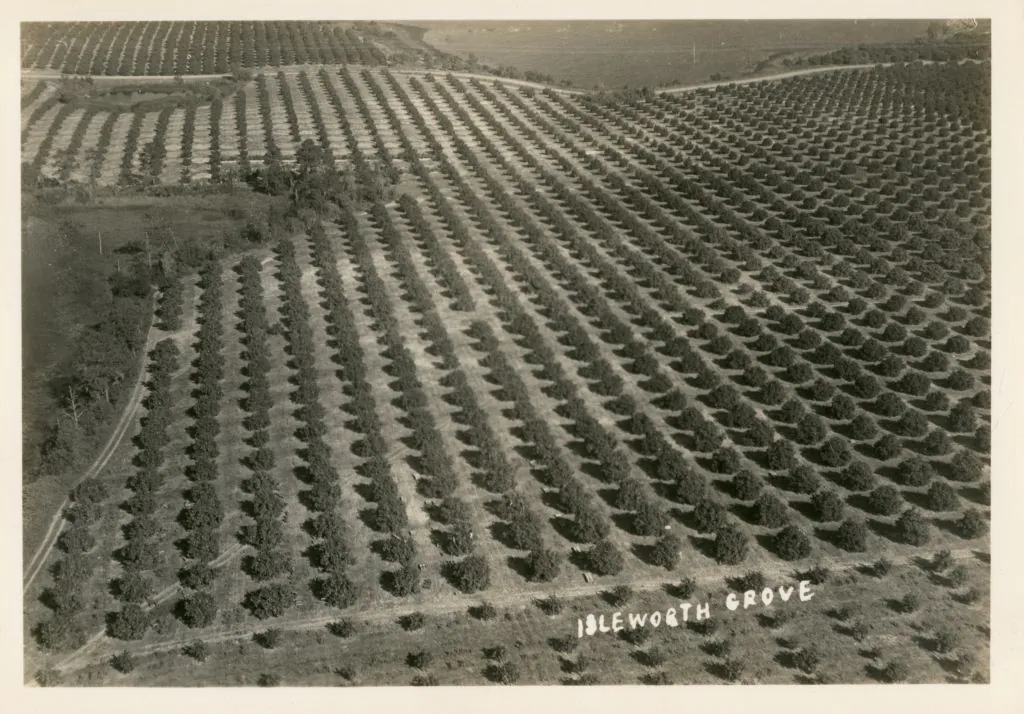
A 1936 aerial photograph captioned ISLEWORTH GROVE in white, showing endless parallel rows of citrus trees covering rolling land to the horizon.
Isleworth Grove, from the air — 1936
The Isle of Worth when it was still a grove: an aerial of Isleworth Grove in 1936 — about 1,300 acres of citrus on the Butler Chain of Lakes. Chase Collection, RICHES / University of Central Florida.

A little over a century ago, two brothers from Philadelphia — Joshua and Sydney Chase — ran citrus across Central Florida, and one grove on the Butler Chain of Lakes they called the Isle of Worth. The name was really a bet. Their trees out here, ringed by water, seemed to shrug off the cold snaps that scorched groves a few miles inland — and in the Florida citrus business, surviving the cold was the entire game. A patch of ground where the fruit lived through a freeze was, quite literally, worth having.

Why an island, of all places

The lakes were the whole reason. Water holds the day’s heat and gives it back slowly after dark, so on a cold night the air over a lake stays a few degrees warmer than the air over dry land. A grove wrapped on three sides by the Butler Chain froze last, if it froze at all. The Chases built Chase & Company in 1884, and by 1886 they had assembled this one into a single large operation — a business betting that geography could beat the weather.

Three men in work clothes and wide-brimmed hats, one smoking a pipe, pose in front of a canvas grove tent with buckets and a crate of jars, on bare sandy ground around 1904.
Grove hands — 1904
Workers at Isleworth Grove, 1904. Chase & Company, Chase Collection, RICHES / University of Central Florida.

For a while, the bet paid. The grove shipped fruit north, the brothers’ company grew into one of the bigger names in Central Florida citrus, and the men who worked the rows had steady reason to believe the Isle of Worth was exactly what its name claimed.

The winter the bet broke

Then came the winter of 1894. On December 28, Orlando dropped to 18 degrees — a record that still stands — and groves all over the center of the state went black overnight.

A leafless orange grove with the entire ground carpeted in fallen frozen oranges after a hard freeze.
After the freeze — 1894
A Central Florida orange grove after the Great Freeze — Bartow, 1894 (a regional view, not Isleworth itself). Louise Frisbie Collection, State Archives of Florida, Florida Memory.

What finished the industry wasn’t that one night. A warm January coaxed the surviving trees back into fresh growth, soft and vulnerable — and then a second freeze in February killed the wood itself. The state’s crop fell from more than five million boxes to about seventy-five thousand the following season. Growers who thought they were safe were ruined.

Even the Isle of Worth went down. Water buys you a few degrees, not a miracle.

The grove sat dead for years. Chase & Company didn’t grow citrus here again until 1904, when Joshua came back from a long stretch in California and started over — replanting the rows the cold had taken, and trying to defend them better this time.

Burning fire against the cold

Resilience, in a grove, was something you bought by the hour. Crews tented and fumigated the trees against pests; and on the nights the thermometer fell, they fought the cold the only way anyone knew how — with fire.

White canvas tents draped over individual citrus trees at an early-1900s grove, with men standing among them beside lanterns and equipment.
Tenting the trees — 1904
Fumigating citrus trees at Isleworth Grove, 1904 — part of the constant work of keeping a replanted grove alive. Chase & Company, Chase Collection, RICHES / University of Central Florida.
A tall rusty cylindrical grove heater, a smudge pot, burning a bright column of flame at dusk in a Florida yard.
Fire against the cold
A Florida citrus grove heater — a “smudge pot” — the oil-burning heaters growers lit by the hundreds through a freezing night to keep their trees alive (a surviving pot, photographed lit in 2007). Photo by Mikeman400, CC BY-SA 3.0.

On a hard night a grove would be dotted with smudge pots — squat oil heaters burning diesel, hundreds of them, throwing just enough warmth and smoke to hold the frost off the fruit until morning. It was filthy, expensive work, and it was the difference between a crop and nothing. The lesson of 1894 had sunk in: out here, the land alone wouldn’t save you. You had to be able to make your own heat when the cold came, and you had to be able to afford it.

It worked. The replanted Isle of Worth ran as a serious citrus operation for the better part of eighty years.

Two men load citrus from field crates beside large trucks and a packinghouse at a Florida grove in 1953, young palms in the foreground.
Shipping the crop — 1953
Loading fruit at Isleworth Grove, January 1953 — the grove at its mid-century working peak. Chase & Company, Chase Collection, RICHES / University of Central Florida.

The sale that changed everything

The grove stayed in the family until 1984, when Franklin Chase — Sydney’s son — sold the Isle of Worth to a golfer named Arnold Palmer.

Two men in business clothes crouch at the base of a citrus tree, examining the grafted trunk, with fallen leaves and a single orange on the ground, 1953.
A Chase in the grove — 1953
Franklin W. Chase (left) inspecting Valencia trees at Isleworth, 1953 — the Chase who would sell the grove to Arnold Palmer three decades later. Chase Collection, RICHES / University of Central Florida.

Palmer and the architect Ed Seay laid a championship golf course over the old citrus rows; it opened in 1986. In 1993 the Tavistock Group bought the course and the land around it and began building the mansions. The citrus name stuck — the Isle of Worth became, on the gate, simply Isleworth — and the peninsula that had once grown oranges became a roughly six-hundred-acre guarded enclave on the water, home to Tiger Woods, Shaquille O’Neal, Ken Griffey Jr. and Mark O’Meara.

A modern aerial of the Isleworth community: large tile-roofed mansions and golf-course greens on a wooded peninsula surrounded by the blue Butler Chain of Lakes.
The same ground now
Isleworth today (modern photograph) — mansions and fairways on the same Butler Chain peninsula that the 1936 aerial shows under citrus. Aerial of a lakefront Isleworth estate, via Orlando Weekly / listing photography, 2020.

It stayed mostly invisible to the outside world until one night it wasn’t. At about 2:25 in the morning on November 27, 2009, Tiger Woods pulled out of his Isleworth driveway, clipped a fire hydrant and ran his SUV into a neighbor’s tree; his wife knocked out the back window with a golf club to get him out. For a few weeks, the whole country was looking at a gate that had been built so no one could.

The new thing the cold became

The threat to a place like this isn’t frost anymore. Central Florida barely grows citrus now; the groves moved south generations ago, chased by exactly the kind of freeze that took the Isle of Worth. What takes the lights out today is the hurricane.

A utility bucket truck lifts a lineman to a power pole strung with sagging and downed wires at dusk after a 2004 Florida hurricane.
When the grid goes down
Crews restoring downed power lines in Florida after the 2004 hurricane season (a regional view). Charley crossed Central Florida that August; Irma darkened Windermere in 2017; Milton blew transformers across the area in 2024. FEMA photo by Jocelyn Augustino (public domain).

The region runs on an overhead grid strung through one of the densest tree canopies in the state, and every big storm settles it the same way — limbs into the lines, and hundreds of thousands of people in the dark for days. Charley came straight up through the middle of the state in 2004. Irma tore down lines and trees around Windermere in 2017. Milton blew transformers across the area in 2024.

Behind the Isleworth wall, resilience is handled the way everything else is: privately, and well. Service runs underground where it can, and a standby generator — the kind that senses the outage and starts itself — is common enough that the community has rules about where you’re allowed to put one. It is, almost exactly, the smudge pot’s descendant: your own machine, your own fuel, making your own power when the world outside goes cold and dark.

The name was always a bet — that the right spot and enough money could out-engineer the weather. For the Chase brothers the weather was frost, and in 1894 it won a round. For the people behind the gate now it’s the storm and the long outage after it, and the instinct hasn’t changed at all since the nights the grovemen stood in the rows lighting fires: when the cold comes for the lights, you keep your own burning. On the Isle of Worth it just hums behind a wall now, and nobody has to strike a match.

A present-day note · GENERasic

Isleworth buys its way around the outage. For one normal house, there’s one version of that you can actually own.

Strip away the gate and the lake frontage and Isleworth’s trick is simple: when the regional grid goes down — and in Central Florida it goes down, every hurricane season — the people inside have arranged not to go down with it. Underground service, a well, and a standby generator that starts itself. Most of that is out of reach for a normal budget. The generator isn’t.

For a single house on the big overhead grid, a standby generator is the one piece of Isleworth-grade resilience that’s genuinely available to you — wired to come on by itself when the street goes dark. What it’s really protecting, in a Florida outage, is worth being plain about:

Which of those actually apply to your address — well or city water, your medical needs, how your house is fed — is worth pinning down for your own home rather than guessing. That part is yours to check.

And if you live behind an HOA or in a deed-restricted neighborhood — the way Isleworth is — a generator has to be sited and screened to the neighborhood’s standard, not just dropped on a pad by the AC unit. Worth building into the plan from the start.

You can get an address-specific installed price for standby power — the whole turnkey number, not a callback and a maybe — in one sitting.

Get your installed price for this address→
Sources & Photo Credits

On the history

Photographs & documents

  1. Aerial of Isleworth Grove (hero) — captioned “Isleworth Grove,” March 3, 1936; Chase & Company. Chase Collection, RICHES of Central Florida, University of Central Florida. File: isleworth-grove-aerial-1936. richesmi.cah.ucf.edu
  2. Three citrus workers at Isleworth Grove — 1904; Chase & Company. RICHES of Central Florida, University of Central Florida. File: isleworth-grove-workers-1904. richesmi.cah.ucf.edu
  3. Orange grove after the Great Freeze, Bartow, Florida — 1894 (a regional view, clearly not Isleworth). Louise Frisbie Collection, State Archives of Florida, Florida Memory; public domain. File: florida-orange-grove-after-freeze-bartow-1894. Commons
  4. Fumigating citrus trees at Isleworth Grove — 1904; Chase & Company. RICHES of Central Florida, University of Central Florida. File: isleworth-fumigating-trees-1904. richesmi.cah.ucf.edu
  5. Florida citrus grove smudge pot (grove heater), lit — a surviving oil-burning smudge pot of the kind used in Florida groves, photographed burning in 2007 (modern photograph of a historic tool). By Mikeman400, CC BY-SA 3.0 / GFDL, via Wikimedia Commons. File: florida-citrus-grove-smudge-pot. Commons
  6. Loading fruit at Isleworth Grove — trucks and field crates, January 1953; Chase & Company. Chase Collection, RICHES of Central Florida, University of Central Florida. File: isleworth-grove-trucks-1953. richesmi.cah.ucf.edu
  7. Franklin W. Chase and Randall Chase inspecting Valencia trees at Isleworth Grove — January 1953. Chase Collection, RICHES of Central Florida, University of Central Florida. File: chase-family-inspects-valencias-1953. richesmi.cah.ucf.edu
  8. Isleworth today (modern aerial) — a lakefront Isleworth estate and the surrounding community on the Butler Chain of Lakes, 2020; listing photography via Orlando Weekly. File: isleworth-estate-aerial-today. orlandoweekly.com
  9. Utility crew restoring downed power lines, Florida, 2004 — a mutual-aid crew after the 2004 hurricane season (a regional view, not Isleworth). FEMA photo by Jocelyn Augustino; public domain, via Wikimedia Commons. File: florida-2004-hurricane-power-restoration. Commons

Modern photographs are identified as modern; regional images (the Bartow freeze, the 2004 storm crew, the lit smudge pot) are labeled as regional or as present-day views of a historic tool, not as Isleworth itself. Original downloads and a full research record are kept alongside this page in assets/images/originals/ and source-record.md. No image’s factual content was altered — the Polaroid frames and handwritten notes are CSS added around the photographs, never onto them. Any owner who wants an image removed need only ask.