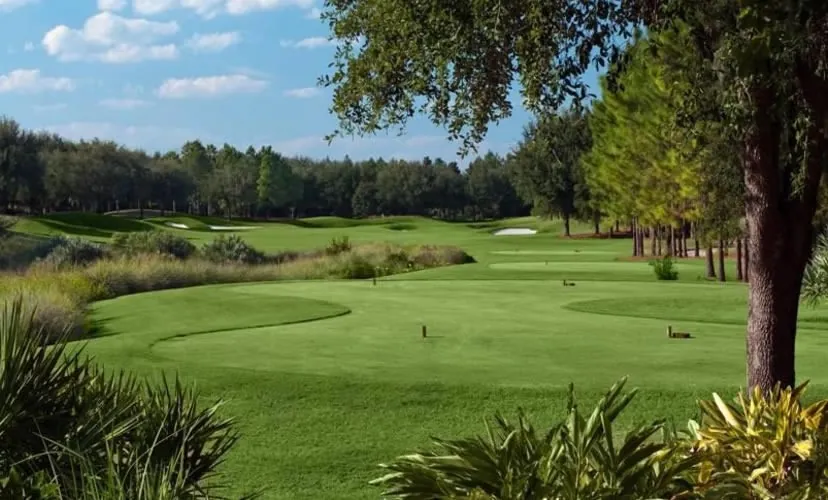
R. Dolph Keene spent sixty years learning how to beat the Florida cold. He came up in citrus as a boy during the freeze of 1895 — the one that stripped the state's orange trees down to bare wood — and he stayed in it until he was running one of the big packing cooperatives in Central Florida. The land in the photograph above was his. The oranges are gone now, and the thing that grows here instead is a golf course.
That's the first strange fact about Keene's Pointe: the green arrived only after the groves died. The second is quieter, and it's the one that still matters on a bad afternoon in late September — everything that keeps this place green and cool runs on electricity it cannot make for itself.
The boy in the frozen grove

Keene was born in 1885. By the account of the Florida Citrus Hall of Fame, which later inducted him, he started working in the groves as a boy during that 1895 freeze, went to work for Dr. P. Phillips — the biggest name in Orange County citrus — and in 1922 bought into a packinghouse up in Eustis.
In 1933 he moved to Winter Garden, a few miles from today's Keene's Pointe, and built a packinghouse of his own. He helped organize the Winter Garden Citrus Products Cooperative and ran it until 1966. A long career, and all of it the same bet: that the warmth would hold one more winter.
A man who starts out in a killing freeze learns the lesson early. In Florida, the warmth is never a given — it's a loan, and the cold keeps the right to call it in.
His groves on the Butler Chain
The land that is now Keene's Pointe sat on the western edge of the Butler Chain of Lakes, near Windermere, and by local accounts it was Keene's orange groves — the north end picked up in the 1930s, the south end in the 1940s. Good high ground above a chain of spring-fed lakes, which is about as close to frost-safe as Central Florida gets.

For a while the bet kept paying. But the ground a crop grows on is only borrowed too, and the next tenant was already coming.
The cold wins
Through the 1980s, Florida did the thing it had done to Keene as a boy, over and over. A run of hard freezes — 1981, 1983, 1985, and a brutal one at the end of 1989 — walked down the peninsula and took the citrus of Lake, Orange, and the counties around them to the ground.
Orange County's groves had already peaked back in the early 1970s. After the 1980s freezes, a lot of growers simply didn't replant. The packing plants around Orlando closed one after another, and where the groves had been, subdivisions went in. The Keene family's land followed the same path: the oranges came out, and the plat maps came in.
The warmth was always on loan. When Florida finally called it in, the groves didn't grow back — the subdivisions did.
The paradise they built on top

In the late 1990s the developer Castle & Cooke began turning the old grove land into Keene's Pointe — a guard-gated community of around 1,100 homes wrapped around a brand-new Jack Nicklaus Signature golf course. The course, the Golden Bear Club, opened in 1999: eighteen holes over roughly 250 acres, laid along the same Butler Chain water the groves had used. They put Keene's name on the gate.
It is, on a quiet evening, genuinely lovely — and none of it is an accident. The fairways are mowed and fed and irrigated. The gate rises and falls. The air conditioning hums in a thousand-odd houses. It is a convincing version of control: your own golf, your own water, your own cooled and quiet streets.
The one thing you can't landscape
Except the current. You can dig the lakes and shape the greens and raise the gate, but you cannot make your own electricity. It comes in from outside, along poles that cross the same open country the groves once stood on — and everything that makes the place the place is downstream of those wires.
In Central Florida, that dependency has a season. Most summers it's an hour's flicker in an afternoon storm. But every so often something far bigger comes up the peninsula to find out how much of that control was ever real.
September 28, 2022

Ian came ashore on the Gulf side and drove across the center of the state, right over Orange County. By a Thursday-evening briefing, Duke Energy — which serves much of the county — reported about 160,000 of its Orange County customers in the dark, something like 41 or 42 percent of them. The city utility, OUC, peaked at 97,560 outages of its own.

Getting it back was not a design problem a developer could solve ahead of time. It was crews on poles, one at a time, spread across a wrecked region. Duke didn't expect to have 90 percent of its Orange County customers back until nearly midnight on that Sunday — days, not hours. And the grid doesn't read the plat map. The most carefully controlled address behind the Keene's Pointe gate waited on the same line as the oldest house on the oldest road nearby.
What's still here
Right next to the gate sits R.D. Keene Park — 52 acres of Orange County land on Lake Isleworth, with a public boat ramp that is one of only two ways the public can get onto the Butler Chain at all. His name is on that too. The oranges are forty years gone, the groves are fairways, but the water he planted beside is unchanged, and so is the one risk that ran under all of it.
Keene spent his life proving you could beat the Florida cold, right up until the cold proved you couldn't. The paradise built where his groves stood made the same kind of bet with a different element: that the power would always be there. The freeze took the oranges. The storm takes the current. And the green place on the old grove land is still renting the one thing that keeps it green.


