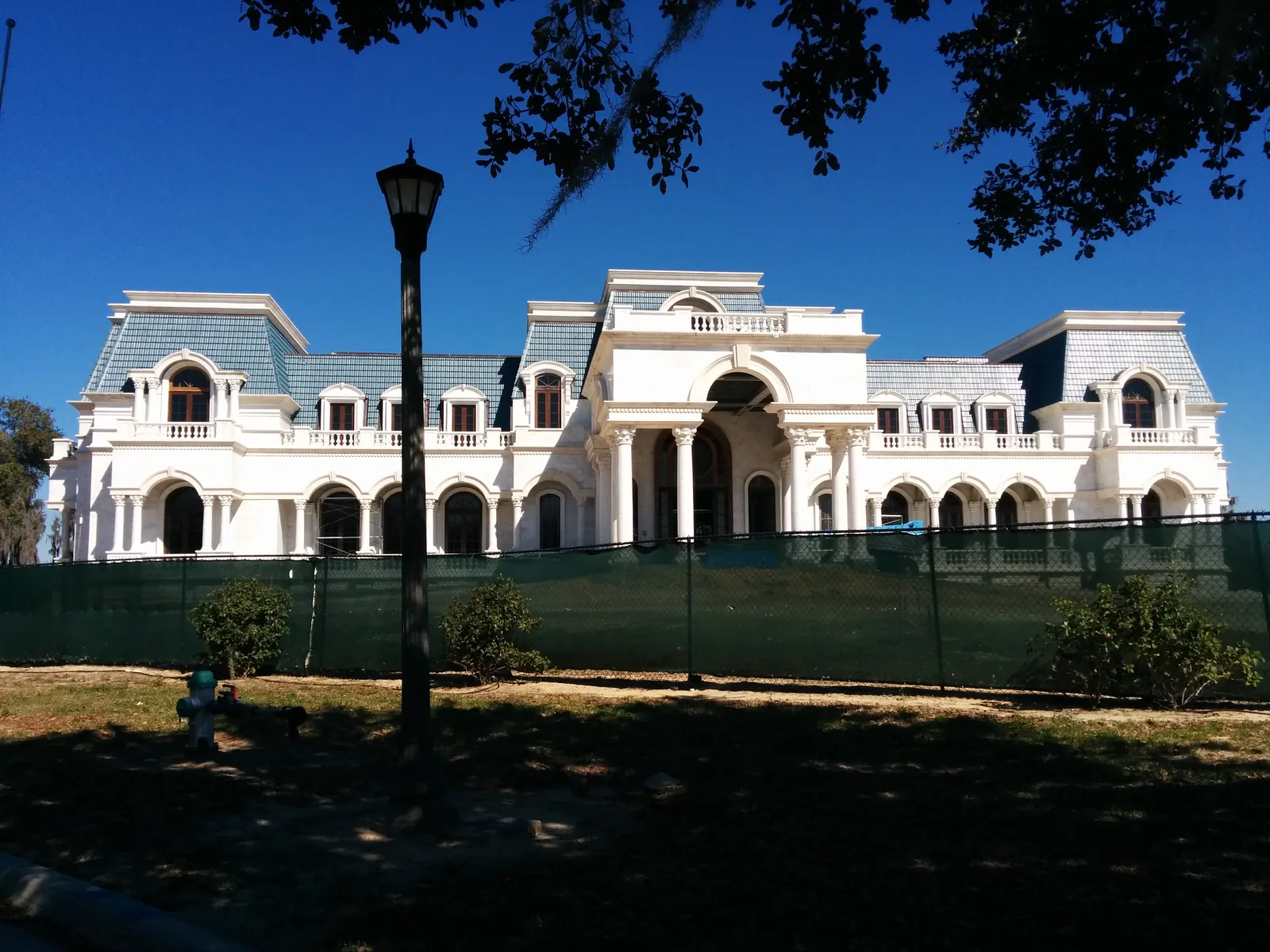
Behind a guardhouse on the Butler Chain of Lakes, on a street most people will never drive down, stands the largest single-family house ever attempted in America. It has a grand ballroom, a bowling alley, a roller rink, a baseball field, and thirty bathrooms. Its owners named it Versailles, after the French palace of a king. And the single strangest thing about it is this: they broke ground in 2004, and more than twenty years later it still wasn’t finished — and the man who built it never spent a night in it.
How do you fail to finish the biggest house in America? Not from lack of money, exactly. From something harder to see, that runs underneath this whole corner of Florida like the water that connects its lakes.
The gated shore
Lake Butler Sound is a small, deliberate place: a guarded Windermere enclave of only about 150 estate lots, many of them oversized and sitting right on the water. It was laid out in the late 1990s and early 2000s on a piece of lakeshore that a single family had held for most of the century — low-density, one way in, quiet on purpose.

What makes the address worth guarding is the water. Lake Butler is the big lake in a chain of thirteen, stitched together by more than thirty navigable canals — clear enough, and clean enough, that in 1985 it became the first lake system in the whole state of Florida to be named an Outstanding Florida Water. You can put a boat in behind your house and run it for miles without leaving the neighborhood.
So the land was never the problem here, the way sandy scrub once was a few lakes over. The problem, when it came, had nothing to do with the ground at all.
The man who sold tomorrow

The owner was David Siegel, and his fortune came from timeshares. In 1982 he opened a 16-unit resort near Orlando. Out of it he built Westgate Resorts, the largest privately held timeshare company in the world — a machine that sold millions of people a single week of vacation a year, almost always on credit, the buyer paying it off month by month.
That is the quiet engine under everything that followed. A timeshare company doesn’t really sell rooms; it sells tomorrow’s payments, today. It borrows against those payments to build the next tower, and sells those rooms on credit too. As long as the money keeps moving, it looks like a fortress. Siegel, by his seventies, was rich enough to decide he would build himself a palace.
A king’s house, on a developer’s budget

The plan, pushed hardest by his wife Jackie — thirty years younger, and the one who would become the house’s public face — was a 90,000-square-foot home modeled on the Palace of Versailles outside Paris and the top floors of a Las Vegas casino. Ground broke in 2004, the same summer Hurricane Charley cut clear across Orange County.

It is easy to make fun of, and the documentary that came later did. But set the jokes aside and the ambition is almost touching: a man who had started with sixteen units wanted, at the end, to build something that would still be standing, and still astonishing, long after he was gone. The French kings had wanted the same thing. They, too, borrowed heavily to get it.
The year the money stopped
Then the thing holding it all up gave way. In 2008 the credit markets froze, and a company that ran on credit froze with them. The banks that had funded Westgate’s lending abruptly pulled their lines. Sales that depended on buyers borrowing dried up. Westgate laid off thousands of workers and surrendered valuable properties to its lenders, including a gleaming new tower in Las Vegas.

Construction on Versailles stopped in 2009. The house stood maybe sixty percent finished — walls up, roof on, and then nothing, a palace-sized shell on a bare lot behind the fence. For a while the Siegels tried to sell it, unfinished, for around sixty-five million dollars. No one came.
A filmmaker named Lauren Greenfield happened to be there with a camera, having meant to document the building of the biggest house in America. Instead she caught the family as the floor dropped out beneath them. Her 2012 film, The Queen of Versailles, turned the half-built house into the most famous symbol of the whole American crash — one family’s version of what nearly everyone on credit felt that year.
The one thing no palace can buy
They did not lose it. As the business recovered, work started again in 2013, and it ground on — year after year, through two more decades of change orders, a fire, and the slow finishing of thirty bathrooms. By 2026 the house was nearly done, needing mostly its pools and stonework and landscaping. Twenty-two years from the first shovel.
David Siegel could borrow a fortune, build a palace, and put a king’s name over the door. The one thing he could not do was buy the time to live in it.
In the spring of 2025, with the house at last nearly finished, his family wheeled him through it. He was dying of cancer. A few weeks later, on April 5, 2025, at eighty-nine, David Siegel died — having never slept a night in the largest house in America. His wife has since turned the palace toward a charity, a place for galas rather than a home. The thing that was built to outlast its builder did exactly that, and sooner than anyone planned.
And the grid doesn’t read the guardhouse
There is one more thing even a finished Versailles cannot command, and it is the most ordinary thing of all. A 90,000-square-foot house is, before it is anything else, an enormous electrical load — acres of air conditioning in Florida heat, the pumps, the kitchens, the lifts, the lights. Every watt of it comes in from outside, along the same poles, strung over the same flat country, as every other house on the lake.

On September 10, 2017, Hurricane Irma ran up the length of Florida and across the middle of the state. When it passed, about 6.7 million customers — close to two-thirds of every electric account in Florida — had no power. In Orange County alone, utilities reported nearly 300,000 homes dark; Duke Energy had lost power to some 208,000 of its roughly 370,000 customers in the county.

The grid does not read the guardhouse. When the line down the road is on the ground, the most expensive address behind the Lake Butler Sound gate waits in exactly the same dark as the oldest house on the oldest street nearby — on the same crews, working their way across the county pole by pole. All the money in the world buys a bigger house. It does not buy a shorter outage.
What’s still here
The lake was here first, and it will be here last. It was named for a man most people have forgotten, it was clean enough to earn a state designation before the first lot was platted, and it does not notice the palace on its shore any more than it noticed the groves before it. Versailles is only the newest thing on an old water.
Siegel set out to build something a storm couldn’t touch and time couldn’t take — a house so large and so permanent that it answered, once and for all, the question of whether he had made it. He got the house. He did not get the night in it, and the finished palace will go dark in the next big storm just like every other roof on the chain. The largest house in America turns out to run on the same thin wire as the smallest — and in Florida, that wire belongs to the weather.


