Sometime in the late 1800s a boy from the scrub and orange groves north of Orlando went off and joined the circus — the real thing, the Bailey show, all tents and torchlight and crowds that gasped on cue. What’s strange is what he did next. He came home, became a chemist, got rich selling dyes and cloth, and then spent the money building a town. Store blocks. Houses. A schoolhouse. A little meeting hall that a century later would hold the town’s museum. His name was Frank Evans, and if you want to understand how Lake Mary became a place instead of a railroad stop, you mostly have to understand him.
Two settlements and a lake named for somebody’s wife
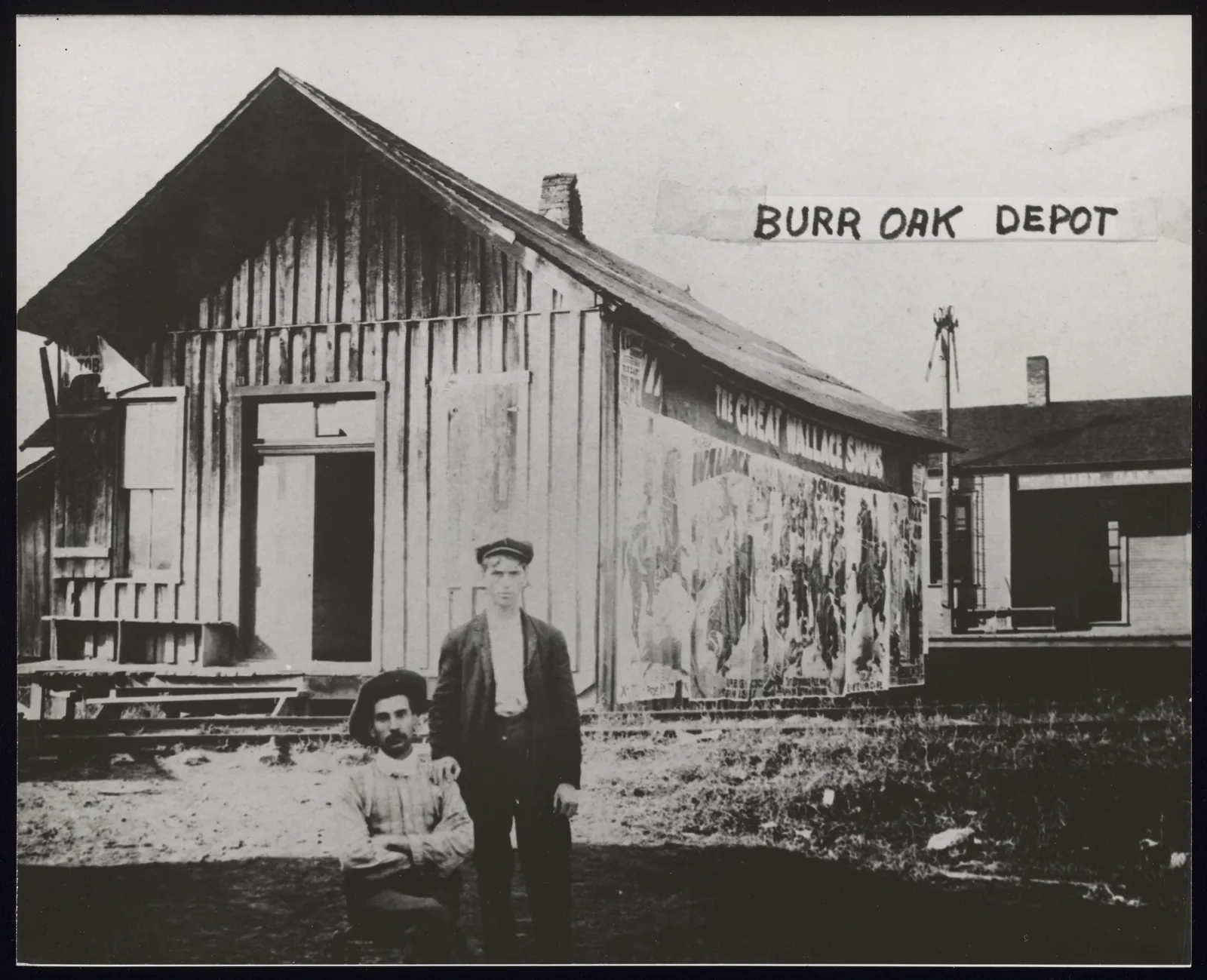
Before Evans built anything, there was barely a town here — just a pair of tiny settlements strung along the railroad that ran between Sanford and Orlando. One was called Bent’s Station, the other Belle Fontaine. The South Florida Railroad had pushed its first train through the two towns in November 1880, and the little depot stops that grew up along the line lived on one thing: oranges.

The lake that gave the town its name was named, most accounts say, for Mary Sundell — the wife of the Rev. J. F. Sundell, who settled on its northern shore and helped organize a Presbyterian church in 1894. There’s a competing story that the name honored a local businessman’s daughter instead, and the old records don’t settle it cleanly. So take the lake’s name as the one piece of Lake Mary that nobody can fully account for.
Not everyone who lived here got counted the same way. Nearby stood Markham, a settlement of Black families that lasted from about 1880 into the 1940s; its burying ground, Pinnie Ridge Cemetery, is still out there in the woods. The groves ran on that kind of labor — lumbermen, turpentine hands, pickers, and Swedish immigrant families working the trees — long before the place had a name on a map.
The man from the big top
Frank Evans came to the area as a boy in 1882. Before he was anyone’s idea of a town father, he was a performer — part of the Bailey Circus, the traveling show that would soon join P. T. Barnum’s to become the Greatest Show on Earth.

Then he walked away from it. Evans trained as a chemist, built a business in dyed goods and textiles, and made real money — enough that a man who’d spent his young years in the loud, temporary world of the circus could afford to go quiet and permanent. He took the fortune back to the citrus country where he’d grown up.
And here’s the turn: he spent it on Lake Mary.
What a showman does with a fortune
With the profits from the dye-and-textile business, Evans put up commercial buildings and houses. He built the original Lake Mary Elementary School. In 1923 he organized the Lake Mary Chamber of Commerce. In 1926 the voters of Seminole County sent him to the county commission — and that same year he built the thing that would outlast all the rest: a modest community hall for the chamber, on what’s now Country Club Road.
A man who’d made his living selling spectacle came home and spent his money on the least spectacular things there are — a schoolhouse, a store block, a meeting hall.

It was the kind of building a town does its growing up inside. But the ground under all of it — under Evans’s stores, under the groves, under the depot fortunes up and down the line — was a single crop, and a single crop can be killed in a night.

The night the oranges died
That night came in the winter of 1894–95, and it came twice. A hard freeze hit in late December 1894. Then a deceptively warm January coaxed the trees into new growth — right before a second, killing freeze in early February 1895.

Across Central Florida the groves went black. Fruit froze on the branch; trees that growers had tended for twenty years split open in the cold. Florida had shipped around five million boxes of oranges the season before that winter — and it would take nearly two decades to ship that many again. Men who’d gone to bed rich woke up starting over, and a good many of them simply left.
A town built on citrus had just learned that its one sure thing was nothing of the kind. What carried Lake Mary through wasn’t the groves. It was the slow, unglamorous work of building that people like Evans kept doing anyway — concrete and lumber and a school that didn’t depend on the weather.
The hall that became the museum
Evans’s little chamber hall from 1926 turned out to be the most durable thing anyone put up here. When Lake Mary finally incorporated as a city on August 7, 1973 — almost a century after Bent’s Station and Belle Fontaine — the brand-new town had no city hall of its own. So it moved into Evans’s building and used it as one, right up until 1990.

A small museum opened in a back room of the building in 1994 and slowly took over the rest of it. Today the whole hall is the Lake Mary Historical Museum, with its exhibits on the town’s history — and on the trains that made it. It went onto the National Register of Historic Places in 2004, under the name it still carries: the Frank Evans Center.
In 1980 Lake Mary counted fewer than 3,000 people. Today it’s closing in on 17,000, wrapped around office parks and golf and the interstate — a long way from two depot settlements and a frozen grove. The circus Evans performed in dealt in things that vanished the instant the tent came down: the gasp, the spectacle, the crowd that went home. What he built when he got home was the exact opposite — a schoolhouse, a store block, a plain hall with his name on it, still standing on Country Club Road with the town’s whole history kept inside. The showman’s real trick was picking the things that stay.


