Lake Nona Golf & Country Club  ·  Orlando, Florida  ·  A Local History

When the World's Golfers Moved to a Cow Pasture


A brand-new course in the Orlando scrub, a teacher in a straw hat, and the strange years when more major champions lived around one lake than almost anywhere on earth — all of it resting on a wire that Florida's storms love to put on the ground.

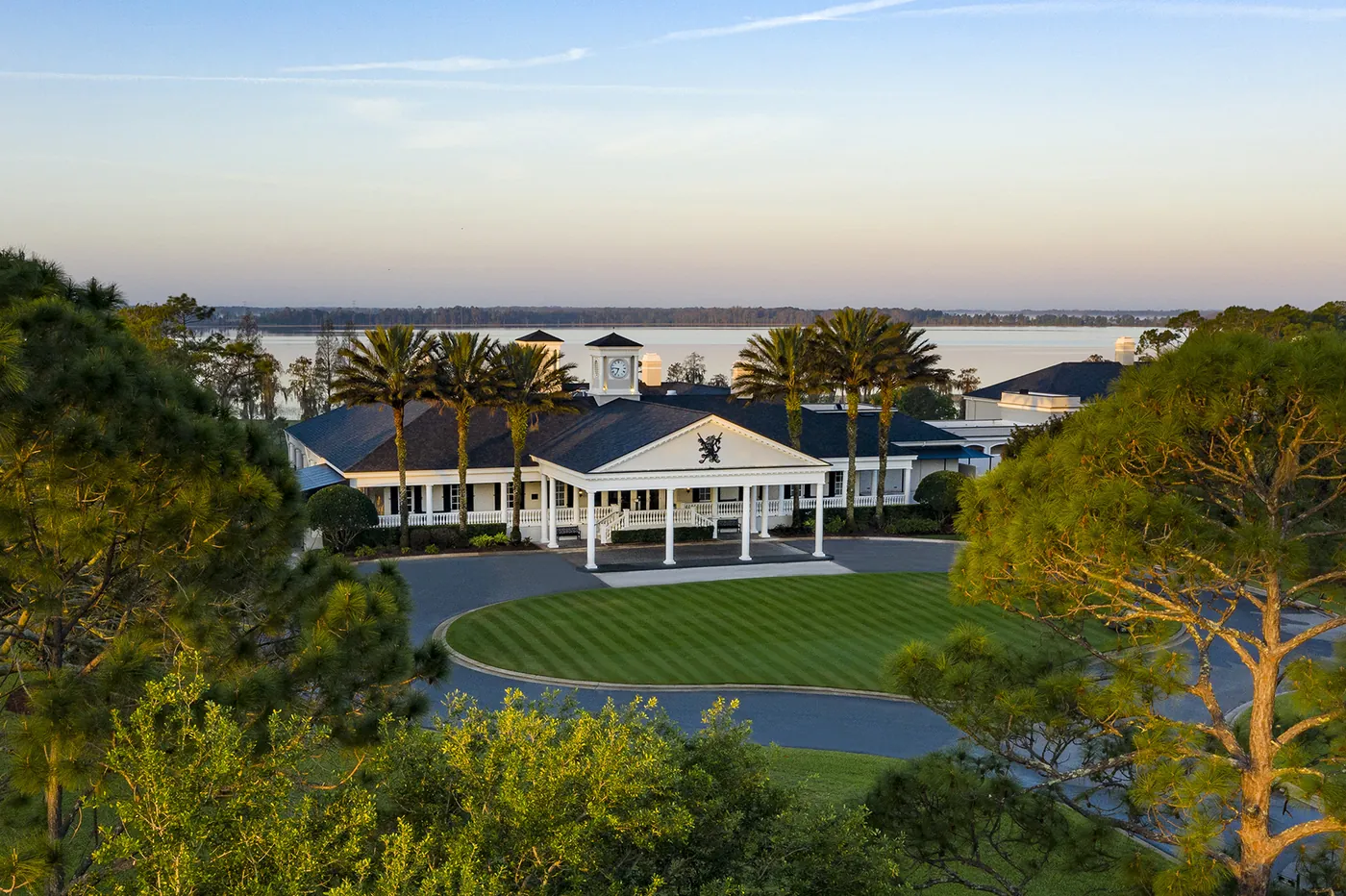
A low white clubhouse with columns and tall palms above a manicured golf green, with a lake catching warm evening light beyond.
The clubhouse on the lake — Lake Nona, 2014
The Lake Nona Golf & Country Club clubhouse and course, 2014. Thirty years earlier this was open range. The lake, the greens, and the champions all arrived after.

Drive the Narcoossee Road southeast of Orlando in the mid-1980s and you passed cows. Orange trees on both sides, one gas station, a Publix, flat pasture running out to the pines and the mosquitoes — the kind of empty Florida nobody put on a postcard. And then, within a few years, behind a gate on one of those lakes, there lived a collection of the best golfers on the planet: men and women who between them had won majors by the dozen, practicing side by side every afternoon in a place that had recently been a ranch.

It is a genuinely strange thing to have happened. Florida is full of golf. Warm weather and cheap land will grow a course anywhere, and most of them summon nobody in particular. So why did this one patch of scrub — no ocean, no mountains, no city around it — pull in a roster of champions you'd otherwise have to fly around the world to assemble? The answer isn't the weather, and it isn't the lake. It's a person.

The empty corner of the county

A single black cow standing in a flat, dry Florida pasture under a wide blue sky with scattered clouds, a red road-marker sign at the fence line.
What the land was — southeast Orange County
Open pasture on the Lake Nona fringe, photographed in 2012. Even decades into the build-out, the edges of the development were still cattle country — the same flat range that covered the whole area before the golf course came.

Until the mid-1980s, the land along Narcoossee Road was cattle ranch, citrus grove, pine flatwoods, and wetland, with a few scattered homes out toward Lake Hart and the Isle of Pines. It was known, locals liked to say, more for its mosquitoes than for anything else. This was the far southeast edge of Orange County, closer to the swamp than to the city, and for a long time nothing much happened there on purpose.

That it sat next to Orlando mattered less than you'd think. Orlando's gravity in those years ran west and south toward the theme parks. The southeast corner was leftover land — useful for cows, and not obviously useful for much else. Which is exactly the kind of place where something unexpected can be built cheaply, if someone has a reason to build it.

A very good course, which was not enough

In 1986 a course went in. It was designed by Tom Fazio, one of the most sought-after architects in the game, and it was excellent — the sort of layout that would eventually be ranked among the best hundred courses in the world. Four years after it opened, it was good enough to host the very first Solheim Cup, in 1990, when the United States and Europe's best women played the inaugural edition of what became the sport's premier team event. The World Cup of Golf followed in 1993.

But a championship course, by itself, does not make golfers move their families across an ocean to live beside it. There were other fine courses within an hour's drive. If the Fazio layout had been the whole story, Lake Nona would have been one more handsome Orlando club and nothing more. The thing that turned it into a colony arrived two years after the course did, and it wasn't made of grass.

The teacher in the straw hat

A man in a wide straw hat talking with a golfer beside a tour bag labeled Ernie Els, a crowd watching from behind a rope at a tournament.
The magnet — Leadbetter with Ernie Els, 2006
David Leadbetter, in his trademark straw hat, with Ernie Els at the 2006 Open Championship. Players didn't come to Lake Nona for the real estate. They came to be near the man teaching the swing that was winning majors. Photograph by Peter from Liverpool, UK.

David Leadbetter was the most talked-about golf coach in the world, and in 1988 he moved his teaching operation to Lake Nona. He had just done something that got everyone's attention: he had taken Nick Faldo, a good player with a suspect swing, torn that swing down to the studs, and rebuilt it. Faldo came out the other side a major champion — and every ambitious professional on tour looked at that and wanted the same.

Leadbetter was now at Lake Nona. So that's where you went. Faldo came. Nick Price came. Frank Nobilo and Retief Goosen came. The quiet corner of Orange County had something no amount of warm weather could manufacture: the teacher, the practice ground, and a growing cluster of the best players in the world all in one place, feeding off each other every day.

The colony fills up

Two golfers in caps standing and talking on a putting green with a gallery of spectators behind them at a tournament.
Nick Price, one of the first to come, 2006
Nick Price on a practice green in 2006. A three-time major winner and Leadbetter pupil, Price was among the earliest tour professionals to settle at Lake Nona, part of the first wave the teacher pulled in. Photograph by MCHart.

Once a few champions live somewhere, the rest is almost gravity. Ernie Els moved in. So, over the years, did Sergio García, Justin Rose, Henrik Stenson, Ian Poulter — names that between them account for Opens, Masters, and U.S. Opens. They bought houses around the water, enrolled their kids in the same schools, and fell into a routine that became semi-legendary on tour: a daily money game that went off at one o'clock, major champions needling each other for a few dollars on a Tuesday afternoon.

That daily game is the whole secret in miniature. You don't get sharper practicing alone. You get sharper when the guy who just won the Open is standing on the next tee, and losing to him stings. Lake Nona had accidentally built the one thing money usually can't buy in golf: a peer group at the very top, in one spot, every single day.

Then the women arrived

A woman in a bright pink shirt and white cap at the finish of a full driver swing, club behind her shoulders, on a tee.
Annika Sörenstam — and the wave that followed
Annika Sörenstam in 2008. After she settled at Lake Nona around 2000, the women's game followed her there the way the men had followed Leadbetter — a second colony layered on top of the first. Photograph by Keith Allison.

Around 2000, Annika Sörenstam — the best woman golfer of her era — moved to Lake Nona, and the same thing happened again, from scratch. Where she practiced, others wanted to practice. Over the following years the club drew a roster of the women's game to match the men's: Yani Tseng, a former world number one; the sisters Ariya and Moriya Jutanugarn; later, Lydia Ko. The pattern that a male coach had started in 1988 simply ran a second time with the women, two decades on.

The land couldn't grow much. What it turned out to be perfect for was growing champions — one wave of them, and then another.

The club now counts, by its own tally, something on the order of forty-four major championships won by its touring members, men and women combined. Whatever the exact number, the point is the concentration: a cattle corner of Orange County that quietly became one of the densest gatherings of elite golf talent anywhere on earth.

Why here, really

An airport terminal with a tall control tower and jet bridges seen across an empty runway under a blue, partly cloudy sky.
Ten minutes away — Orlando International
Orlando International Airport, about ten minutes from the club's gate. For players who chase tournaments across the globe, direct flights to almost anywhere were as much a reason to live here as the practice range. Photograph by Dough4872.

Strip away the romance and the reasons are coldly practical. The teacher and the peer group were the draw; the practice facility was immaculate; and the gate was roughly ten minutes from Orlando International Airport, which flies nonstop to very nearly everywhere a golf tournament is held. For people who spend their lives getting on planes, that last detail is not a small one. You could leave your front door, win a championship in Scotland, and be home for the one o'clock game by midweek.

The empty corner, it turned out, had been waiting for exactly this. In 1996 — a full decade after the course opened — the British billionaire Joe Lewis and his Tavistock Group bought up roughly seven thousand acres of the surrounding land and began building outward from the golf club: a planned town, a medical district, offices, schools. All of that came later. The golfers were first. The famous name on all those new signs was a name the golf course had already made.

The bill under the paradise

A lawn sprinkler throwing a wide arc of water across a green golf fairway lined with large shade trees.
The green is a machine that has to be run
Irrigation on a golf course (representative photograph, not Lake Nona). A championship course in Florida is kept alive by pumps, and pumps run on electricity. Stop the water for a few summer days and the greens begin to die.

Here is the part the postcard leaves out. A manicured Florida golf community is not a natural thing holding still — it is a machine that has to be run, constantly, on electricity. The greens stay green because pumps push water through them; the lakes and fountains are circulated; the clubhouse and the big houses are air-conditioned against the same heat that makes the golf possible; the gates open on power, the wells draw on power. Turn the current off and the whole engineered paradise starts, quietly, to come apart.

And this is Central Florida, where the current goes off. In 2004 three hurricanes — Charley in August, then Frances, then Jeanne — crossed the state within six weeks, and Charley raked straight across the Orlando area. Millions of Floridians lost power; in parts of the region, some neighborhoods sat in the dark for close to two weeks. The grid that keeps a place like this alive is the first thing a storm takes down, and the last thing to come back.

A utility bucket truck with its boom raised to power lines at dusk, a crew restoring electricity beside a roadside billboard.
After the 2004 storms — Florida
An out-of-state line crew restoring power in Florida after the 2004 hurricane season. When the grid goes down across the region, bringing it back is slow, manual work — and everything that runs on the wire waits in the dark until the truck reaches your road. Jocelyn Augustino / FEMA.

Which is the one honest thing the land kept from its ranching days. You can put a Fazio course and a colony of champions on top of a cow pasture, but you can't move it out of the hurricane belt. The cows are gone and the greens are perfect, and when the next storm walks across Orange County, Lake Nona goes dark on exactly the same terms as the pasture it replaced — waiting on a bucket truck working its way, road by road, back toward the gate.

A present-day note · GENERasic

Lake Nona's whole story is a bet that you can engineer a better place on top of raw Florida — and that bet runs on the wire.

The golf colony is proof of how much you can build on an empty corner of the state: a world-class course, a town, a medical city, all of it conjured out of pasture. And every bit of it leans on the same thing a single house leans on — the power coming in from the road. When a storm takes that line down, the most carefully built place in the county is suddenly no better off than the cattle range it replaced.

A home runs on the same bargain. Cooling, clean water from a well, refrigeration, a CPAP at night, medical equipment — nearly everything that keeps a Florida house livable needs electricity, and in a hurricane the grid is the first thing to go. Here that's a when, not an if. No amount of planning keeps the lights on when the line down the street is lying in the yard.

A standby generator is the one part of that you get to decide ahead of time. It doesn't wait on a crew working its way across the county — it starts itself the moment the power drops, whether anyone's home or not. In a Florida outage, here's what it's actually holding up:

An enclosed residential standby generator on a pad beside a house, next to a white picket fence and garden bed.
The fallback, wired before you need it
A residential standby generator (representative photograph, not Lake Nona equipment) — wired to start on its own the moment the grid drops. Via Cummins.

Which of those actually apply to your address — your medical needs, how your house is fed, well or city water — is worth pinning down for your own home rather than guessing. That part is yours to check.

You can get an address-specific installed price for standby power — the whole turnkey number, not a callback and a maybe — in one sitting.

Get your installed price for this address→
Sources & Photo Credits

On the history

Note on the chosen lens and on uncertainties

This page was built with a “power resilience” lens for GENERasic. The honest, documented connection is structural rather than a single historical event: Lake Nona is an entirely engineered place — a championship golf course, lakes, and climate-controlled homes conjured onto raw Central-Florida scrub — and an engineered landscape of that kind is kept alive by pumps, chillers, wells and gates that all run on electricity, in a region that loses power to hurricanes. A few points are stated carefully. The “44 major championships” figure is the club's own promotional tally and is presented as such, not as an independently audited count; the verifiable fact is the unusual concentration of major winners who have lived or practiced there. Residency vs. visitation: the named professionals are documented as residents, members, or practice regulars at various times (membership and residency change over the years); the page does not claim all of them lived there simultaneously. Image geography: the clubhouse/course photograph is Lake Nona (2014); the cow-pasture photograph is the Lake Nona fringe (2012); the golfer portraits (Els with Leadbetter, Nick Price, Annika Sörenstam) were taken at tournaments elsewhere, not at Lake Nona, and are used as portraits of the people in the story; the irrigation sprinkler, the 2004 line-crew photograph, and the standby generator are explicitly labeled representative, not Lake Nona equipment. Dates for the course (1986), Leadbetter's move (1988), Sörenstam's arrival (c. 2000) and the Tavistock purchase (1996) follow the sources above.

Photographs

  1. Lake Nona Golf & Country Club clubhouse and course (hero, 2014) — the clubhouse, course and lake in evening light. Photograph by Cem0030, CC BY-SA 4.0, Wikimedia Commons. File: lake-nona-golf-course-2014. commons.wikimedia.org
  2. Open pasture on the Lake Nona fringe (2012) — a cow in flat Florida pasture; representative of the cattle land that covered the area before development. Photograph by "East Park," CC BY 3.0, Wikimedia Commons (filed as Lake Nona Town Center). File: lake-nona-land-cow-pasture-2012. commons.wikimedia.org
  3. David Leadbetter with Ernie Els (2006 Open Championship) — Leadbetter in his straw hat beside Els and his tour bag. Photograph by Peter from Liverpool, UK, CC BY-SA 2.0, Wikimedia Commons. File: ernie-els-david-leadbetter-2006. commons.wikimedia.org
  4. Nick Price on a practice green (2006 Wachovia Championship) — three-time major winner and early Lake Nona professional. Photograph by MCHart, CC BY 2.0, Wikimedia Commons. File: nick-price-practice-green-2006. commons.wikimedia.org
  5. Annika Sörenstam (2008 LPGA Championship pro-am) — the player whose arrival drew the women's game to Lake Nona. Photograph by Keith Allison, CC BY-SA 2.0, Wikimedia Commons. File: annika-sorenstam-tee-shot-2008. commons.wikimedia.org
  6. Orlando International Airport (2012) — terminal and control tower, roughly ten minutes from the club. Photograph by Dough4872, public domain, Wikimedia Commons. File: orlando-international-airport-terminal-2012. commons.wikimedia.org
  7. Golf-course irrigation (representative — not Lake Nona) — a sprinkler watering a fairway; stands for the pumps that keep a Florida course alive. Photograph of Mountain View Golf Course, Ewing Township, New Jersey, Wikimedia Commons. File: golf-course-green-sprinkler-representative. commons.wikimedia.org
  8. Power restoration after the 2004 hurricanes (Florida, representative — labeled) — an out-of-state mutual-aid line crew restoring electricity. Jocelyn Augustino / FEMA, public domain, Wikimedia Commons. File: florida-2004-hurricane-power-restoration. commons.wikimedia.org
  9. Residential standby generator (representative — not Lake Nona equipment) — an enclosed home standby generator on a pad beside a house. Via Cummins. File: home-standby-generator-representative.

The historical and portrait images are from Wikimedia Commons under Creative Commons or public-domain licenses; the FEMA line-crew image is public domain; the standby-generator image is a representative photograph via Cummins. No image's factual content was altered — the Polaroid frames and handwritten notes are CSS added around the photographs, never onto them. Original downloads and a full research record are kept alongside this page in assets/images/originals/ and source-record.md. Any owner who wants an image removed need only ask.