Lake Nona, Orlando, Florida  ·  A Local History

The Windowless Building That Keeps the City of the Future Alive


Lake Nona rose out of a Central Florida cow pasture as a self-styled city of the future — a whole district of hospitals that are never allowed to lose power. The building that actually makes that promise good has no windows, a blast-rated shell, eight generators and a quarter-million gallons of diesel buried in the ground.

Behind a long blast wall on the southern edge of Lake Nona sits a building almost nobody is meant to notice. It has hardly any windows. Next to it stands a water tank holding two million gallons, and buried in the ground beneath it is a tank of diesel fuel large enough to fill a backyard swimming pool several times over. It is one of the most important buildings in Orlando’s “city of the future,” and you have almost certainly never heard of it.

That is the quiet paradox of Lake Nona. A place sold as frictionless, futuristic and brand-new leans, in the end, on the least glamorous idea in Florida: that sooner or later the power goes out, and somebody had better have planned for it.
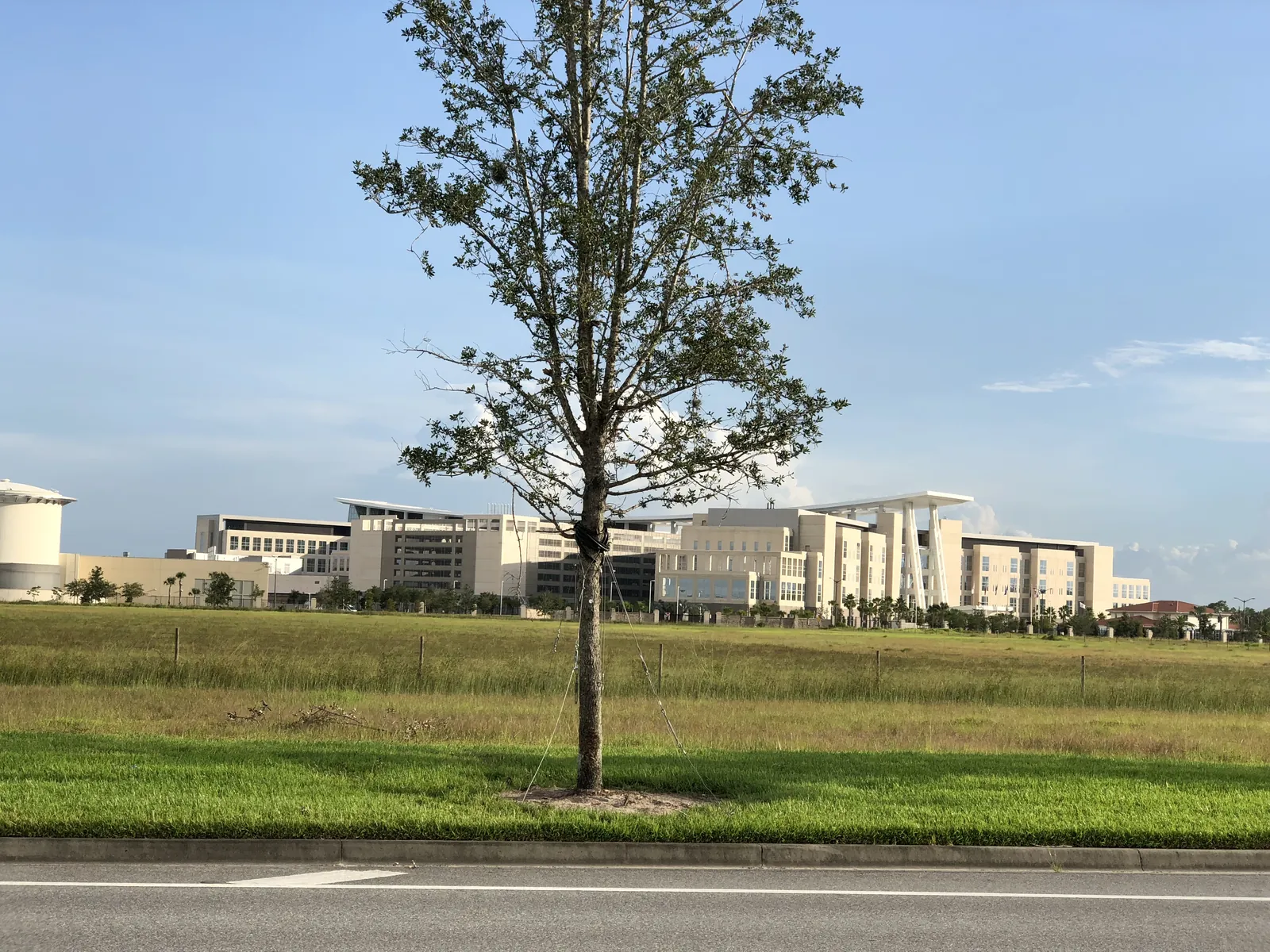
A large cream-colored hospital complex seen across an open green field, with a single young planted oak in the foreground and a white cylindrical water tank just visible at the far left.
The hospital that can’t go dark
The Orlando VA Medical Center at Lake Nona (modern photograph), seen across the open ground that used to be pasture. The white cylinder at the far left is the water tank of its own power plant. Photo by Jessica Feinleib, 2018; CC BY-SA 4.0.

A city built on a cow pasture

Not very long ago, this was cattle country. In 1996 the London-based Tavistock Group quietly bought up roughly 7,000 acres of old pasture and citrus land in southeast Orange County, a flat green nowhere between the airport and the county line. For years it mostly stayed that way: fence wire, scrub, cows, and power lines marching across an empty horizon toward somewhere more important.

A single dark cow standing behind a barbed-wire fence in a flat Florida pasture, with high-voltage transmission towers running along the distant horizon under a blue sky.
The grid got here first
Pasture on the edge of Lake Nona, December 2012 — a cow, a fence, and transmission towers already crossing the horizon where the development was spreading. Photo by “East Park,” 2012; CC BY 3.0.

What changed it was a medical school. In 2005 the University of Central Florida needed somewhere to put one, and Tavistock offered land — 50 acres and a cash gift to seed the fundraising. That single decision pulled in everything after it. Over the next few years a research institute, a children’s hospital, a veterans’ hospital and a cluster of health-science buildings all agreed to come, and a stretch of cow pasture started calling itself Medical City.

Longhorn cattle grazing in a rough pasture in the foreground while a vast unfinished hospital with open upper floors and a sweeping curved roof rises on the horizon behind them; a pale round tank stands at the right end of the construction site.
Cows out front, the future going up behind
Longhorn cattle on the last of the pasture while the Orlando VA Medical Center goes up behind them, early 2013. The pale round tank at right is the Central Energy Plant’s water store. Photo by “East Park,” 2013; CC BY 3.0.

For a while the two worlds overlapped on the same frame: longhorns grazing a weedy field in the foreground, and behind them a billion dollars of hospital rising out of the flatwoods. Then the fences came down, the cattle went somewhere else, and the city of the future had the ground to itself.

Medical City

The medical school opened its doors, and the rest followed close behind. Nemours built a 130-bed children’s hospital that opened in 2012, all glass and colored panels. UF Health put up a research center; the University of Central Florida’s own hospital arrived later, run jointly with HCA. The whole thing was master-planned on a clean sheet of paper — wide boulevards, buried utility lines, a town center, and the kind of promotional language (“innovation,” “wellness,” “the city of the future”) that gets printed on banners.

A wide, symmetrical cream-and-glass academic building with a central clock tower and a sweeping curved facade, fronted by a broad empty lawn.
Where it all started — 2010
The UCF College of Medicine, the building whose arrival turned the pasture into Medical City. Photographed in 2010, soon after it opened, by SlothMcCarty; CC BY-SA 3.0.

But under all the future-talk, Medical City had quietly signed up for a very old and very serious obligation. A research park can close for a hurricane and reopen Monday. A hospital cannot. The moment you put operating rooms, intensive-care units and children on ventilators onto a patch of Florida, you have promised something absolute: the power here is never, under any circumstances, allowed to stop.

A modern multi-story children's hospital of glass, metal louvers and warm orange panels behind a low monument sign reading 'Nemours Children's Health,' with palm trees and an American flag.
Nemours Children’s
Nemours Children’s Hospital, opened at Lake Nona in 2012 (modern photograph). Photo by Walter Lowe, 2021; CC BY-SA 4.0.

Florida, for its part, makes exactly one promise back, and keeps it reliably: sooner or later, a storm will come across the state and knock the lights out for days. The city of the future was built directly into that fact.

A bright red 'EMERGENCY' sign beside a Nemours Children's Health sign in front of the hospital, with an electrical equipment cabinet visible to the left.
The one door that can never close
The emergency entrance at Nemours (modern photograph) — the kind of door, and the kind of care behind it, that a Florida outage is never allowed to reach. Photo by Nemours Children’s Hospital, Florida, 2021; CC BY-SA 2.0.

The hospital that opened three years late

The clearest sign of how hard that promise is to keep came from the veterans’ hospital. The government broke ground on the Orlando VA Medical Center in 2009 and said it would open in 2012. It did not. It opened in May 2015 — years behind schedule and tens of millions of dollars over budget, after a public feud between the VA and its contractor that landed in congressional hearings. It was one of the first entirely new VA hospitals the country had built from the ground up in decades, and it became a national case study in how badly a big build can go.

And yet one piece of that troubled project was finished early, quietly, and almost perfectly — and it’s the piece this whole story turns on. Before the hospital itself was anywhere near ready to open, its power plant was already built, tested, and waiting.

The building with no windows

They call it the Central Energy Plant. It was finished in 2012, a long low box of tilt-up concrete and structural steel, built behind a wall and designed to meet a “mission-critical blast rating” — the kind of standard you apply to a building you cannot afford to lose. It cost about $42 million, and its entire job is to keep the hospital campus running when everything outside it fails.

An aerial view of a long, nearly windowless tan industrial building inside a walled compound, with a row of large cooling-tower fans along one side and a tall pale cylindrical water tank, the hospital complex rising in the background.
The plant that never sleeps
The Central Energy Plant at the Orlando VA Medical Center, photographed during construction by its builder — the windowless plant, its cooling towers, and the two-million-gallon water tank, with the hospital rising behind. Photo: Gulf Building LLC (project record).

What’s inside reads like a list written by someone who has decided never to be caught off guard. Eight emergency generators, together able to produce about 20,000 kilowatts — enough electricity for a small town. Five big chillers to make the cold water that air-conditions the hospital, because in Florida losing the air conditioning in an ICU is itself a medical emergency. Three industrial boilers for steam. A two-million-gallon tank of water. And, buried in the ground, a 208,000-gallon reservoir of diesel fuel.

Put plainly: this one building can make its own electricity, its own cooling, its own steam, and hold its own water and fuel — enough to run a two-million-square-foot hospital for days with nothing at all coming in from the outside world. No grid, no water main, no fuel truck. It won a national construction award in 2013, which is a strange thing to celebrate about a building most people will never see — but then, the whole point of it is to be unnoticed.

The most futuristic thing in the city of the future turned out to be a windowless concrete box full of diesel — built because Florida always, eventually, turns off the lights.

Back on the ordinary grid

Here is where the story quietly turns on itself. All that armor — the blast wall, the eight generators, the quarter-million gallons of fuel — wraps around the hospitals. It stops at the property line. The homes of Lake Nona, the Laureate Park bungalows and the gated streets with their brick pillars and wrought-iron crests, draw their power the same way every other Orlando neighborhood does: from the regional grid, one utility, one set of lines.

A gated residential entrance with two brick pillars, a decorative wrought-iron gate bearing a gold crest, holiday wreaths, and palm trees over a paver driveway leading into a Lake Nona neighborhood.
Same grid as everyone else
The gated entrance to a Lake Nona neighborhood (modern photograph) — the houses behind it ride the ordinary utility grid, armor or no armor next door. Photo by “East Park,” 2012; CC BY 3.0.

The lines here are newer, and buried, which helps. But buried lines still feed from poles, transformers and substations out in the open weather, and Central Florida is hurricane country. When Charley, Frances and Jeanne crossed the state in 2004, when Irma came through in 2017, when Milton raked Orlando in 2024, the power went out across the whole region — and the houses of the city of the future sat in the dark with everyone else.

At dusk, a lineworker stands in the raised bucket of an out-of-state utility truck beside a power pole and overhead wires, restoring electric service after a storm.
After the storm
Out-of-state mutual-aid crews restoring power in Florida after the 2004 hurricane season (regional image — not Lake Nona). Photo by Jocelyn Augustino / FEMA, September 2004; public domain.

So the two halves of Lake Nona answer the same Florida question in completely different registers. The hospitals answer it with a bunker, eight generators and days of buried fuel. The neighborhoods answer it with a flashlight and a cooler of melting ice — unless a homeowner has gone and installed, on a pad beside the house, a much smaller version of the very thing humming behind that blast wall.

A tan enclosed diesel standby generator mounted on a black fuel-tank base on a concrete pad beside a lawn and trees.
The same idea, house-sized
A commercial standby generator of the kind that makes power on site when the grid drops (representative image — not the VA plant’s own equipment). Photo by Gregsedits, 2011; CC BY-SA 3.0.

Stand on one of those streets the next time a storm knocks the power out and the whole “city of the future” goes as dark as any subdivision. A mile away, behind its wall, the plant will be running — eight generators, a tank of water, a reservoir of fuel, keeping the hospitals lit without so much as a flicker. The future, it turns out, isn’t the glass and the banners. It’s the windowless box that assumed the lights would fail, and made sure that for the people who couldn’t afford the dark, they never would.

A present-day note · GENERasic

The hospital’s answer to a Florida outage fills a whole building. A house’s answer fits beside the air conditioner.

That blast-walled plant is the industrial extreme of a simple idea: make your own power on site, so that when the line from the street goes dead, what matters stays on. For a single home it isn’t eight generators and a buried fuel farm — it’s one standby generator, wired to start itself the moment the grid drops, whether you’re home or not.

In a Florida outage, what it’s really protecting is worth being plain about:

Which of those actually apply to your address — your medical needs, how your house is fed, well or city water — is worth pinning down for your own home rather than guessing. That part is yours to check.

And in a Lake Nona neighborhood, with its gates and its HOA, a generator has to be sited and screened to the street’s standard, not just dropped on a pad — worth building into the plan from the start.

You can get an address-specific installed price for standby power — the whole turnkey number, not a callback and a maybe — in one sitting.

Get your installed price for this address→
Sources & Photo Credits

On the history

Photographs

  1. Orlando VA Medical Center across the field (hero) — modern photograph by Jessica Feinleib, 2018; CC BY-SA 4.0, via Wikimedia Commons. File: orlando-va-medical-center-2018. Commons
  2. Cow and transmission towers, Lake Nona pasture — December 2012, by “East Park”; CC BY 3.0, via Wikimedia Commons (panoramio). File: lake-nona-cow-pasture-2012. Commons
  3. Longhorn cattle with the VA Medical Center under construction — early 2013, by “East Park”; CC BY 3.0, via Wikimedia Commons (panoramio). File: orlando-va-hospital-construction-2013. Commons
  4. UCF College of Medicine, Lake Nona — 2010, by SlothMcCarty; CC BY-SA 3.0, via Wikimedia Commons. File: ucf-college-of-medicine-2010. Commons
  5. Nemours Children’s Hospital, Florida — modern photograph by Walter Lowe, 2021; CC BY-SA 4.0, via Wikimedia Commons. File: nemours-childrens-hospital-2021. Commons
  6. Nemours Children’s emergency entrance — modern photograph by Nemours Children’s Hospital, Florida, 2021; CC BY-SA 2.0, via Wikimedia Commons. File: nemours-emergency-entrance-2021. Commons
  7. Central Energy Plant under construction (the windowless plant, cooling towers and water tank) — project record photograph by Gulf Building LLC, the plant’s builder. File: va-central-energy-plant-exterior. gulfbuilding.com
  8. Gated Lake Nona neighborhood entrance — December 2012, by “East Park”; CC BY 3.0, via Wikimedia Commons (panoramio). File: lake-nona-gated-homes-2012. Commons
  9. Utility crews restoring Florida power after the 2004 hurricanes (regional — not Lake Nona) — by Jocelyn Augustino / FEMA, September 20, 2004; public domain, via Wikimedia Commons. File: florida-2004-hurricane-power-restoration. Commons
  10. Commercial diesel standby generator (representative — not the VA plant’s equipment) — a 200 kW Olympian/Caterpillar standby set, by Gregsedits, 2011; CC BY-SA 3.0, via Wikimedia Commons. File: standby-generator-set-representative. Commons

Modern photographs are identified as modern; the 2004 storm-restoration photograph and the standby-generator photograph are clearly labeled as regional/representative and are not Lake Nona equipment. Original downloads and a full research record are kept alongside this page in assets/images/originals/ and source-record.md. No image’s factual content was altered — the frames and handwritten notes are CSS added around the photographs, never onto them. Any owner who wants an image removed need only ask.