Laureate Park, Lake Nona, Orlando, Florida  ·  A Local History

The Neighborhood That Measured Everything It Couldn’t Control


Laureate Park was drawn on a clean sheet of paper next to Orlando’s Medical City and built to control every watt a house uses, a fifth less energy per home, solar offered on the roofs, a townhouse wired as a working laboratory for the future of the home. It mastered how a house spends electricity. It never got a vote on whether the power arrives.

On an ordinary block in Laureate Park, behind a door that matches every other door on the street, is a house that doesn’t quite work like a house. Companies bring their not-yet-finished ideas here and switch them on: windows that tint themselves, kitchen lights tuned to kill germs on the countertop, a mirror that reads your vital signs while you brush your teeth. It even has a name that sounds like a lab notebook, because it is one. WHIT, the Wellness Home built on Innovation and Technology, and people actually live in it while the future is tested around them.

That townhouse is the whole idea of Laureate Park in miniature. This is a neighborhood built on the belief that a home is a thing you can keep improving: measure it, wire it, tune it, make it a little better every year. For more than a decade it has been proving that belief right, with one stubborn exception no amount of engineering has touched.
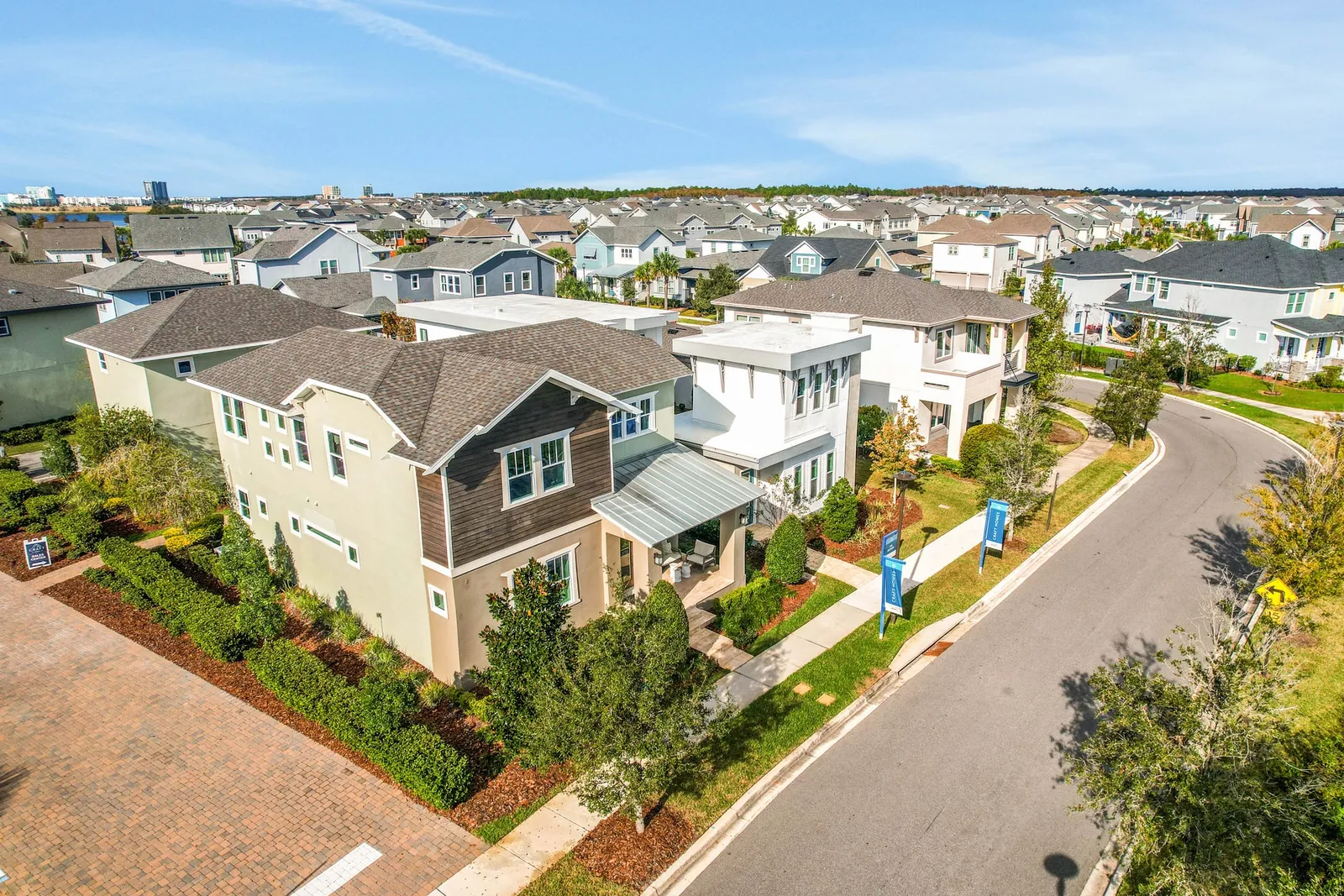
A drone view down a Laureate Park street of new two-story homes with deep front porches and paver driveways, lined with young trees and sidewalks, with no utility poles or overhead wires anywhere in the frame.
Laureate Park, built new, 2012
A Laureate Park street from above (modern photograph), porches, paver drives, and a detail that’s easy to miss: no poles, no wires. The power here runs underground. Photo: Craft Homes.

A neighborhood drawn on a clean sheet

Not long ago there was nothing here to improve. This corner of southeast Orange County was pasture and scrub on the edge of Lake Nona, the seventeen-square-mile community the London-based Tavistock Group has been building out of old ranch land since the 1990s. Then the hospitals of Medical City went up next door, and the empty fields around them became the most planned ground in Central Florida.

Laureate Park was announced in May 2012 as a brand-new neighborhood of roughly 2,700 homes, laid out all at once beside that medical campus, streets, parks, utilities and house lots drawn together on a single master plan. There was no old neighborhood to work around. Everything could be decided on purpose.

An aerial view of the Laureate Park neighborhood: rows of new homes with grey and white roofs set along curving streets around a landscaped stormwater pond.
Drawn all at once
Laureate Park from the air (modern photograph), a whole neighborhood platted at one time next to Medical City, down to the ponds and the street grid. Photo: Craft Homes.

And what the planners decided, first, was that these houses would be measured.

Engineered down to the watt

From its very first phase, Laureate Park was sold on efficiency. Tavistock paired General Electric’s “ecomagination” program with Masco’s Environments For Living, and promised that every home would use at least twenty percent less energy, water and emissions than a standard new house, tighter construction, better insulation and air sealing, high-efficiency equipment, the kind of things a buyer never sees but a power bill does.

A two-story Laureate Park home at dusk with a double front porch, warm interior lights glowing in every window, framed by palms and tropical planting.
Every watt accounted for
A Laureate Park home at dusk (modern photograph), the houses were built to a measured energy standard from the first phase onward. Photo: ICI Homes, via Lake Nona.

“Our collaboration with GE brings a global perspective to Lake Nona that is helping us achieve a level of efficiency unmatched in the region.”. Jim Zboril, president of Lake Nona, 2012

On many of the roofs, the idea went one step further: solar was offered as an option, so a house could make a share of its own daytime power on the shingles above the porch. The whole pitch was mastery of electricity at the scale of a single family, spend less of it, and make some of it yourself.

Black solar panels mounted in neat rows across a residential asphalt-shingle roof, with green trees behind.
Sun on the roof
Rooftop solar of the kind offered on Laureate Park homes (representative photograph, not a specific Laureate Park house). Daytime generation trims the bill; by itself it does not keep a dark house running at night.

Look up, there are no wires

Walk one of these streets and something is quietly absent overhead. No poles. No wires sagging from house to house. The electric lines in Laureate Park are buried, run under the ground with everything else the neighborhood would rather you not see.

Beside those buried power lines runs something rarer: fiber. Lake Nona wired itself for gigabit internet early, before most of the country had heard the word, and today advertises more than forty thousand miles of fiber cable and a strand to every lot, the first gigabit community in Florida, by its own account. That’s what makes a house here able to behave like WHIT: measured, connected, always talking to something.

A quiet Laureate Park townhome street: attached three-story homes with balconies and front stoops, cars parked along a clean curb, and an open sky with no utility poles or overhead lines.
Look up, no wires
A Laureate Park townhome street (modern photograph), the kind of ordinary-looking block where the WHIT research home sits in a row of townhouses. Nothing overhead; the lines are underground. Photo: Monta Consulting & Design (project portfolio).

Inside the WHIT house, that connection gets strange and specific. Fred Maxik, the LED pioneer behind Lighting Science Group, who holds hundreds of lighting patents, fitted it with lights you don’t just switch on: kitchen LEDs tuned to disinfect the countertop, lighting meant to steady your sleep. Companies have tested self-tinting windows and drone deliveries against its walls. It is a house trying to anticipate every variable of how you live.

An aerial view of Lake Nona Town Center near Laureate Park: low modern commercial buildings, parking, and new construction spreading across flat Central Florida land toward the horizon.
The living lab
Lake Nona Town Center, beside Laureate Park (modern photograph), the hub of a community that markets itself as a “living lab” for the future of how people live. Photo by “East Park,” via Wikimedia Commons; CC BY 3.0.

The one variable left out

Here is the exception that all of it runs into. Efficiency is about how much power a house spends. Solar is about how much it can make at noon. Fiber is about how much it knows. None of those three has anything to do with whether the power actually arrives, and in Florida, sooner or later, it doesn’t.

Laureate Park’s electricity comes from the Orlando Utilities Commission, which is about as good as this gets. In 2024 OUC billed itself as Florida’s most reliable electric utility, and the numbers behind the slogan are real: more than three thousand miles of line across its territory, two-thirds of it already underground, hardened pole by pole against the weather.

An Orlando Utilities Commission lineworker in a hard hat and safety harness, reaching from a bucket to work on an overhead transformer and crossarm against a blue sky.
The one everybody shares
An OUC lineworker on the system that feeds Laureate Park (modern photograph). The utility calls itself Florida’s most reliable, and it still can’t promise the lights. Photo: Orlando Utilities Commission.

And still, on a single night in October 2024, Hurricane Milton crossed the state and knocked out about 89,000 OUC homes at once. Crews had almost everyone back within three days, a genuinely fast recovery, but for those three days the most reliable utility in Florida could not keep the power on. The buried lines helped. They did not win. A line can run underground for miles and still feed from a substation, a transformer, a pole standing out in the open where a live oak can land on it.

A large live oak draped in Spanish moss snapped and fallen across a residential street after Hurricane Milton, dragging down the overhead power lines, as two utility workers in high-visibility vests assess the damage.
Milton. October 2024
A fallen oak and downed lines in the Orlando area after Hurricane Milton, October 2024, the canopy trees that shade Central Florida streets are the same trees that take the wires with them. Photo: Orlando Sentinel.

This is the part no master plan edits out. The storms come on their own schedule. Charley in 2004, Irma in 2017, Milton in 2024, and when they do, the whole region goes dark together: the 1950s bungalows and the brand-new, measured, fiber-wired houses of the city of the future, all of them waiting on the same crews in the same buckets.

At dusk, a lineworker stands in the raised bucket of an out-of-state utility truck beside a power pole and overhead wires, restoring electric service after a Florida storm.
After the storm
Mutual-aid crews restoring Florida power after the 2004 hurricane season (regional image, not Lake Nona). Photo by Jocelyn Augustino / FEMA, September 2004; public domain.

A neighborhood that mastered how a house spends electricity never got a vote on whether it arrives.

What the measuring couldn’t reach

So go back to that townhouse on the ordinary block, the one with the self-tinting windows and the lights that clean a countertop. When Milton came through, it went as dark as the oldest house in Orlando. Every clever thing inside it depends on a current from the street, and the street is the one line in the whole neighborhood the planners couldn’t redraw.

The only houses on these streets that stayed lit were the ones with a small engine humming on a pad beside the air conditioner, a standby generator, wired to start itself the second the grid drops. It is, in the end, the least futuristic object in the city of the future: no app, no fiber, no sensor. Just a machine that assumes the lights will fail, and makes its own when they do.

A tan enclosed standby generator on a concrete pad beside a lawn and trees, the kind installed next to a house to make power when the grid goes down.
The house-sized answer
A home standby generator of the kind that makes power on site when the grid drops (representative photograph, not a specific Laureate Park installation). Photo by Gregsedits, 2011; CC BY-SA 3.0.

That’s the quiet lesson of the most engineered neighborhood in Central Florida. It learned to shave a fifth off its bills, to catch the sun, to wrap every house in fiber and sensors and good intentions. What it never managed to measure or wire or tune was the wind, and on the streets of Laureate Park, the wind still decides when the lights go out.

A present-day note · GENERasic

Efficiency and solar decide your bill. A standby generator decides whether the lights stay on.

Laureate Park got the demand side right, tighter houses, panels on the roof, a smaller power bill. All of it is about how much electricity a home uses. None of it answers the Florida outage, because an outage isn’t about use. It’s about supply, and a storm takes supply from the whole street at once.

A standby generator is the one piece that answers that question. It wires into the house and starts itself the moment the grid drops, whether you’re home or not, and in a Florida outage, what it’s protecting is worth being plain about:

Which of those actually apply to your address, your medical needs, whether your solar can island, how your house is fed, is worth pinning down for your own home rather than guessing. That part is yours to check.

And in a Laureate Park with its HOA, a generator has to be sited and screened to the neighborhood’s standard, not just dropped on a pad, worth building into the plan from the start.

You can get an address-specific installed price for standby power, the whole turnkey number, not a callback and a maybe, in one sitting.

Get your installed price for this address→
Sources & Photo Credits

On the history

Photographs

  1. Laureate Park street from above (hero), modern photograph, Craft Homes (builder marketing imagery of Laureate Park, Lake Nona). File: laureate-park-streetscape. Source: media.crafthomes.com.
  2. Laureate Park neighborhood aerial, modern photograph, Craft Homes. File: lake-nona-neighborhood-aerial. Source: media.crafthomes.com.
  3. Laureate Park home at dusk, modern photograph, ICI Homes, via Lake Nona (lakenona.com). File: laureate-park-home-dusk.
  4. Residential rooftop solar (representative, not a specific Laureate Park house), modern photograph via a solar/roofing source. File: residential-rooftop-solar-representative.
  5. Laureate Park townhome street, modern photograph, Monta Consulting & Design (Laureate Park at Lake Nona townhomes, project portfolio). File: laureate-park-townhome-street.
  6. Lake Nona Town Center aerial, modern photograph by “East Park”; CC BY 3.0, via Wikimedia Commons (panoramio). File: lake-nona-town-center-aerial. Commons
  7. OUC lineworker, modern photograph, Orlando Utilities Commission (ouc.com). File: ouc-lineworker-transformer.
  8. Fallen oak and downed lines after Hurricane Milton, Orlando area, October 2024, news photograph, Orlando Sentinel. File: florida-storm-fallen-tree.
  9. Mutual-aid crews restoring Florida power after the 2004 hurricanes (regional, not Lake Nona), by Jocelyn Augustino / FEMA, September 20, 2004; public domain, via Wikimedia Commons. File: florida-2004-hurricane-power-restoration. Commons
  10. Home standby generator (representative, not a Laureate Park installation), by Gregsedits, 2011; CC BY-SA 3.0, via Wikimedia Commons. File: standby-generator-set-representative. Commons

Modern photographs are identified as modern; the solar roof, the 2004 storm-restoration photograph and the standby generator are clearly labeled as representative/regional and are not specific Laureate Park equipment. Original downloads and a full research record are kept alongside this page in assets/images/originals/ and source-record.md. No image’s factual content was altered, the frames and handwritten notes are CSS added around the photographs, never onto them. Any owner who wants an image removed need only ask.