Longwood, Florida  ·  A Local History

The Man Who Brought Boston to the Pines


A Union veteran from Boston named his town before it existed, floated a railroad on Boston money, and built a winter hotel for “tourists and invalids” — then the one Florida winter he never planned for took it all back.

In 1973 a three-story Victorian house went down a Central Florida road on the back of a trailer, leaning and half-condemned, with a hand-lettered sign nailed across its porch: “HELP! We’ve gone about as far as we can go … more funds needed to pay for moving this historic house.” A town was dragging a dying mansion out of the path of a bulldozer and had run out of money somewhere in the middle of the trip. To understand why anyone would do that — why a small place would beg strangers for cash to rescue an old house most of them had never lived in — you have to go back ninety years, to a man from Boston who tried to move a piece of New England into the Florida pines.
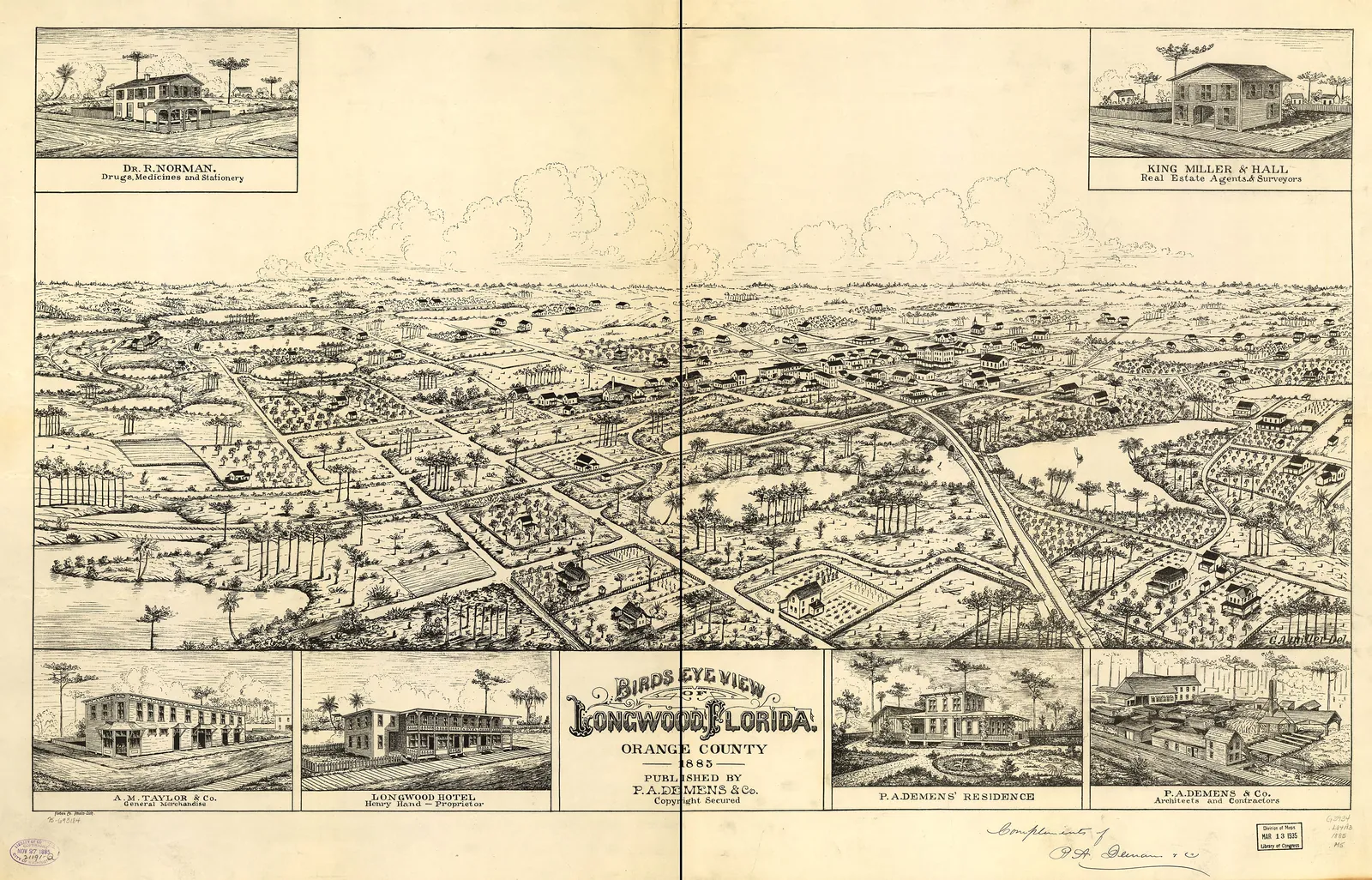
An 1885 bird's-eye-view lithograph of Longwood, Florida: a grid of dirt streets and scattered frame buildings among pine woods and lakes, ringed by inset drawings of the town's stores, hotel, and residences.
Longwood as Henck drew it up — 1885
“Bird’s Eye View of Longwood, Florida,” 1885. The town one Boston man willed into the pinewoods, published by P. A. Demens & Co. — a Longwood contractor who would soon build his own railroad to the Gulf and name the town at the end of it St. Petersburg. The vignettes ring the real businesses of the moment, the original Longwood Hotel among them. Drawn by G. A. Miller; Library of Congress.

A town named before it existed

Edward Warren Henck stepped off a steamboat at Mellonville — now Sanford — in November 1872, a Union Army veteran out of Boston. He walked south into the flatwoods, claimed a homestead beside a lake, and lived in a tent with his wife, Mary, while he built a house.

Then he did the strange thing. He decided the empty scrub around him ought to be a town, and he named it before there was anything to name. He called it Longwood, after a leafy suburb of Boston where he had worked as a young engineer.

A low, pavilion-fronted colonial house behind a blue picket fence and a bank of wildflowers, with a French tricolor flag flying beside it, under a wide sky.
Where the name came from — St. Helena
Longwood House, St. Helena (modern photograph). By local telling, Boston’s Longwood took its own name from this house in the South Atlantic — where Napoleon lived out his exile and died. If the story holds, a Florida town in the pinewoods carries, at two removes, the name of an emperor’s prison. Photograph by Michel Dancoisne-Martineau, via Wikimedia Commons.

And there’s a longer thread hanging off that name. By the local account, the Boston neighborhood had itself borrowed “Longwood” from the house on St. Helena where Napoleon was held after Waterloo. Whether or not the chain is exact, Henck clearly wasn’t trying to sound like Florida. He was trying to sound like home.

He became Longwood’s first postmaster in 1876. When the place finally incorporated as a town in 1883, the voters made him its first mayor. But a town needs a reason for people to arrive, and by then Henck had already built one.

The railroad, floated on Boston money

In 1879 Henck and two partners incorporated the South Florida Railroad and raised the money for it the way a Boston man would — by floating the bonds in Boston. He was its president. Construction started that fall: a narrow-gauge line pushing south through the palmettos.

A single-track railroad line running straight away through a green Florida right-of-way lined with trees and power poles, on a bright day.
The line he built — still running
The old South Florida Railroad right-of-way through Longwood today (modern photograph). Henck’s narrow-gauge line of 1880 was later widened, sold into Henry Plant’s system, and absorbed into the big railroads; a commuter train still runs the route. Photograph by Ebyabe, via Wikimedia Commons.

The first train covered the twenty-three miles from Sanford to Orlando in the fall of 1880, and daily service began that November. Longwood was no longer a clearing in the woods. It was a stop, and the stop had a schedule.

Henck wasn’t the only Northerner betting on the place. One of the men building and promoting it was Peter Demens, a Russian émigré who ran a Longwood contracting firm and published the very bird’s-eye view at the top of this page. A few years later Demens would push his own railroad to the Gulf coast and hand the town at the end of the line its name: St. Petersburg.

A hotel for “tourists and invalids”

What Henck really wanted off those trains was tourists — the wealthy Northerners who wintered in Florida to escape the cold and, the advertising of the day promised, to get their health back. So he built something for the train to slow down in front of.

He hired a builder named Josiah Clouser in 1883 to put up a big frame hotel. A man named Carlos Cushing bought it, finished it in 1886, and named it the Waltham — after yet another slice of Boston. Three stories of porches and gables, meant to be the first thing a passenger saw.

A large three-story cream-and-maroon wooden hotel with wraparound porches on two levels, shaded by palms and live oaks, fronted by a clipped hedge and lawn.
Henck’s hotel — the Waltham, 1886
The Longwood Hotel — now the Longwood Village Inn (modern photograph), the three-story frame hotel begun for Henck in 1883. Henck’s own 1887 flyer advertised it to “tourists and invalids” as a winter home. On the National Register since 1984, it is an office building today, across from the commuter-rail platform. Photograph by Ebyabe, via Wikimedia Commons.

It ran only in the cold months. Like other Florida resort hotels of the era, its managers paired it with a New England hotel that opened in summer — same guests, same staff, two climates, one business. The building kept nearly everything over the decades except a steady name: the Waltham, then the Longwood Hotel, then the St. George, then, briefly, the Orange and Black, then the Longwood Hotel again. It outlasted all of them, and the boom they were built for.

A Boston man tried to plant New England in the Florida scrub — the name, the railroad, a winter hotel for “tourists and invalids” — and then the one winter he was selling escape from took it all back.

The bet under everything

Under the hotel and the railroad and the imported Boston ambition sat the same thing that held up every depot town along the line: oranges. The groves were the reason the North was curious and the reason the trains had freight to haul. In a good year it was a fine bet.

A late-1800s stereoscopic card showing two men on tall ladders picking oranges into shoulder baskets beside a loaded mule cart, in front of a frame house.
The bet under everything
Picking oranges in a Florida grove, stereoscopic card, roughly 1870s–1880s (a representative view of the citrus country Longwood lived on, not Longwood itself). Robert N. Dennis collection of stereoscopic views, via Wikimedia Commons.

The trouble with a one-crop town is that the crop and the weather are the same gamble. Everything Henck had built — the depot, the resort, the Boston money — rested on the assumption that Florida would stay warm. For twenty years it mostly did.

The winter that sent him home

The weather came due in the winter of 1894–95, and it came twice. A hard freeze in late December. Then a deceptive warm spell that coaxed the trees into fresh growth — right before a second, killing freeze in early February.

Across Central Florida the groves went black. Florida had shipped about five million boxes of oranges the season before that winter; it would take nearly twenty years to ship that many again. People who had come down on Henck’s railroad to make a citrus fortune packed up and left.

And so did Henck. The man who had named the town and railroaded it and hoteled it into being pulled out after the freeze and went back to Boston — for the better part of twenty years. He returned in old age to boost the village again, but the resort-town dream was finished; the winter tourists and the citrus money never came back at the scale he had built for. He died in 1930, having outlived the Longwood he imagined by decades.

What a town decides to carry to safety

Here is where the house on the trailer comes back. The boom faded, but a scatter of the 1880s buildings held on — and in the 1970s a handful of residents decided the oldest of them were worth saving, even with the bulldozers closing in.

A black-and-white 1973 photograph of a large, weathered Victorian frame house jacked up onto a flatbed trailer on a road, with a hand-painted sign on its lower porch asking for donations to finish the move.
Rescued ahead of the bulldozer — 1973
The Bradlee-McIntyre House en route to Longwood, 1973. The sign reads: “HELP! We’ve gone about as far as we can go … more funds needed to pay for moving this historic house. Please send donations. P.O. Box 500, Longwood, Fla.” State Archives of Florida, Florida Memory.

In 1973 they moved two threatened houses out of neighboring Altamonte Springs and into Longwood. One was the Bradlee-McIntyre House — a Queen Anne winter home that a Boston architect, Nathaniel Bradlee, had built in the 1880s and barely lived to see finished. The fire department had planned to burn it for training practice; the town hauled it away instead, and ran short of cash halfway down the road.

A pale-green Queen Anne house with a wraparound porch, a corner bay topped by a steep gable, and the street number 130 over the front steps, shaded by oaks.
Saved, and still standing
The Bradlee-McIntyre House today (modern photograph), restored on its new Longwood lot and run as a museum. Nathaniel Bradlee designed it; he died in December 1888, soon after it was finished. Photograph by Ebyabe, via Wikimedia Commons.

The other was stranger — the Inside-Outside House, itself a piece of the North shipped south. It was a prefabricated house, among the earliest in the country by local accounts, built in New England, sent by steamship to Sanford, and hauled by wagon into the woods in 1873 — the same year Henck was staking out his town. Its name comes from how it was put together: the structural framing runs on the outside, the finish on the inside, a house built partly inside out.

A two-story frame house with two levels of porch, every post and railing covered in white latticework and open framing, now used as a shop with an 'Open' sign out front.
Shipped from the North, framing out
The Inside-Outside House today (modern photograph), moved to Longwood alongside the Bradlee-McIntyre House in 1973. Shipped prefabricated from New England to Sanford and hauled inland by wagon in 1873. Photograph by Ebyabe, via Wikimedia Commons.

Both houses still stand on their new lots, inside a few blocks of 1880s Longwood now protected as a historic district — some thirty-odd buildings, Henck’s three-story hotel among them, kept on the National Register.

A small white wood-frame Carpenter Gothic church with a steep gabled roof and a pointed-arch window, set among tall trees in the Longwood Historic District.
What the district kept
Christ Episcopal Church, in the Longwood Historic District (modern photograph) — one of the small 1880s buildings preserved in the few protected blocks of old Longwood. Photograph via Wikimedia Commons.

The town Henck built for winter tourists who mostly stopped coming grew into something he never drew up — a bedroom suburb of about fifteen thousand, wrapped around the interstate, with a commuter train still running down the line he laid. The strange thing about Longwood isn’t that a Boston man tried to build New England in the pinewoods and mostly failed. It’s that the pieces worth keeping turned out to be the ones somebody physically moved out of the way of the loss — a prefab house shipped a thousand miles, a condemned mansion dragged down the road ahead of a bulldozer with a tin cup nailed to its porch. Longwood survives in the things people decided, deliberately and ahead of time, to carry to safety.

A present-day note · GENERasic

Longwood’s founder bet everything on two things he couldn’t control — the weather, and whether the trains kept coming. A modern home runs on a faster version of the same bet.

One freeze erased the sure thing in 1895 and sent the man who built the town back to Boston. The lesson wasn’t “don’t grow oranges.” It was that when your whole life leans on one thing you can’t control, you’d better have something to fall back on — and the pieces that lasted here were the ones somebody moved to safety before the loss arrived.

A Longwood house today leans on electricity the way those groves leaned on the weather. Almost everything that keeps a modern Florida home livable — cooling, water, food, medical equipment — runs on power, and in a hurricane the grid is the first thing to go. That’s a when, not an if. No amount of building quality keeps the lights on when the line down the street is on the ground.

A standby generator is the unglamorous version of moving the house before the bulldozer: a fallback wired up ahead of time, that starts itself the moment the power drops, whether anyone’s home or not. In a Florida outage, here’s what it’s actually holding up:

An enclosed residential standby generator on a concrete pad beside a building, with trees behind it.
The fallback, wired before you need it
A residential standby generator (representative photograph, not Longwood equipment) — wired to start on its own the moment the grid drops. Via Wikimedia Commons.

Which of those actually apply to your address — your medical needs, how your house is fed, well or city water — is worth pinning down for your own home rather than guessing. That part is yours to check.

You can get an address-specific installed price for standby power — the whole turnkey number, not a callback and a maybe — in one sitting.

Get your installed price for this address→
Sources & Photo Credits

On the history

Note on the chosen lens and on uncertainties

This page was built with a “power resilience” lens for GENERasic. Longwood has no documented electricity or power history of its own, so the lens is carried in the present-day GENERasic note at the end rather than forced into the history; the historical through-line is Edward Henck’s attempt to transplant a New England resort town into the pinewoods, and the fragility of the one-crop, one-season bet that the 1894–95 freeze made concrete. Sources differ on a few points, flagged rather than smoothed over: the hotel’s exact completion (1885–1886) and room count (sources give roughly 30); the Inside-Outside House’s build date (c.1870 vs. 1873) and its “earliest prefab” status, which traces to local history and is not independently verified here; the Bradlee-McIntyre House’s construction span (c.1883–1888); and Longwood’s incorporation date, variously given as 1883 (as a town) and later as a city. The Napoleon/St. Helena origin of the name is given as the local telling, not as settled fact. The orange-grove stereoview and Napoleon’s Longwood House are labeled as representative and as St. Helena so they aren’t mistaken for Longwood.

Photographs

  1. “Bird’s Eye View of Longwood, Florida, Orange County,” 1885 (hero) — lithograph drawn by G. A. Miller, published by P. A. Demens & Co., Forbes Co. lith.; Library of Congress. File: longwood-birdseye-view-1885. loc.gov/item/75693184
  2. Longwood House, St. Helena (modern) — Napoleon’s place of exile, used to illustrate the local account of the town’s name; not Longwood, Florida. Photograph by Michel Dancoisne-Martineau (CC0), via Wikimedia Commons. File: napoleon-longwood-house-st-helena. Commons
  3. South Florida Railroad right-of-way, Longwood (modern) — the route Henck’s 1880 line followed; photograph by Ebyabe, via Wikimedia Commons (CC BY 2.5). File: longwood-railroad-tracks-today. Commons
  4. Longwood Hotel / Longwood Village Inn (modern) — the three-story frame hotel begun for Henck in 1883; on the National Register since 1984. Photograph by Ebyabe, via Wikimedia Commons (CC BY 2.5). File: longwood-hotel-village-inn-today. Commons
  5. Picking oranges in a Florida grove — stereoscopic card, roughly 1870s–1880s, a representative view of Florida citrus work (not Longwood). Robert N. Dennis collection of stereoscopic views, via Wikimedia Commons (public domain). File: florida-orange-grove-stereoview-circa-1880s. Commons
  6. Bradlee-McIntyre House en route to Longwood, 1973 — the house on a trailer with the donation plea nailed to its porch. State Archives of Florida, Florida Memory (call no. AHS0104; no known restrictions), via Wikimedia Commons. File: bradlee-mcintyre-house-en-route-1973. Commons
  7. Bradlee-McIntyre House today (modern) — 130 W. Warren Avenue, restored and run as a museum. Photograph by Ebyabe, via Wikimedia Commons (CC BY 2.5). File: bradlee-mcintyre-house-today. Commons
  8. Inside-Outside House today (modern) — the prefabricated house with exposed exterior framing, moved to Longwood in 1973. Photograph by Ebyabe, via Wikimedia Commons (CC BY 2.5). File: inside-outside-house-today. Commons
  9. Christ Episcopal Church, Longwood Historic District (modern) — a small 1880s-era building in the preserved district. Via Wikimedia Commons (CC BY-SA 3.0). File: christ-church-longwood-historic-district. Commons
  10. Standby generator (representative — not Longwood equipment) — an enclosed residential standby generator on a pad. Via Wikimedia Commons. File: standby-generator-set-representative.

The 1885 bird’s-eye view and the 1973 move photograph are archival; the hotel, houses, church, and railroad right-of-way are modern photographs of the real Longwood subjects; the orange grove and Napoleon’s Longwood House are representative and labeled as such. No image’s factual content was altered — the frames and handwritten notes are CSS added around the photographs, never onto them. Original downloads and a full research record are kept alongside this page in assets/images/originals/ and source-record.md. Any owner who wants an image removed need only ask.