Maitland, Florida  ·  A Local History

The War Artist Who Carved a Lost City Into Maitland


He had lost a leg to the First World War and his eyes were failing. So Jules André Smith left the center of the American art world, came to a frost-emptied Florida citrus town, and spent the rest of his life hand-casting a Mayan fantasy out of concrete — the one piece of old Maitland still standing.

Drive the right quiet street in Maitland, a few miles north of Orlando, and you pass something that has no business being in Florida at all. White stucco walls step up into a Mayan skyline. The doorways are framed in carved stone faces — suns, birds, a monkey god or two — and there are more than two thousand of them, no two the same. It looks like a fragment of a lost city, or a very good movie set. It is neither. One middle-aged man built it by hand, and he did it after the century had already done its worst to him.
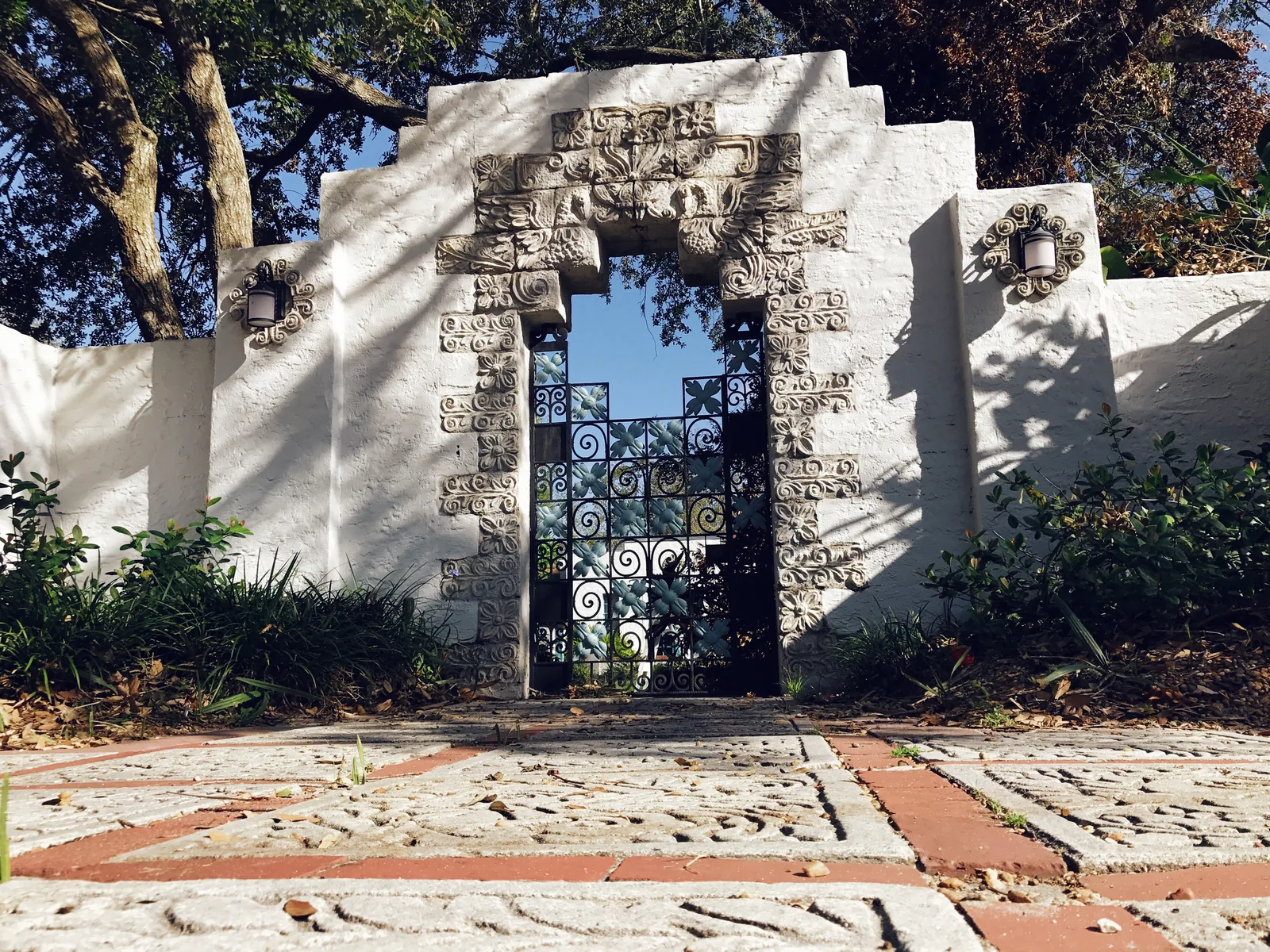
A white stucco gateway built in a stepped, Mayan-temple shape, its arched opening framed by densely carved concrete reliefs and closed by a decorative metal gate, seen from a brick path looking up.
The temple that isn’t a temple — the old Research Studio gate
The entrance to the Research Studio, now the Maitland Art Center (modern photograph). The stepped parapet, the carved surround and the gate are all poured concrete, shaped by one man in the 1930s. Photograph via Wikimedia Commons.

A town the frost nearly erased

Maitland started as a gun. In 1838, during the Second Seminole War, the U.S. Army put a small log fort on the shore of a lake here and named it for Captain William Seton Maitland, an officer who had fought in the war and died soon after. The fort lasted barely a year. The name stuck to the lake, and then to the settlement that grew up around it after the Civil War, when Northerners came down to plant orange groves and a railroad finally reached the place in 1880.

Then the thing that haunts every Central Florida citrus town happened. The Great Freeze of 1894–95 killed the groves to the ground over two brutal winters, and a lot of people who had bet everything on oranges simply left. Maitland did not vanish, but it shrank back into a small, shaded, half-forgotten place between the bigger ambitions of Orlando and Winter Park. That is the town — quiet, a little faded, nobody’s idea of an art capital — that a famous man chose, on purpose, in the depths of the Depression.

The man who had seen too much

A black-and-white 1919 studio portrait of a middle-aged U.S. Army captain in an overseas cap and Sam Browne belt, looking tired and directly at the camera.
Capt. J. André Smith, official war artist — France, 1919
Captain Jules André Smith in uniform as an official artist of the American Expeditionary Forces, photographed at Vincennes, France, early 1919. U.S. Army Signal Corps photograph, via the National Archives & Wikimedia Commons.

Jules André Smith was born in Hong Kong in 1880 to American parents, trained as an architect at Cornell, and then walked away from architecture to become an artist. He was a very good one — an etcher who won the gold medal for etching at the 1915 world’s fair in San Francisco. He had the kind of career that keeps a man in New York.

The war took him instead. In 1917 Smith put on a uniform, and in 1918 he became one of eight official artists the Army sent to France to record the American Expeditionary Forces — the senior man of the group, the only one with real military training. He drew the front from inside it.

A detailed pen-and-ink drawing of a soldier seated at a cluttered desk inside a dim French farmhouse, papers spread before him and gear hung on the wall behind.
His own war — a regimental command post near Belleau Wood, June 1918
“Regimental Headquarters near Belleau Woods, France,” a drawing by Captain J. André Smith, 1918 — the farmhouse known as Maison Blanche, where a Marine colonel had set up his command post the day Smith came through. Via the National Archives & Wikimedia Commons.

He came home decorated and, in a quiet way, famous. He is credited with designing the Distinguished Service Cross, the Army’s second-highest award for valor — an architect’s eye applied to a medal. He published a book of about a hundred of his field sketches. And he carried something else home with him.

A bronze cross-shaped military medal with an eagle at its center and the words 'For Valor,' hanging from a red, white and blue ribbon on red felt.
The medal he is credited with designing
The Distinguished Service Cross. Smith, an architect by training, is credited with designing the Army’s second-highest award for valor. Representative photograph of the medal, not Smith’s own drawing. Via Wikimedia Commons.

During officer training at Plattsburg he had cut his leg on barbed wire. The wound never healed. In 1924 the right leg was amputated, and he lived the rest of his life in constant pain. By the mid-1930s a second door was closing: his eyesight had failed too far for the fine, patient lines that etching demands. A man who made his living with his eyes and his legs had, in the span of a decade, badly lost the use of both.

He could not etch anymore and he could barely walk. So he went looking for something he could still make — something bigger than a sheet of paper, that he could build slowly, with his hands, in the sun.

Six acres and a patron

He found the sun in Central Florida. Smith first came down in 1930 looking for a winter studio, found nothing he liked, and ended up renting a house in Winter Park. What turned a winter escape into a life’s work was money — specifically the money of Mary Louise Curtis Bok, the Philadelphia publishing heiress who had already built the Singing Tower gardens near Lake Wales and founded the Curtis Institute of Music. She agreed to buy six acres on the edge of Lake Maitland and pay for the first stage of building. In 1937, Smith started pouring concrete.

A sepia studio portrait of a woman in a 1920s cloche hat, fur stole and pearl necklace, looking calmly to one side.
Mary Louise Curtis Bok — she paid for it
Mary Louise Curtis Bok, the Philadelphia publishing heiress who financed the Research Studio. She had already given Florida the Singing Tower at Lake Wales and Philadelphia its tuition-free Curtis Institute of Music. Portrait via Wikimedia Commons; the archive’s date is uncertain (circa the 1920s).

He called it the Research Studio, and he meant the word. It was not a gallery and not a home — it was a working winter colony where invited artists could come and experiment, away from the market and the critics. Over the years the guest list got serious: the painter Milton Avery worked here, so did Ralston Crawford and the photographer Consuelo Kanaga. But the real artwork was the place itself.

What he built out of nothing but cement

What Smith built, across the years that followed, was a compound of fourteen low buildings in stucco and concrete block, laid out around courtyards and a reflecting pool, in a style the building survey file calls Aztec-Mayan — the kind of thing that was rare anywhere in the Southeast and is unique in Central Florida. He did not import it. He invented it, surface by surface.

A row of low white stucco buildings with stepped rooflines and carved stone trim, fronted by palms and a brick street, with a stylized monogram above one doorway.
Six acres of a sleepy lake town, turned into this
The Research Studio from the street (modern photograph) — white Mayan-Revival buildings behind a carved wall, the artist’s own monogram above the gallery door. Photograph via Wikimedia Commons.

The reliefs are the heart of it. More than 2,500 of them — suns and serpents, birds, faces, leaves — were carved and cast in concrete, most of them by Smith and a family friend named Ralph Ponder, doing the work themselves. For a half-blind man with one leg, this was not decoration. It was the whole point: a way of making art the size of a building when he could no longer make it the size of a page.

A cross-shaped cluster of square concrete relief tiles set into a white stucco wall, each carved with suns, birds and leaves, with palm-frond shadows falling across them.
More than 2,500 of these, cast by hand
Cast-concrete reliefs on an exterior wall (modern photograph) — a central sun-face ringed by birds and foliage, in the Mayan-and-Aztec vocabulary Smith invented for the place. Photograph via Wikimedia Commons.
A life-size concrete relief of a robed angel with a bobbed haircut and folded hands, standing against an ornate pierced-concrete screen of flowers and diamonds, under a mossy oak.
An angel against a pierced screen, in the chapel garden
A carved concrete angel beside a pierced garden screen (modern photograph) in the Mayan courtyard. Smith and Ralph Ponder did much of the carving with their own hands. Photograph via Wikimedia Commons.

He built a chapel into it, and a garden chapel courtyard, and a lily pond with a statue standing at its head — the kind of quiet, shaded, slightly unreal place that makes more sense the longer you stand in it. Guests painted in the mornings and argued about art in the evenings. Smith lived on the grounds and kept working until he died there, at the studio, in 1959.

A rectangular lily pond covered in pads and white blossoms, a carved female statue on a plinth at its head, a pink flowering tree and low white buildings behind.
The colony its guests actually came for
The Mayan courtyard and lily pond (modern photograph) — the heart of the artists’ colony, with a flowering tree over a reflecting pool. Painters including Milton Avery worked here as winter guests. Photograph via Wikimedia Commons.

The one thing still standing

Here is the part that would have surprised the people who watched a sick man pour concrete into the shape of a daydream. Old Maitland is mostly gone. The groves froze out. The boom towns around it paved over their own histories. And the fragile-looking fantasy that a half-blind veteran built by hand is the piece that lasted.

An entrance sign reading 'Maitland Art Center — National Historic Landmark' beside a bronze plaque and a white wall patterned with black spiral reliefs.
National Historic Landmark, 2014
The Maitland Art Center today (modern photograph), named a National Historic Landmark in 2014 — one of only a handful in Central Florida. Photograph via Wikimedia Commons.

It is the Maitland Art Center now, part of the Art & History Museums of the city, still running classes and residencies the way Smith meant it to. It went on the National Register in 1982 and was made a National Historic Landmark in 2014 — a rank almost nothing else in Central Florida holds. The man who could no longer trust his eyes or his leg had, without quite meaning to, built the most durable thing for miles.

Stand at that carved gate and the strangeness resolves into something simpler. Smith did not come to Maitland to make a monument. He came because two winters of war and a decade of his own body failing had left him looking for something that would outlast all of it — and he found it in the one material that doesn’t forget a freeze or a hurricane. The lost city on the quiet street is a lesson in what it takes to still be standing when everything around you isn’t.

A present-day note · GENERasic

André Smith built something to outlast the storms. He did it in concrete. For a modern house, “keep going” comes down to one machine in the yard.

Smith’s whole late life was about durability — making a thing that would still be there after the freezes, the booms and the bulldozers had done their work. He chose concrete because concrete doesn’t quit. A modern home has the same wish and a different weak point: almost everything that keeps it livable now runs on electricity, and in a Florida hurricane the grid is the first thing to go — a when, not an if.

A standby generator is the home-scale version of building something that keeps going when the thing around it fails. It’s wired to start itself the moment the power drops, whether you’re home or not. In a Florida outage, what it’s holding up is worth being plain about:

An enclosed residential standby generator on a concrete pad beside a building.
The modern version of building to last
A residential standby generator (representative photograph, not Maitland equipment) — wired to start on its own the moment the grid drops. Via Wikimedia Commons.

Which of those actually apply to your address — your medical needs, how your house is fed, well or city water — is worth pinning down for your own home rather than guessing. That part is yours to check.

You can get an address-specific installed price for standby power — the whole turnkey number, not a callback and a maybe — in one sitting.

Get your installed price for this address→
Sources & Photo Credits

On the history

Note on the chosen lens

This page was built with a “power resilience” lens for GENERasic. Maitland has no strong documented power-industry story (the WDBO radio origin belongs to Rollins College in Winter Park, and its Kennedy Boulevard transmitter sits on the Maitland–Eatonville line, so it is not a Maitland story). The strongest true Maitland story is the Research Studio, so it is told straight; the resilience idea — building something that outlasts what destroys everything around it — is genuinely in the history, and the present-day connection to standby power is made explicitly in the GENERasic note, not forced into the historical narrative.

Photographs

  1. Research Studio / Maitland Art Center gateway (hero) — modern photograph of the stepped, carved concrete entrance gate; via Wikimedia Commons (“Maitland Art Center” category). File: maitland-art-center-mayan-gateway.
  2. Captain Jules André Smith, Vincennes, France, February 1919 — U.S. Army Signal Corps portrait (photographer Lt. C. C. Mayhew), NARA Local Identifier 111-SC-153116; public domain, via Wikimedia Commons. File: jules-andre-smith-war-artist-portrait-1919. Commons
  3. “Regimental Headquarters near Belleau Woods, France” by Capt. J. Andre Smith, 1918 — wartime drawing, NARA Local Identifier 111-SC-20139; public domain, via Wikimedia Commons. File: smith-regimental-hq-belleau-woods-1918. Commons
  4. Distinguished Service Cross (representative) — photograph of the medal Smith is credited with designing; not Smith’s own drawing; public domain, via Wikimedia Commons. File: distinguished-service-cross-medal. Commons
  5. Mary Louise Curtis Bok (Zimbalist) — studio portrait, circa the 1920s (the Commons date field is uncertain; the source file is captioned “MLCB Zimbalist, circa 1928”); public domain, via Wikimedia Commons. File: mary-louise-curtis-bok-patron. Commons
  6. Research Studio street facade — modern photograph of the white Mayan-Revival buildings and carved wall; via Wikimedia Commons. File: maitland-art-center-street-facade.
  7. Cast-concrete wall reliefs — modern close-up of a sun-face relief cluster; via Wikimedia Commons. File: maitland-art-center-carved-reliefs.
  8. Carved concrete angel and pierced screen — modern photograph in the Mayan courtyard; via Wikimedia Commons. File: maitland-art-center-carved-angel-screen.
  9. Mayan courtyard and lily pond — modern photograph of the colony’s central garden pond; via Wikimedia Commons. File: maitland-art-center-mayan-courtyard-pond.
  10. Maitland Art Center / National Historic Landmark sign — modern photograph of the entrance sign and plaque; via Wikimedia Commons. File: maitland-art-center-nhl-sign.
  11. Standby generator (representative — not Maitland equipment) — an enclosed residential standby generator on a pad; CC BY-SA, via Wikimedia Commons. File: standby-generator-set-representative.

The Maitland Art Center photographs are modern and are labeled as such; they show the buildings J. André Smith designed and built from 1937 on. The Distinguished Service Cross and the standby generator are labeled as representative images, not Smith’s own objects or Maitland equipment. Original downloads and a full research record are kept alongside this page in assets/images/originals/ and source-record.md. No image’s factual content was altered — the frames and handwritten notes are CSS added around the photographs, never onto them. Any owner who wants an image removed need only ask.