Drive the length of Markham Woods Road today, between Longwood and Lake Mary, Florida, and you move through a tunnel of live oaks past guarded gates, half-acre and multi-acre lots, and houses that change hands from the mid-six figures past three million dollars. It is one of the most expensive addresses in Seminole County. And it is named for a town that isn't there.
So where did Markham go? And why does the richest road in the county carry the name of a place almost no one alive remembers?
A grove, a settler, and a name

The name came first, and it came from one man. By local accounts an early settler named William Markham bought land out here in 1875 — a transplanted Georgian, said to have been a rare Union sympathizer in a defeated South — and put in an orange grove. “Markham's grove” was marked on maps of the area for the next twenty years, until his death in the 1890s.
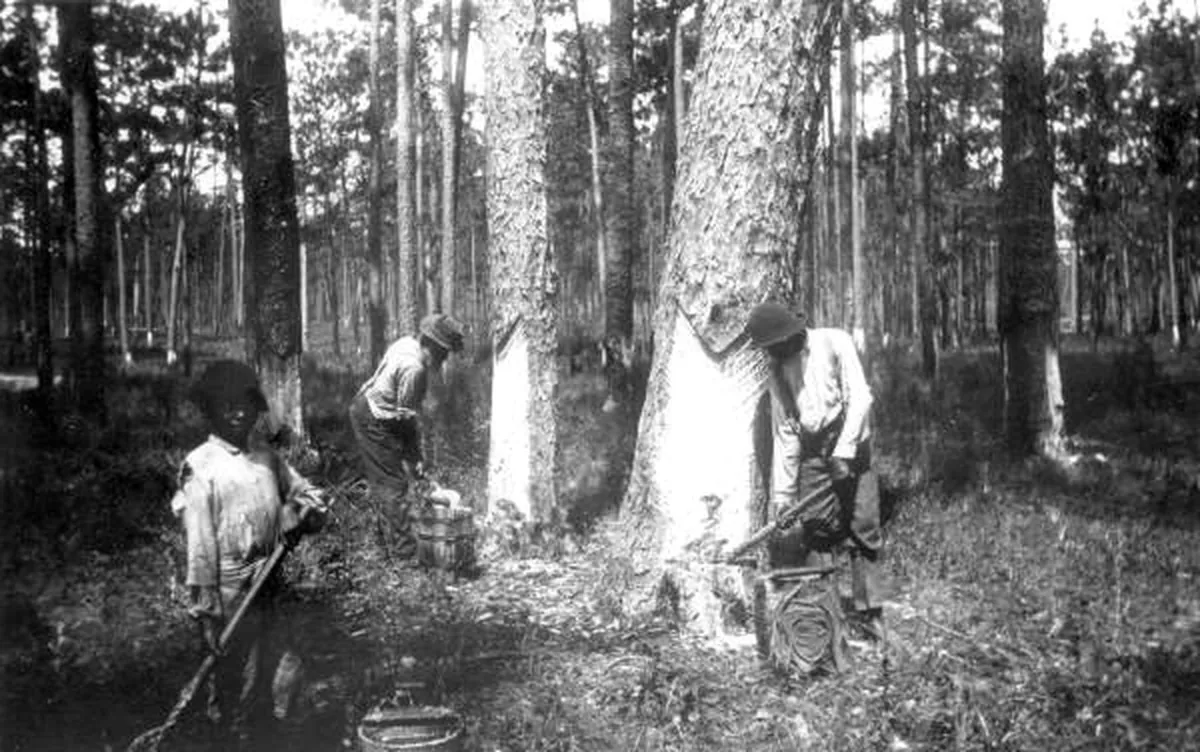
A grove alone doesn't make a town. What made Markham was the pine. The flat country north of Longwood was covered in longleaf, and longleaf was worth a fortune — not as lumber first, but as sap. Scored and bled, a longleaf pine gives up a sticky resin that distills into turpentine and rosin: the paint thinner, the lamp fuel, the ship's caulk, the soap and the medicine of the age. They called the whole trade “naval stores,” a holdover from the days of wooden fleets.
The railroad arrives, and the town fills with people

What turned the grove into a working town was a rail line pushed through the pine country in the 1880s, the Sanford and Lake Eustis Railway. Steel reached the trees, and the trees could finally be turned into money at scale. Through the 1880s and into the early 1900s, a community grew up in the woods to do the work.
It was, overwhelmingly, a Black community. The laborers who chipped the pines, dipped the resin, fed the sawmills, and loaded the rail cars were African American, working a generation after emancipation in the hard, isolated economy of the turpentine camps. By the surviving accounts they worked hard, raised and schooled their children, and carried a good deal with dignity.

The land around Markham was held and worked by the firms whose names ran the region: the Overstreet Turpentine Company, the Spencer Sawmill, the Zachary Lumber Company, the Wilson Cypress Company. The mills here were busy enough that planks cut at Markham were used to build the first bridge across the Wekiva River. In the 1920s and ’30s, when the biggest pines were gone, crews turned to the local basswood and cut it into cigar boxes.
How you turn a pine into money

The work was brutal and exact. A worker cut a diagonal streak into the face of a pine with a curved blade called a hack, opening the wood so the resin ran. Below it hung a cup to catch the gum. Every week or so the face was re-chipped, a little higher, and the full cups were dipped into buckets and carried off — tree after tree, acre after acre, through a Florida summer.

The raw gum was hauled to a still and cooked over a fire. The vapor came off as spirits of turpentine and was condensed into barrels; the thick rosin was drawn off and barreled separately. Both went out on the same rail line that had brought the workers in. It was, in the plainest sense, an energy business — a town that made fuel and sealant by hand, powered by fire, steam, and its own sweat.
A town built to move
And that is the thing about a turpentine town: it was never meant to stay. A stand of longleaf can only be bled for so many years before it is cut out, and when the trees were finished the camp picked up and followed the pine somewhere else. As one local historian, Bennett Lloyd, described those camps: “They would move the whole town…and it would just migrate around the county.”
Markham wasn't abandoned so much as used up. When the pines ran out, the economy that had built the place simply walked away to the next stand of trees.
The leaving was gradual, then total. The Oak Grove Missionary Baptist Church — the center of the community, the place people gathered to worship, learn, and organize — burned in 1928. The big timber was gone. Families drifted toward Sanford, toward Longwood, toward steadier work. By the 1940s, Markham existed mostly on paper; by about 1945 it was finished as a town. The name stayed on the map longer than the people did.
What the woods kept

Walk the ground now and the town is almost nothing: broken brick half-buried in white sand, a rusted tool, a square of old floor tile under the leaves. In a few spots a whole corrugated-metal roof lies flat on the ground where the walls rotted out from under it and let it down in one piece.

The clearest trace is the one that outlasts everything else: the burying ground. The African-American cemetery that served Markham — known over the years as Pinnie Ridge, Oak Grove, and New Island Lake — still holds somewhere between two and seven dozen graves back in the trees. The wooden markers have rotted away; a handful of the sturdier ones remain, mostly unreadable. It is the last plainly human thing on the site.

Everywhere else, the forest has simply closed over the town. Second-growth pine and hardwood stand where the streets and houses were. The land did to Markham exactly what Markham had done to the pines: took what was useful and moved on, and let the rest grow back.
The name, on richer gateposts

The word didn't die with the town. It survived on the road — Markham Woods Road — and then the money found the road. The same shaded pine-and-oak country that was too poor and too remote to be anything but a turpentine camp turned out to be exactly what wealth wanted a century later: quiet, green, close to the interstate, far enough from everything. Gated communities with names like Heathrow Woods and Magnolia Plantation filled in the corridor. A Black working town's name now sits on the gateposts of estates its workers could never have entered.
There is one more difference between the two Markhams, and it is the one that matters when the sky turns bad.
The old town made its own power — fire, steam, muscle — and when its power source ran out, it could get up and leave. The estates that took its place can't move. They run entirely on a wire from somewhere else.
The one thing the new town can't pick up and carry

On September 10, 2017, Hurricane Irma came up almost the entire length of the peninsula and drove through Central Florida. Statewide it knocked out power to about 6.7 million customers — roughly two-thirds of every electric account in Florida, the largest outage in the state's history. In Seminole County, around 158,000 homes and businesses went dark.

Duke Energy, which serves this corridor, warned that the hardest-hit areas could wait a week or more. And a gated estate waits in that line the same as everyone else: the grid does not read the entrance sign. For all the money on Markham Woods Road, the current still arrives on a single wire strung down the same flat pine country the turpentine men worked — and that wire can lie in the yard for days.
The first Markham answered that problem by being able to leave. The second Markham can't. Which leaves exactly one way to keep the lights on when the line goes down: carry your own power with you, on your own lot, the way the old town once carried its fire into the woods.


