Mount Dora, Florida  ·  A Local History

The Winter a President Moved to Mount Dora


In 1930 a citrus town of sixteen hundred people, perched on an improbable Florida hill, spent a quarter-million dollars enlarging its hotel — just as the boom that paid for it collapsed. Then a former President checked in for a month.

In the middle of January 1930, Calvin and Grace Coolidge stepped off a train in a town most of the country had never heard of and settled in for a month. He had been out of the White House less than a year. The country was four months past the stock-market crash and sliding into the worst decade of its economic life. And the place the former President chose to spend his winter was Mount Dora, Florida — population about sixteen hundred, sitting on a hill in the middle of orange country. The obvious question is the one the whole town was betting on: why here?
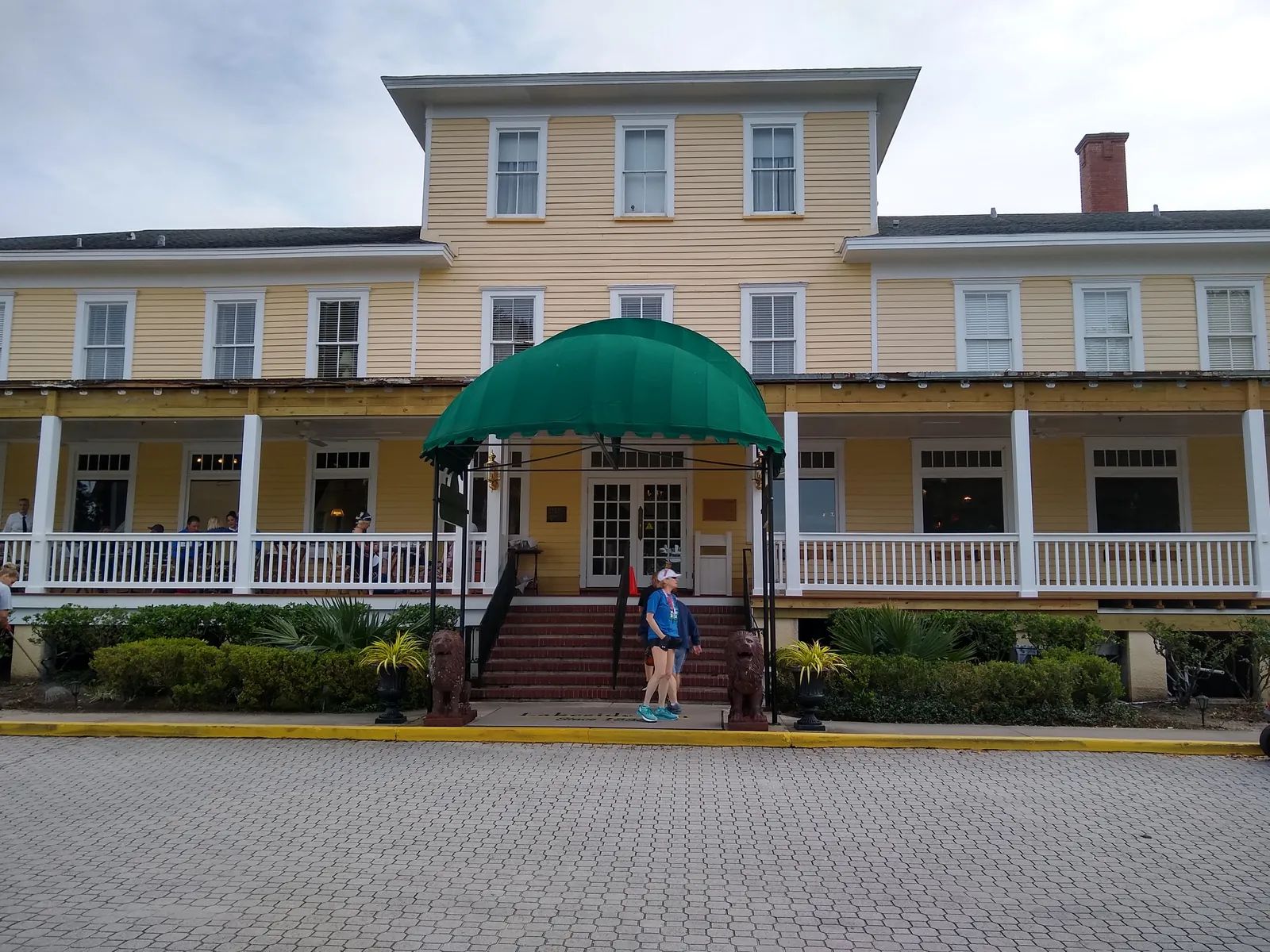
A long, low, yellow historic resort hotel with white trim and a deep veranda, set among palms and oaks beside a lake.
The Lakeside Inn — the stage for the whole story
The Lakeside Inn, Mount Dora (modern photograph). It opened in 1883 as the ten-room Alexander House; by the time the Coolidges arrived it had grown into the resort you see here, and it is still taking guests today. Via Wikimedia Commons.
A formal 1920s studio portrait of Calvin Coolidge, a serious-looking man in a dark suit and tie, seated.
The guest — out of office less than a year
Calvin Coolidge, 1924. By the winter of 1930 he was a former president — he had chosen not to run again and left the White House in March 1929. The Inn’s own history says the Coolidges “arrived in mid-January for a month-long stay.” Library of Congress, via Wikimedia Commons.

To understand how a retired President ended up on a hotel veranda in central Florida, you have to start with the hill — because almost nothing else in this story would make sense without it.

The town that had a mountain

Florida does not really do hills. Mount Dora does. The town sits on a plateau about 184 feet above sea level, high enough and breezy enough that the first settlers treated it like a resort climate the moment they arrived. That is the whole reason the word “Mount” is in the name — it is a genuine, if modest, rise in a state that is otherwise famously flat.

The first permanent settler, David Simpson, came in 1874. When the village got a post office in 1880, the postmaster, Ross Tremain, named it “Royellou” after his three children — Roy, Ella, and Louis. The prettier name won out: in 1883 the town took the name of the lake at its foot, Lake Dora, itself named for an early settler, Dora Ann Drawdy. (The exact year the surveyors attached her name to the water is one of those details the old records don’t agree on, so take it loosely.)

A black-and-white 1920 photograph of passengers standing beside a railroad station platform in Mount Dora.
Mount Dora station — passengers, 1920
Passengers at the Mount Dora depot, 1920. The railroad reached the town in 1887 and changed everything — before it, visitors came the slow way, by steamer up the Ocklawaha River and the Harris chain of lakes from Jacksonville. The depot is now the Chamber of Commerce and on the National Register. RICHES of Central Florida, University of Central Florida.

Before the railroad arrived in 1887, getting to Mount Dora meant a steamboat crawl up the Ocklawaha River and across the chain of lakes, or a jolting wagon ride. The train collapsed that trip into something a northern family might actually make for a holiday — and it arrived just as the town was discovering what it could sell.

A sure thing that died in a night

What it could sell, at first, was oranges. R. C. Tremain & Son built the first packing house in 1891, and crates of Mount Dora fruit moved out by rail and by boat on Lake Dora. For a few years the groves looked like the town’s fortune.

A single enormous orange tree, heavy with fruit, with a man in a hat standing beneath it for scale, in 19th-century Florida.
The crop that wasn’t forever
A Florida orange tree (near Palatka; representative of the late-1800s groves that fed Central Florida’s towns). Mount Dora’s first fortune rode on trees like this — and on a Florida winter behaving itself. Via Wikimedia Commons.

Then came the winter of 1894–95. A hard freeze in late December, a warm spell that coaxed the trees into new growth, and a second killing freeze in February wiped out most of Central Florida’s citrus. Across the region groves that had taken twenty years to grow split open in the cold; it would be close to two decades before Florida shipped as much fruit again. Mount Dora replanted some of what it lost, but the lesson was permanent: a town that lives on one crop is one cold night away from starting over.

So the town stopped betting everything on the trees. It bet on the hill, the lake, the climate — on being a place people would come to.

Reinventing as a destination

The pivot had actually begun before the freeze. The Alexander House — ten rooms of termite-proof Georgia pine — had opened in 1883, the same year the town took its name. It was renamed the Lake House in the 1890s and, later, the Lakeside Inn. Around it grew the machinery of a winter resort: cottages, a yacht club on Lake Dora, and a town that learned to measure its year by who arrived in January.

An ornate yellow Queen Anne Victorian house with a turret, wraparound porch, and elaborate white gingerbread trim.
Donnelly House — 1893
The John P. Donnelly House, built 1893 (photograph). Donnelly came to Mount Dora in 1879, helped build its citrus trade and its yacht club, and in 1910 became the chartered town’s first mayor. His Queen Anne house went on the National Register in 1975. He died in 1930 — the same winter the Coolidges came. Via Wikimedia Commons.

The man whose name sits on most of that early civic history is John P. Donnelly. He arrived in 1879, married into a prominent local landholding family, built up the fruit business, helped found the yacht club, and in 1910 — when Mount Dora was finally granted a town charter, all 371 residents of it — became its first mayor. The gaudy, turreted Queen Anne house he put up in 1893 is still the most photographed building in town.

By the 1920s the resort idea had money behind it, because for a few giddy years all of Florida did. The great land boom sent speculators and tourists pouring south. And then, between a collapsing land market in 1926, a devastating hurricane that September, and the Wall Street crash of October 1929, the money vanished almost as fast as it had come.

The quarter-million-dollar gamble

Which is what makes what happened next look either reckless or inspired, depending on how it turned out. Right into the teeth of that collapse, the owners of the Lakeside Inn spent about $250,000 — a fortune in 1930 dollars — to enlarge it. They added two new buildings, the Gables and the Terrace, plus a swimming pool, a new lobby, a dining room, and formal landscaping. A small-town hotel was doubling down on luxury at the exact moment luxury looked finished.

The gamble needed a headline. It got one.

In mid-January 1930 Calvin Coolidge — silent, famously frugal, barely a year removed from the presidency — came to Mount Dora with Grace Coolidge and stayed a month. Whatever the town had hoped a hotel on a hill could do, a former President on its veranda for a Florida winter did it. The sixteen-hundred-person citrus town had, for one season, the most watched houseguest in America.

A vintage large-letter postcard spelling out GREETINGS FROM MOUNT DORA FLORIDA, each letter filled with a small scene.
The identity that stuck — 1951
A “Greetings from Mount Dora” postcard, 1951 (Curt Teich & Co.). Two decades after the Coolidge winter, the town was still selling exactly what it had chosen in the 1890s: a place worth coming to. Steven R. Shook collection, via Wikimedia Commons, CC BY 2.0.

It is worth being careful here, because the Coolidge winter is the kind of story that grows in the retelling. What the records actually support is modest and remarkable enough on its own: the Coolidges came, they stayed about a month, and they did it at a brand-new-again hotel in a town that had just bet its future on being worth visiting.

What the gamble bought

It bought survival. The Lakeside Inn came through the Depression and every decade since, and today it bills itself as the oldest continuously operating hotel in Florida; it went on the National Register of Historic Places in 1987. The depot where the Coolidges’ train pulled in is on the Register too. So is Donnelly’s turreted house.

A modern view down a tidy small-town main street lined with low shopfronts, awnings, and shade trees.
The bet, still paying out
Downtown Mount Dora today (modern photograph) — the small, walkable main street that still runs on the thing the town chose over citrus a century ago: visitors. Via Wikimedia Commons.

The town that counted 1,613 people the year Coolidge visited is pushing nineteen thousand now, and it still makes its living almost exactly the way the Lakeside Inn’s owners gambled it would — on antiques fairs and festivals and people who drive up the hill for a weekend. In 1988 it even built itself a lighthouse on Lake Dora, one of the very few freshwater lighthouses in the state, which is either charming or absurd for a town with no ocean. Mount Dora has always known that charming and absurd are not opposites.

A small red-and-white lighthouse standing at the edge of a lake under a blue sky, with a dock nearby.
A lighthouse on a lake, 1988
The Mount Dora lighthouse at Grantham Point (modern photograph), dedicated in 1988 on the shore of Lake Dora — a town with no coastline building itself a lighthouse anyway. Via Wikimedia Commons.

Coolidge went home that spring to write his memoirs, and he was dead within three years. John Donnelly died that same winter of 1930, in the town he’d helped charter. The groves that started the whole thing never fully came back. But the hill is still there, and so is the long yellow hotel at the bottom of it — because the one bet Mount Dora made that actually held wasn’t citrus, and it wasn’t the land boom. It was spending real money, at the worst possible moment, on a reason for someone to come up the hill. A hundred years later, they still do.

A present-day note · GENERasic

Mount Dora learned the hard way that a sure thing can fail in a single night. A modern home leans on one just like it — and loses it in a storm the same way.

The freeze of 1895 taught this town a lesson it never unlearned: when your whole life rests on one thing you can’t control, you need something to fall back on. For the groves, there was nothing. The cold came, and the money was simply gone by morning.

A Florida house today rests on electricity the way those groves rested on the weather. Cooling, water, food, medical equipment — nearly everything that keeps a home livable runs on power, and in a hurricane the grid is the first thing to go. That’s a when, not an if. No amount of charm or craftsmanship keeps the lights on when the line down the street is on the ground.

A standby generator is the unglamorous version of the fallback the groves never had: wired up before you need it, and it starts itself the second the power drops, whether anyone’s home or not. In a Florida outage, here’s what it’s actually holding up:

An enclosed residential standby generator on a concrete pad beside a building, with trees behind it.
The fallback the groves never had
A residential standby generator (representative photograph, not Mount Dora equipment) — wired to start on its own the moment the grid drops. Via Wikimedia Commons.

Which of those actually apply to your address — your medical needs, how your house is fed, well or city water — is worth pinning down for your own home rather than guessing. That part is yours to check.

You can get an address-specific installed price for standby power — the whole turnkey number, not a callback and a maybe — in one sitting.

Get your installed price for this address→
Sources & Photo Credits

On the history

Note on the chosen lens and on uncertainties

This page was built with a “power resilience” lens for GENERasic. Mount Dora has no documented municipal-electricity or power history of its own, so the lens is carried in the present-day GENERasic note at the end rather than forced into the history; the historical through-line is a one-crop town that survived by reinventing itself as a destination, which the 1894–95 freeze and the 1930 Lakeside Inn gamble make concrete. Calvin Coolidge was a former president during the 1930 visit (he left office in March 1929); the page says so rather than calling him the sitting President. The documented claim, from the Inn’s own history and Wikipedia, is that the Coolidges stayed about a month beginning in mid-January 1930; some popular retellings add a formal dedication ceremony, a Coolidge speech, and a tree-planting by Grace Coolidge, none of which the Inn’s current history page or Wikipedia confirms, so they are left out. Ownership of the Inn in 1930 is recorded differently across sources (the Inn’s site credits a 1924 investor group led by Charles Edgerton; Wikipedia emphasizes a Boston operator and a 1933 company) and is kept deliberately light. The lake-naming date (surveyors and Dora Ann Drawdy) is genuinely fuzzy in the records and is flagged rather than fixed. The lighthouse is called “one of the very few” freshwater lighthouses because sources themselves disagree (“only inland freshwater lighthouse in Florida” vs. “one of three”).

Photographs

  1. Lakeside Inn, Mount Dora (modern, hero) — the historic resort hotel beside Lake Dora, labeled modern; opened 1883 as the Alexander House. Via Wikimedia Commons. File: lakeside-inn-mount-dora-modern. Commons
  2. Calvin Coolidge, 1924 portrait — a presidential-era studio portrait; by the 1930 visit he was a former president. Library of Congress, via Wikimedia Commons. File: calvin-coolidge-1924-portrait. Commons
  3. Mount Dora depot, passengers, 1920 — passengers at the Atlantic Coast Line station; the depot is now the Chamber of Commerce and on the National Register. RICHES of Central Florida, University of Central Florida. File: mount-dora-depot-passengers-1920. RICHES
  4. Florida orange tree, near Palatka — a large fruiting orange tree with a man for scale, representative of the late-1800s groves (not Mount Dora specifically). Via Wikimedia Commons. File: florida-orange-grove-near-palatka. Commons
  5. John P. Donnelly House, built 1893 — the Queen Anne landmark built by Mount Dora’s first mayor; on the National Register since 1975. Via Wikimedia Commons. File: donnelly-house-mount-dora. Commons
  6. “Greetings from Mount Dora” large-letter postcard, 1951 — a Curt Teich & Co. tourist postcard, two decades after the Coolidge winter, labeled by its date. Steven R. Shook collection, via Wikimedia Commons, CC BY 2.0. File: greetings-from-mount-dora-postcard-1951. Commons
  7. Downtown Mount Dora (modern) — the present-day main street, labeled modern. Via Wikimedia Commons. File: downtown-mount-dora-modern. Commons
  8. Mount Dora lighthouse, Grantham Point (modern) — the freshwater lighthouse on Lake Dora, dedicated 1988, labeled modern. Via Wikimedia Commons. File: mount-dora-lighthouse-grantham-point. Commons
  9. Standby generator (representative — not Mount Dora equipment) — an enclosed residential standby generator on a pad. Via Wikimedia Commons. File: standby-generator-set-representative.

The Coolidge portrait (1924) and the depot photograph (1920) are period images; the postcard is dated 1951 and labeled as such; the Inn, the Donnelly House, downtown, the lighthouse and the generator are modern or representative and labeled. No image’s factual content was altered — the Polaroid frames and handwritten notes are CSS added around the photographs, never onto them. Original downloads and a full research record are kept alongside this page in assets/images/originals/ and source-record.md. Any owner who wants an image removed need only ask.