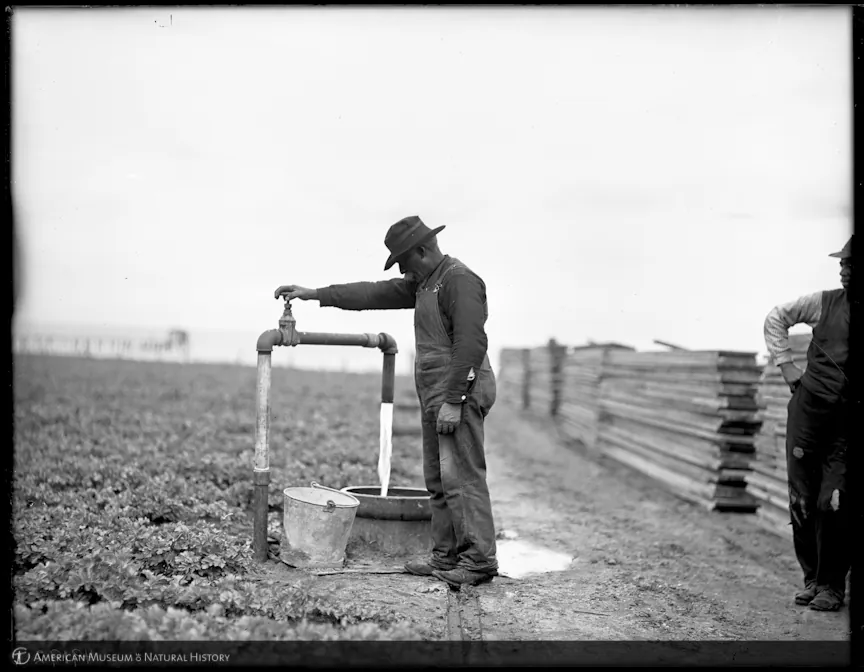
The man in the photograph isn’t pumping anything. He’s just holding his hand under a pipe stuck in the dirt at the edge of a celery field, and the water is coming up on its own. No windmill, no engine — drill a hole deep enough into the ground around here and the water shoves itself to the surface and keeps coming. That pipe, running quietly in a field outside Oviedo, is the reason a patch of Florida swamp turned into one of the richest few square miles of farmland in the country. Oviedo’s fortune didn’t fall out of the sky. It came up out of the ground.
A citrus town, before the cold came
Settlers reached the shore of Lake Jesup in 1875 and called the place the Lake Jesup Settlement. A few years later a Swedish-born postmaster, Andrew Aulin, filed the paperwork for a post office and gave it a name borrowed from a city in northern Spain: Oviedo. For its first twenty years it was an orange town, like every other depot stop in Central Florida — packing houses along the rail line, boxes of fruit heading north. In 1915 alone, farmers here shipped more than sixty thousand boxes of citrus.

Then the weather came due. A pair of brutal freezes in the winter of 1894–95 killed the orange trees across Central Florida, and the citrus fortune with them. Growers who had bet everything on a frost-free Florida were suddenly standing in fields of dead wood.
What they reached for, to stay alive while the groves recovered, was celery. It was meant to be a stopgap. It became the thing the whole town was known for.
Why celery, and why here
Celery is a northern-climate crop with an awkward appetite: it needs an enormous, steady supply of water and not much else. Most places can’t give it that without a fight. Oviedo could give it that almost at no cost.
The low ground around Lake Jesup was black muck — old swamp bottom, soft and rich. Drain it with ditches and buried clay tile, and that same tile could run in reverse to water the roots from below instead of from above. Underneath it all sat the artesian aquifer: bore a well and the water rose by itself, no pump required. The field essentially watered itself.

The rest was brutal hand work. The stalks were blanched pale by standing boards along each row to block the sun — “boarding up.” Then crews moved down the rows on foot, cutting, stripping, and packing by hand. By the 1920s the farms around Oviedo and neighboring Sanford were growing something like a quarter of all the marketable celery in the United States. The local boast wrote itself: the Celery Capital of the World.
A town frozen out of oranges survived on a crop it could keep alive only by keeping the ground permanently wet — and got rich doing it.
The men who packed it, and the man who bought the house
The crop made fortunes at the packing house more than in the field. The biggest in town was Nelson and Company, started by the brothers Steen and Gus Nelson as Nelson Brothers. In 1908 a citrus grower named Benjamin Franklin Wheeler bought in as a partner; by 1923 he had bought the others out and put his stamp on the name.

Wheeler had come to celery the same way the whole town had — frozen out of oranges and looking for something to carry him until the groves came back. He ended up in the Florida Citrus Hall of Fame instead, remembered as much for the packing house and the fertilizer plant beside it as for any orange. The celery money built homes to match.

It wasn’t only Wheeler. A Slovak immigrant named Andrew Duda had tried to farm here once, failed, and gone back north — then returned in 1926 to try celery again. That second attempt held. The Duda family’s farm grew into an agribusiness that outlasted the celery era entirely and still operates today.
What the work actually paid
The postcards made it look like a garden by a lake. The pay sheet told the other half.

A notice nailed to a packing-house wall in 1937 set the going rate: twenty cents an hour for a packer, fifteen for a field-box filler, twelve and a half for the people stripping the stalks. That was the engine under the Celery Capital — rows of people bent over black muck for pennies, so that crates could ride the Seaboard line to tables up north.
The two things nobody controlled
For all its cleverness, the whole business rested on two things no farmer could command. One was the water pressure in the aquifer. The other was a frost-free night.

Celery is a cool-weather crop grown through a Florida winter, which means it is grown right up against the edge of the thing that can kill it. The same cold that had wiped out the oranges in the 1890s never really went away — it just waited.
It came back in the 1980s, in a run of hard winter freezes. The celery didn’t bounce back the way it had after the groves died, because this time there was somewhere else for the crop to go — and something else for Oviedo to become. The Nelson and Company complex, the center of the town’s farming life for most of a century, shut down for good in the 1980s. The packing houses went quiet.
What the water left behind
Oviedo didn’t empty out when the celery stopped — it filled up. The groves and muck fields became subdivisions; the crossroads of a few hundred people became a suburb of more than forty thousand. You can drive the whole town today and never guess what it used to be.

But a few blocks held on. In 2001 the town drew a historic district around the surviving Nelson and Company buildings on the old rail siding — the sheds, a boxcar, the fertilizer-plant ground. The one thing you can’t miss still stands over all of it.

It’s a water tower — which is almost too neat. The town that got rich because water pushed itself up out of the ground, in the end, is marked by a tank built to hold water up in the air. The muck is under the lawns now. But the name is still up there, lettered on the one thing tall enough to see from the highway, over a field that doesn’t water itself anymore.


