Reunion, Florida  ·  A Local History

The Town Named Reunion Where Almost Nobody Stays


A developer bought 2,300 acres of citrus grove six miles from Disney, got three golf legends who spent their careers trying to beat each other to sign a course apiece, and called it Reunion. It stays green and lit for one reason: the wire from outside is still up.

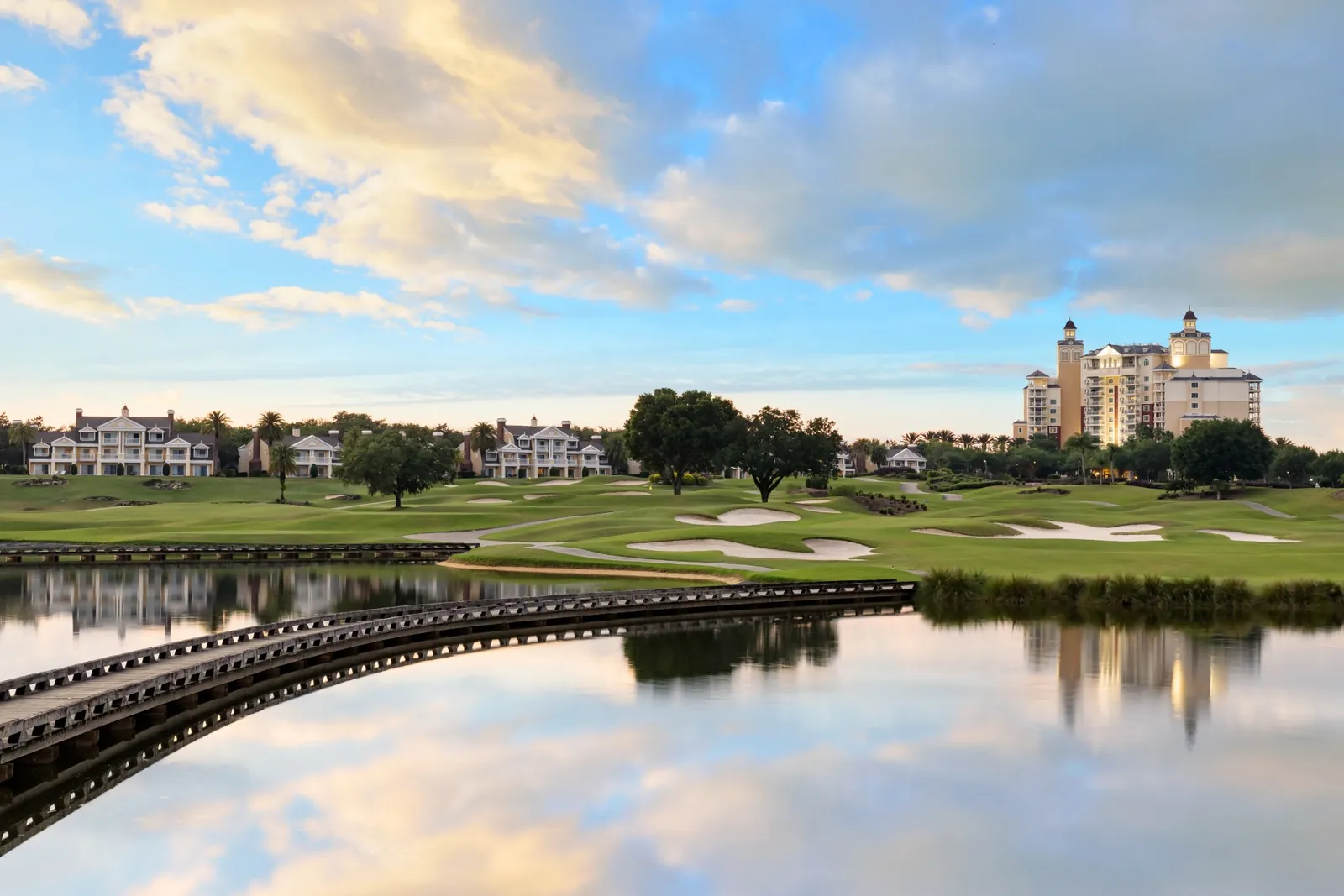
A golf resort at sunset: a manicured fairway and bunkers in the foreground, a wooden boardwalk crossing still water, and clustered Mediterranean-style buildings catching the last light under a pink and blue sky.
Reunion at sundown — six miles from the parks
Reunion Resort, Osceola County, Florida. Fairways, villas, and a lake, lit gold at the end of the day. Every blade of that grass is watered by pumps, every building cooled by air conditioning, every light on a wire that runs in from outside. Photograph via Reunion Resort.

The place is called Reunion, which is a strange name for a town where almost nobody stays. Behind a gate in Osceola County, six miles from Walt Disney World, sit about three thousand houses — pastel townhomes, golf villas, eight-bedroom mansions with their own pools — and most of them are empty tonight, or full of people who will be gone by Sunday. The name promises people coming back together. What actually happens here is people passing through.

So where does a name like that come from? And why would anyone build a whole town, all at once, on a flat stretch of Central Florida six miles from the busiest theme park on earth?

A town ordered off the plans

An illustrated resort map showing a large gated community laid out around winding golf courses, with lakes, villages of buildings, and a road running along one edge.
A whole town, drawn at once
The Reunion community map. Not a place that grew street by street over a century — a town drawn complete on paper and then built, golf courses first. Map via Reunion Resort.

In 2000 the developer Bobby Ginn bought 2,300 acres known as Magnolia Creek — citrus grove — from the Herman J. Heidrich family for $42 million. The pitch was permanence: a private resort community built for big multi-generational family gatherings, the kind of place three generations would come back to year after year. Hence the name.

Ground broke in June 2001. That December, at the first priority sales event, 264 home sites worth $40 million sold in sixteen hours. Across three such events, roughly $320 million in real estate changed hands before much of it existed. The plans ran to more than 5,000 properties when finished.

A vintage colored postcard of a Florida orange grove: neat rows of trees heavy with oranges running back toward a distant tree line under a pale sky.
An orange grove in Florida — the land before
A Florida orange grove. A vintage postcard view, representative of the citrus that covered this land — Magnolia Creek — before the grove was cleared for the resort. Via Wikimedia Commons (public domain).

But the thing that made Reunion Reunion wasn't the houses, or the water park, or the grove it replaced. It was three signatures.

Three men who spent their lives trying to beat each other

Bobby Ginn got Arnold Palmer, Tom Watson, and Jack Nicklaus — three of the greatest golfers who ever lived — to each design a championship course on the same property. Palmer's and Watson's opened in 2004; Nicklaus's in 2007. Reunion became, by the resort's own account, the only destination in the world with signature courses from all three. For Watson, the course here was his first design in the state of Florida.

A golfer in a yellow shirt finishes a swing on a sunlit fairway, with a clubhouse in the distance across the grass.
Palmer — the Legacy
A golfer swings beside a sand bunker and a pond, water and green behind.
Nicklaus — the Tradition
A golfer in a dark shirt and cap holds a club across the shoulders after a shot on an open course under a bright sky.
Watson — the Independence

Golfers on Reunion's three signature courses today — the Arnold Palmer (Legacy), Jack Nicklaus (Tradition), and Tom Watson (Independence) layouts. Photographs via Reunion Resort.

Put those three names on one entrance sign and you are selling a reunion of people who, in life, were anything but a team. Palmer and Nicklaus split American golf down the middle in the 1960s — Arnie's Army against the young man who kept beating their king. And Watson spent his prime taking titles directly off Nicklaus: the 1977 Duel in the Sun at Turnberry, where Watson won the Open Championship by a single stroke, 268 to 269; and the 1982 U.S. Open at Pebble Beach, where Watson holed an improbable chip from the rough on the 71st hole to snatch the trophy out of Nicklaus's hands by two.

Decades later, their three names sit a few fairways apart on a Florida grove, under one gate that says they've all come together.

A golf hole framed by oak trees: a wide green fairway curving around a pond and a large white sand bunker, clustered resort rooftops in the background under a blue sky with towering clouds.
The Nicklaus course — kept green by pumps
A hole on the Jack Nicklaus Tradition course at Reunion. Three championship layouts cover these old grove acres. Keeping them this green through a Florida summer takes constant irrigation, and irrigation takes power. Photograph via Reunion Resort.

The reunion that never quite happens

An aerial view of the resort community: clusters of tile-roofed homes and condo buildings set among golf fairways, ponds, and palm-lined streets stretching to a hazy horizon.
Three thousand houses — mostly rented by the week
Reunion from the air. Townhomes, condos, and estate homes among the fairways. Most are zoned and equipped for short-term rental — the “residents” are largely vacationers doing the parks for a week. Photograph via Reunion Resort.

The reunion Ginn sold — families, roots, coming back — isn't quite what got built. Of the roughly 3,000 homes here, most are zoned and equipped for short-term vacation rental; Osceola County permits it, and Reunion's own governing documents are built around it. A five-acre water park opened in 2005 for the people renting.

So the census counts a few thousand permanent residents, but the real population on any given night is whoever booked. It is less a town that gathers than a town that turns over — a lobby with a golf course, six miles from the Magic Kingdom.

Then, as at so many Florida resorts, the money vanished. When the 2008 crisis hit, Ginn's company filed for bankruptcy that November and the big planned town center, Reunion Square, stopped where it stood. But — and this is where Reunion's story turns away from its sister developments — the resort itself didn't die. Salamander took over management in 2011; Kingwood International Resorts bought it in 2019. The golf stayed. The gate stayed. The rentals kept turning over.

The one thing nobody could put in the ground

Which leaves the thing all of it rests on and none of it can fake. Ginn could buy the grove, clear it, draw the town, and hire three legends to shape the land. He could not put the electricity in the ground.

Three signature courses stay green on irrigation pumps. Three thousand houses stay livable on air conditioning. The water park, the gate, the pool and fountain pumps, the lights in every rented kitchen — all of it runs downstream of a wire that comes in from outside, along poles crossing the same flat country the grove once grew on.

A town can be built around three of the most famous names in golf and still go dark on an ordinary September afternoon.

September 10, 2017

Two side-by-side night-time satellite images of the Florida peninsula labeled Before and After: on the left the state glows with city lights; on the right much of it has gone dark.
Florida at night — before Irma, and after
Florida's lights before and after Hurricane Irma, September 2017. Night-time satellite views show the peninsula glowing, then much of it gone dark after the storm crossed. NOAA / Suomi NPP (public domain).

Central Florida has seen exactly what that looks like. On September 10, 2017, Hurricane Irma came up almost the entire length of the peninsula. It knocked out power to about 6.7 million customers — roughly two-thirds of every electric account in the state, the largest outage in Florida's history. Across the Southeast, as many as 13 million people lost power.

A satellite image of Hurricane Irma as a vast white spiral of cloud with a visible eye, covering much of the Florida peninsula and the surrounding ocean.
Irma over the peninsula — Sept. 10, 2017
Hurricane Irma crossing Florida, September 10, 2017. The storm came ashore in the Keys and the southwest coast, then drove up the middle of the state — through the Orlando region Osceola County sits inside. Satellite image, NASA/NOAA (public domain).

In Osceola County, where Reunion sits, the local utility had more than half of its customers in the dark at the peak. Restoration figures here are county- and state-wide, not Reunion-specific — but the storm crossed the region the resort is part of, and the grid does not read the entrance sign.

A long line of white utility bucket trucks parked in rows in a lot under a bright blue sky, staged for storm power restoration.
The only thing that ends an outage
Florida utility line trucks staged for storm restoration. After a hurricane, power comes back the one slow way it always has — crews and bucket trucks, street by street, across a wrecked region. Representative Florida restoration fleet, not Reunion-specific. Via FPL.

And the power comes back the only way it ever does: crews on poles, one truck at a time, spread thin across a broken state. A gated resort full of visiting families waits in the same line as everyone else. For people who flew in for a theme-park week and have never sat through a Florida storm, a dark rented mansion — no air conditioning, a dead pool pump, warm water in the taps — is not the vacation they booked.

What the name gets right

So the name turns out to be backwards and exact at the same time. Reunion is a town of people who leave — the houses fill and empty, the names on the courses were rivals who shared nothing, the place itself was nearly abandoned once inside its first decade.

But one thing has to arrive every single day for any of it to work, and keep arriving, or the whole bright machine stops: the current, coming in from outside. Three rivals can share a grove. Three thousand houses can share a gate. They all share the same wire — and when it goes down, the most famous golf names in the world are just more dark windows, six miles from the brightest place on earth.

A present-day note · GENERasic

Reunion can hire three legends and draw a whole town on paper. The one thing no plan puts in the ground is the power — and a storm can lay it on the ground for days.

When Hurricane Irma crossed Florida in 2017, the honest answer for this region was “days for most, longer for some” — about 6.7 million customers lost power statewide, two-thirds of every account in Florida, and in the hardest-hit areas restoration dragged on well after the storm passed. That part was never in a resident's hands; it came down to how fast a crew could reach each particular street.

A single home runs on electricity exactly the way that resort does. Cooling, clean water, refrigeration, a CPAP at night, medical equipment — nearly everything that keeps a house livable needs power, and in a storm the grid is the first thing to go. In Florida that's a when, not an if. No amount of money, planning, or new construction keeps the lights on when the line down the street is lying in the yard.

A standby generator is the one piece of that you can decide ahead of time. It doesn't wait on a bucket truck working its way across the county — it starts itself the moment the power drops, whether anyone's home or not. In a Florida outage, here's what it's actually holding up:

An enclosed residential standby generator on a pad beside a stone-faced house, with a flower bed in front of it.
The fallback, wired before you need it
A residential standby generator (representative photograph, not Reunion equipment) — wired to start on its own the moment the grid drops.

Which of those actually apply to your address — your medical needs, how your house is fed, well or city water — is worth pinning down for your own home rather than guessing. That part is yours to check.

You can get an address-specific installed price for standby power — the whole turnkey number, not a callback and a maybe — in one sitting.

Get your installed price for this address→
Sources & Photo Credits

On the history

Note on the chosen lens and on uncertainties

This page was built with a “power resilience” lens for GENERasic. Reunion is a 2000s resort community, not a place with a deep public archive, so the strongest true, power-centered story is the contradiction in the name itself: a town called Reunion — sold as permanence and family gathering, and built around the single, one-of-a-kind gathering of three career-rival golf legends — that is in practice a town of transients who mostly don't live there, and that depends entirely on grid electricity for everything that keeps it green, cool, and lit, in a region whose grid went dark statewide when Hurricane Irma crossed it in 2017. A few points are stated carefully. “Only destination in the world” with all three signature designers is the resort's own claim. Reunion's citrus-grove origin (“Magnolia Creek”) and the early sales figures come from the resort's published history. Population figures for a heavily short-term-rental place are inherently fuzzy; the ~3,718 figure is the Census ACS estimate of permanent residents, not nightly occupancy. Irma's outage figures are statewide and county-wide, not a Reunion-specific count. Image geography: the orange-grove image is a vintage Florida postcard used as representative of the land before the resort, not a photo of Magnolia Creek; the three “course” photos show golfers on Reunion's courses today, not the legends themselves; the Irma satellite and night-lights images are NASA/NOAA views of the storm and the state, not of Reunion; the line-truck photo is a representative Florida (FPL) restoration fleet, not Reunion; and the standby generator is explicitly a representative image, not Reunion equipment.

Photographs

  1. Reunion Resort at sunset (hero, modern) — fairway, boardwalk, and resort buildings at dusk. Via Reunion Resort. File: reunion-resort-hero-sunset-aerial. reunionresort.com
  2. Reunion community map (document, modern) — the planned layout of the gated community and its courses. Via Reunion Resort. File: reunion-location-map-orlando-disney. reunionresort.com
  3. Florida orange grove (vintage postcard, representative) — a colored postcard view of a Florida orange grove, standing in for the citrus land cleared for the resort. Via Wikimedia Commons (public domain). File: florida-citrus-orange-grove-historical. Wikimedia Commons
  4. Golfer on the Palmer (Legacy) course (modern) — via Reunion Resort. File: reunion-palmer-legacy-course-golfer. reunionresort.com/golf
  5. Golfer on the Nicklaus (Tradition) course (modern) — via Reunion Resort. File: reunion-nicklaus-tradition-course-golfer. reunionresort.com/golf
  6. Golfer on the Watson (Independence) course (modern) — via Reunion Resort. File: reunion-watson-independence-course-golfer. reunionresort.com/golf
  7. Nicklaus Tradition course hole (modern) — a fairway, pond, and bunker with resort rooftops beyond. Via Reunion Resort. File: reunion-nicklaus-tradition-course-hole14. reunionresort.com/golf
  8. Reunion community from the air (modern) — homes and condos among fairways and ponds. Via Reunion Resort. File: reunion-resort-community-aerial. reunionresort.com
  9. Florida lights before and after Hurricane Irma (2017) — night-time satellite views of the peninsula lit, then darkened. NOAA / Suomi NPP (public domain). File: hurricane-irma-florida-lights-before-after-2017. Wikimedia Commons
  10. Hurricane Irma over Florida, September 10, 2017 — a satellite view of the storm's spiral over the peninsula. NASA/NOAA (public domain). File: hurricane-irma-over-florida-2017-09-10. Wikimedia Commons
  11. Florida line trucks staged for storm restoration (representative — not Reunion) — a row of utility bucket trucks staged for power restoration. Via FPL. File: power-line-crew-fpl-florida-restoration.
  12. Residential standby generator (representative — not Reunion equipment) — an enclosed home standby generator on a pad beside a house. File: home-standby-generator-representative.

The orange-grove, NASA/NOAA, and NOAA/Suomi NPP images are public-domain works. The Reunion resort, course, community, and map images come from Reunion Resort and show the real community in Osceola County, Florida. No image's factual content was altered — the Polaroid frames and handwritten notes are CSS added around the photographs, never onto them. Original downloads and a full research record are kept alongside this page in assets/images/originals/ and source-record.md. Any owner who wants an image removed need only ask.