Sweetwater Country Club  ·  Apopka, Florida  ·  A Local History

The Town That Grew a Country's Houseplants Under a Roof


Twice a hard freeze killed Apopka's orange groves. The growers who stayed quit trusting the open sky and moved the whole garden under cover — and in doing so handed the weather's old job to the one thing that now runs everything: the wire coming in from the road.

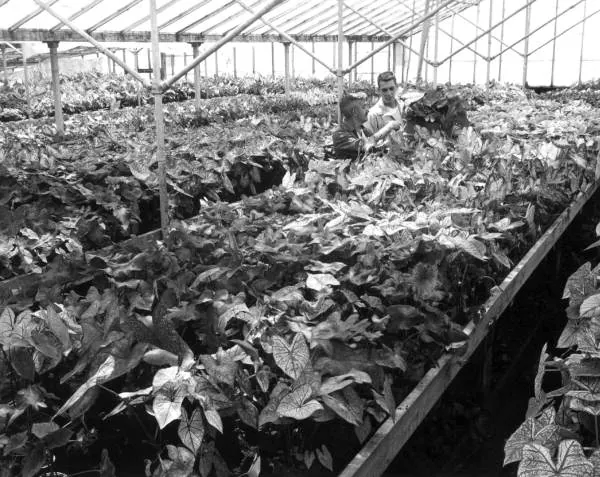
Two men standing among tiered benches of potted foliage plants inside a greenhouse, with the plants crowding the frame floor to roof.
Where the weather doesn't get a vote — Apopka, 1960
Inside a greenhouse at Thompson's Nursery, Apopka, 1960. David Barringer Sr. and Jr. among the potted foliage. The whole point of the room is that nobody outside it decides the temperature, the light, or the water. State Archives of Florida / Florida Memory.

On a cold January night in Apopka, the most valuable farmland in town is the land with a roof over it. Step inside one of the long nursery houses and the air goes close and green and still — ferns, caladiums, and a few hundred kinds of tropical plant growing in neat rows under cloth and glass, in a climate nobody outside gets a vote on. That is the entire idea. Apopka calls itself the Indoor Foliage Capital of the World, and the word that did the work was always indoor.

It took the town two disasters to learn why. Apopka began, like half of Central Florida, as an orange town — and twice the sky reached down and killed the oranges where they stood. What the growers built on the second time was not a hardier tree. It was a roof, and under it, a bet that you could grow a fortune in Florida only if you stopped letting Florida's weather decide the outcome.

The town the oranges built

A man and woman in early-1900s clothing standing in an orange grove among tall citrus trees heavy with fruit.
An Apopka grove, before the cold
Benjamin and Ella Hawthorn in their orange grove near Apopka, around 1912–1918. For a generation this was the whole economy: trees in the open air, fruit packed and shipped north by rail. State Archives of Florida / Florida Memory.

The settlement that became Apopka grew up around a Masonic lodge in the 1850s and took the name of the big lake to the southwest — from the Seminole Ahapopka. By the time the railroad reached it in the 1880s, the business of the place was citrus. Groves ran out in every direction, and the fruit went by the carload to New York, Boston, and Baltimore.

It was a good living and an exposed one. An orange tree lives outdoors by definition, which means it lives at the mercy of whatever comes down out of the sky. For years, in Central Florida, nothing much did.

Two nights that ended it

A black-and-white view of an orange grove killed by cold, the trees bare and blackened with dead leaves hanging on dark branches.
What the sky left behind — the 1890s freeze
A Central Florida orange grove after a hard freeze of the 1890s. Groves across the region looked like this after the winter of 1894–95 — blackened, split, and finished. State Archives of Florida / Florida Memory.

The reckoning came in the winter of 1894–95, in two blows. A freeze two days after Christmas 1894 dropped Orlando to around eighteen degrees and stripped the groves bare. Then, in early February, a second freeze caught the trees with their sap already running back up toward a false spring — and that one split the trunks. Across Central Florida, the citrus was all but wiped out in a matter of weeks.

A grower had two honest choices. Pull up and chase the warmth south, the way much of the citrus industry did — or stay on the land and grow something the cold couldn't reach the same way. The men who stayed in Apopka made a strange decision. They kept growing tender things. They just stopped growing them in the open.

Under cover

Feathery asparagus ferns growing in long rows beneath a roof of narrow wooden slats that throws striped shade across the plants.
The first roof over the garden
Asparagus "plumosus" ferns under a slatted shade roof at a Central Florida fernery. The new crop needed filtered light and shelter, so growers built it a sky of their own out of lath. State Archives of Florida / Florida Memory.

The first crop of the new era was asparagus "plumosus" — a feathery green the florist trade called fern, though it is really a cousin of the asparagus on your plate. It was delicate, it shipped well packed in ice, and florists up north wanted all of it they could get. It had one demand: it would not grow in full Florida sun. It needed shade.

So the growers built shade. Acre after acre of slat houses went up on the old grove land — roofs of narrow wooden laths that broke the sunlight into stripes and held a softer, steadier climate underneath. By the 1920s Apopka had a growers' association and a new nickname: The Fern City. The fern went north by the trainload, iced down in crates, and the dead groves quietly became something else.

Then the dime stores changed the business again. Chains like Woolworth's bought the ferns for their counters, and before long they were asking the same growers for potted plants people could carry home. Apopka's answer was to grow those too — and then every tropical houseplant it could coax along under cover.

The indoor capital

Rows of leafy caladium plants with pale patterned leaves growing in a shade house, receding toward the back of a long nursery building.
Caladiums in the shade — Apopka, April 1960
Caladiums growing under shade at Thompson's Nursery, Apopka, April 1960. One variety after another moved under the roof — ferns, then caladiums, then the whole tropical catalog. Photograph by Charles Barron, State Archives of Florida / Florida Memory.

One plant at a time, Apopka turned a freeze-ruined citrus county into the place the rest of the country bought its greenery. The sheds filled with caladiums, philodendrons, ferns, and foliage no one in Ohio could name but everyone wanted on a windowsill. By the 1960s the town had a title to match, the one it still uses: the Indoor Foliage Capital of the World, supplying a large share of the nation's houseplants from a few square miles of Orange County.

A detail from a 1924 Orange County advertisement with the heading FERNS reading 'A new, attractive and profitable industry that is destined to play a large part in this county's growth. See Apopka and Zellwood,' between sections on grapes and dairying.
1924 — ferns, "a new… industry… See Apopka"
A detail from an Orange County promotional advertisement, 1924. It pitches ferns as "a new, attractive and profitable industry… See Apopka and Zellwood" — the shade-house economy already worth bragging about a generation after the freeze. State Archives of Florida / Florida Memory (Florida Times-Union, Florida Roads and Resorts, 1924).

The citrus died because it lived outdoors. The foliage survived because Apopka decided the weather would no longer get to make the call.

The freeze that grew the business

A worker packing bunches of cut fern into a long cardboard crate stamped 'Asparagus-Plumosus,' with more ferns stacked alongside.
Still shipping green north — 1985
Cut fern packed for shipping in a crate stamped "Asparagus-Plumosus," at a fernery in Florida's fern belt, 1985. By the 1980s the cut-foliage and houseplant trade was a serious industry, not a consolation prize. State Archives of Florida / Florida Memory.

Here is the twist the orange growers of 1895 never got to see. The same cold that had destroyed Apopka's first economy came back in the 1980s — the Christmas freeze of 1983, then a brutal one in January 1985 — and killed off most of what citrus was left north of Interstate 4 for good.

For the groves, it was the end. For the nurseries, it was room to grow. Growers cleared the dead citrus and threw up more shade structures — by then made of lightweight black "saran" cloth instead of wood — and filled them with a tougher, longer-lasting cut green called leatherleaf fern. The crop that had once been a fallback became a crop worth tens of millions of dollars a year. The freeze that ruined the farmer who trusted the sky made the grower who had stopped trusting it richer than ever.

What the roof costs

A hand-tinted postcard of a small Florida downtown street lined with low early-20th-century storefronts and a few parked cars.
The town the shade houses paid for
A downtown Apopka street on an early postcard. The foliage money built the modern town around it — and the modern town, like the greenhouses, runs on power that comes in from somewhere else. State Archives of Florida / Florida Memory.

A climate you control is a climate you have to run. That is the quiet bill under the whole Indoor Foliage Capital. On a freezing night the shade houses don't save themselves the way a sunny day saves an orange tree — someone has to run heaters, or run water, and keep them running until dawn. The light is managed, the humidity is managed, and the water is pumped. Every one of those jobs the open sky used to do at no cost, the grower now does with a motor. And every motor runs on electricity.

Apopka got its own electric plant in 1915, back when "power" meant a few streetlights and nobody imagined a whole industry — let alone a whole way of living — leaning its full weight on the wire. The town that beat the weather did it by handing the weather's job to the power company. It is a better deal than a dead grove. It is not a deal without a catch.

What grows on the grove land now

Drive the northwest side of Apopka today and the old grove-and-nursery ground carries something new again: rooftops. Subdivisions and golf communities spread across the sandy rises where citrus once stood and shade houses took over, among them Sweetwater Country Club, the residential golf course laid out off Sweetwater Country Club Drive in the mid-1970s. It is the same move the town has always made — take the ground you have and grow the next useful thing on it.

And every one of those houses runs on exactly what the greenhouses run on. The air conditioning, the well pump, the refrigerator, the lights — all of it hangs on the same wire coming in from the road, in the same flat, storm-exposed stretch of Florida that knocks that wire down. Apopka learned a long time ago that the sky can't be trusted and the roof has a price. The oranges found out the hard way. The greenhouses, and the houses that followed them, just pay the bill a different way: not in a cold night's dead fruit, but in a dark house waiting for the power to come back.

A present-day note · GENERasic

Apopka's whole history is one lesson told twice: in Florida, the thing you can't control is the thing that decides everything.

The growers solved it by taking the weather out of the equation and running the climate themselves — heaters, pumps, fans, lights, all night if that's what a freeze demanded. It works beautifully, and it works only as long as the power holds. The moment the grid drops, a controlled climate is just a dark room full of things that need it.

A single home runs on the same bargain. Cooling, clean water from a well, refrigeration, a CPAP at night, medical equipment — nearly everything that keeps a Florida house livable needs electricity, and in a storm the grid is the first thing to go. Here that's a when, not an if. No amount of planning keeps the lights on when the line down the street is lying in the yard.

A standby generator is the one part of that you get to decide ahead of time. It doesn't wait on a bucket truck working its way across the county — it starts itself the moment the power drops, whether anyone's home or not. In a Florida outage, here's what it's actually holding up:

An enclosed residential standby generator on a concrete pad beside a house, next to a white picket fence and garden bed.
The fallback, wired before you need it
A residential standby generator (representative photograph, not Apopka equipment) — wired to start on its own the moment the grid drops. Via Cummins.

Which of those actually apply to your address — your medical needs, how your house is fed, well or city water — is worth pinning down for your own home rather than guessing. That part is yours to check.

You can get an address-specific installed price for standby power — the whole turnkey number, not a callback and a maybe — in one sitting.

Get your installed price for this address→
Sources & Photo Credits

On the history

Note on the chosen lens and on uncertainties

This page was built with a “power resilience” lens for GENERasic. The honest, documented connection is the spine of Apopka's own history: the town survived the freezes that destroyed its outdoor agriculture only by moving its crops under cover into a managed climate — shade, heat, water, and light supplied by people and machinery rather than the open sky — and a managed climate runs on electricity. The modern town that grew on the same ground depends on the grid the same way, in a hurricane-exposed region. A few facts are stated carefully. Exact fern-origin dates and names (e.g. a specific first grower, a precise “by 1912”) appear mainly in secondary/tourism retellings and are not asserted here; the page credits the documented arc (freeze → iced fern sprays → “Fern City,” 1920s → dime stores → foliage → “Indoor Foliage Capital,” 1960s). Asparagus “plumosus” is Asparagus setaceus, a florist “fern” but botanically a relative of edible asparagus, not a true fern. The leatherleaf dollar figure (“tens of millions a year”) follows trade reporting that puts it near $70 million wholesale. Sweetwater Country Club's opening year is given variously as 1974 or 1975; the page says “mid-1970s.” Image geography: the slat-roof fernery and the 1985 packing photograph are Central-Florida fern-belt images representative of the industry, not identified as Apopka operations; the 1890s freeze grove is a representative Central-Florida grove; the line-crew photo is a 2004 FEMA image of general Florida storm restoration; and the standby generator is explicitly a representative image, not Apopka equipment. The Thompson's Nursery greenhouse and caladium photographs and the Hawthorn grove, Fourth Street, and 1924 advertisement are Apopka items.

Photographs

  1. Greenhouse interior, Thompson's Nursery, Apopka (hero, 1960) — David Barringer Sr. and Jr. among potted foliage under glass. State Archives of Florida / Florida Memory. File: apopka-barringer-greenhouse-thompsons-nursery-1960. floridamemory.com/items/show/77358
  2. Orange grove near Apopka, c. 1912–1918 — Benjamin and Ella Hawthorn in their grove (a modern caption bar was cropped from the bottom of the scan). State Archives of Florida / Florida Memory. File: apopka-hawthorn-couple-orange-grove. floridamemory.com/items/show/155817
  3. Orange grove after a 1890s freeze (representative, Central Florida) — a cold-killed grove; stands for the region-wide damage of 1894–95. State Archives of Florida / Florida Memory. File: orange-grove-cold-damage-bartow-1890s. floridamemory.com/items/show/117876
  4. Asparagus "plumosus" ferns under a slat shade roof (representative, fern belt) — the Royal Fernery, Altamonte Springs. State Archives of Florida / Florida Memory. File: ferns-under-slat-roof-royal-fernery-altamonte. floridamemory.com/items/show/330036
  5. Caladiums under shade, Thompson's Nursery, Apopka (April 1960) — rows of caladiums in a shade house; photograph by Charles Barron. State Archives of Florida / Florida Memory. File: apopka-caladiums-shade-thompsons-nursery-1960. floridamemory.com/items/show/57741
  6. Orange County advertisement, 1924 (cropped detail) — promotional ad; the page shows a readable detail of the grapes/ferns/dairying band, with ferns pitched as "a new… industry… See Apopka and Zellwood." State Archives of Florida / Florida Memory (Florida Times-Union, Florida Roads and Resorts, 1924). Files: orange-county-ad-ferns-apopka-1924 (cropped detail shown); the untouched full advertisement is preserved as orange-county-advertisement-1924 in originals/. floridamemory.com/items/show/318842
  7. Packing cut fern, 1985 (representative, fern belt) — a crate stamped "Asparagus-Plumosus" at a Florida fernery. State Archives of Florida / Florida Memory. File: packing-ferns-in-box-fernery-pierson-1985. floridamemory.com/items/show/115988
  8. Downtown Apopka street (early postcard) — Fourth Street, Apopka. State Archives of Florida / Florida Memory. File: apopka-fourth-street-postcard. floridamemory.com/items/show/137516
  9. Residential standby generator (representative — not Apopka equipment) — an enclosed home standby generator on a pad beside a house. Via Cummins. File: home-standby-generator-representative.

The Florida Memory images are from the State Archives of Florida (public records); the FEMA line-crew image (referenced in the research record) is public domain. No image's factual content was altered — the Polaroid frames and handwritten notes are CSS added around the photographs, never onto them. Original downloads and a full research record are kept alongside this page in assets/images/originals/ and source-record.md. Any owner who wants an image removed need only ask.