Thornton Park, Orlando, Florida  ·  A Local History

The Summer the Fountain Went Dark


Orlando’s own power company built the city a monument made entirely of light and moving water, and set it in the middle of the lake Thornton Park wraps around. Then one August night in 2009, the sky switched it off.

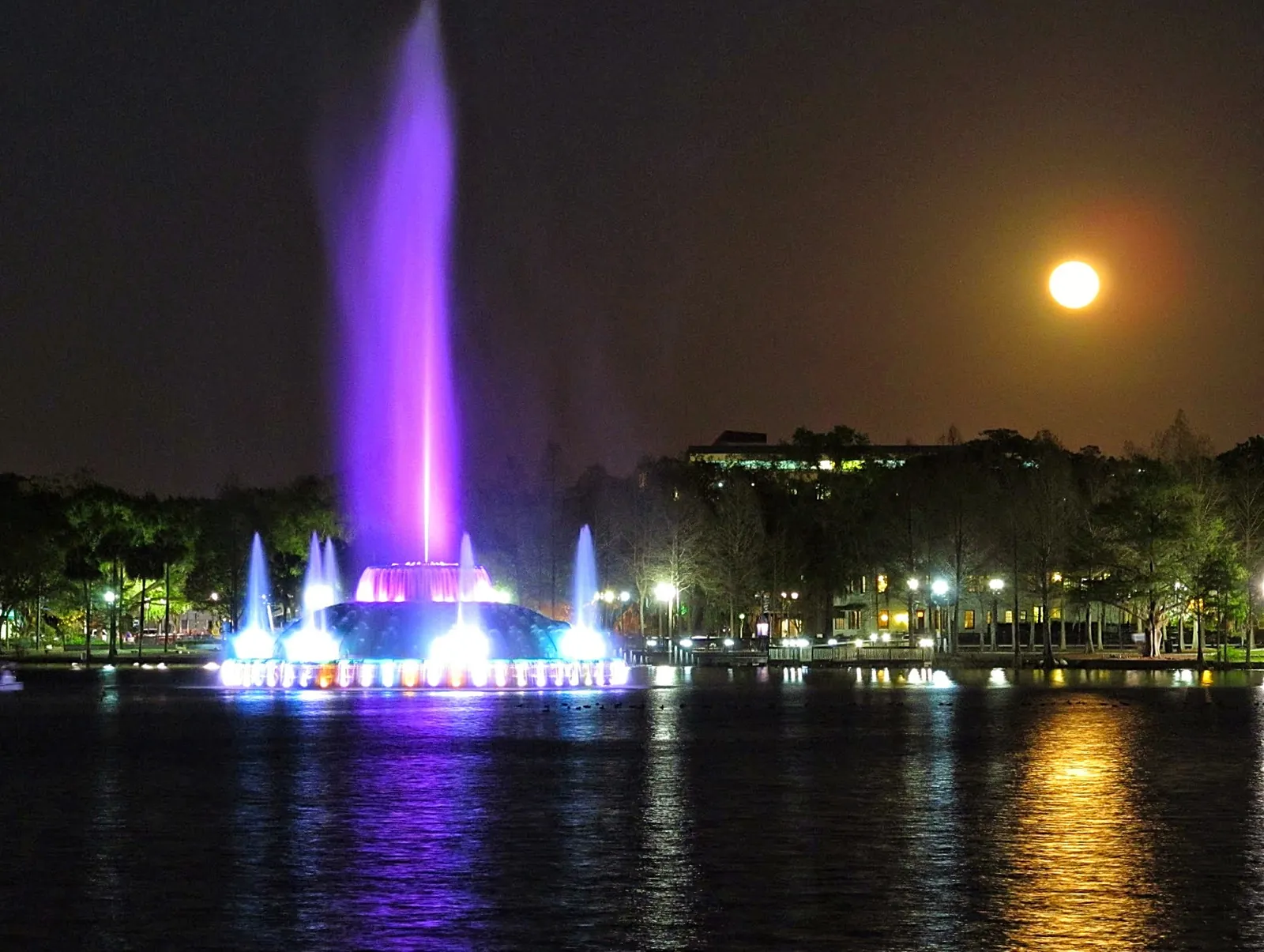
The Lake Eola fountain lit up at night, throwing a tall column of violet-lit water into the dark above the lake, the downtown Orlando skyline glowing behind it and a full moon over the water.
The symbol of the city, every night — Lake Eola
The fountain at Lake Eola after dark. For most of its life it has done this every single night — a lit column of water over the lake that Thornton Park faces. It ended up on street signs and city stationery. Then, for almost two years, there was nothing here but black water. Photograph by Miosotis Jade, via Wikimedia Commons.

One night at the end of August in 2009, a bolt of lightning dropped out of a Florida thunderstorm and hit the fountain in the middle of Lake Eola. In a second it did what nothing in half a century had managed to do: it switched off the most recognizable thing in Orlando. The jets stopped. The colored lights died. The spray that had stood over the lake every night since Eisenhower was in the White House simply went out — and it stayed out, as it turned out, for almost two years.

To understand why a broken fountain made the news — why the mayor had to stand up and promise the city would turn it back on — you have to know whose front yard that lake is, and who built the thing in the first place.

The neighborhood on the water

Just off the east shore of Lake Eola sits Thornton Park: a few blocks of brick streets and old bungalows under big live oaks, laid out starting around 1915 and named, by most accounts, for the developer who platted it, James Thornton. It is one of the oldest neighborhoods in Orlando, and its whole orientation is toward the water.

A quiet Thornton Park street corner: red brick pavement, street signs, mature live oaks, low buildings, and power lines running overhead against a pale Florida sky.
Thornton Park — brick, oaks, and wires overhead
A Thornton Park corner today. Brick streets, live oaks, and the power lines that feed the neighborhood — a block or two from the lake it faces. Photograph by Dclemens1971, via Wikimedia Commons.

The lake is the reason people come. It is a round, calm, 23-acre basin in the middle of downtown, ringed by a walking path, patrolled by swans, and centered on that fountain. Walk the Thornton Park side at dusk and the fountain is simply what you look at. Which is why, when it went dark, the whole city noticed a hole where its emblem used to be.

A lake that started as a hole in the ground

Lake Eola is not really a lake in the way you’d draw one. It is a sinkhole — the ground over an underground cavern gave way and filled with water, better than 80 feet deep at its middle.

An old color postcard captioned Court House and Lake Eola, Orlando, Fla., showing a brick courthouse and a tall water standpipe on the far shore of the lake, with low buildings and open ground in the foreground.
“Court House and Lake Eola” — circa 1900
Lake Eola around the turn of the last century (printed postcard view). The old Orange County courthouse and the city’s water standpipe stand on the far shore — decades before there was a fountain, or a skyline, or a Thornton Park bungalow. New York Public Library, via Wikimedia Commons.

In 1883 a cattleman named Jacob Summerlin — rich enough that people called him the Cattle King of Florida — donated the land around the sinkhole so the city could make it a park. The water took the name Eola, the story goes, after a young woman who died only weeks before her wedding. For its first half-century the lake was a plain, pretty thing: a shoreline, a bandstand, a modest fountain that went in back in 1912 for ten thousand dollars.

A black-and-white portrait of Jacob Summerlin, a bearded 19th-century man in a vest, seated and holding a riding crop.
Jacob Summerlin — the man who gave the lake away
Jacob Summerlin, the “Cattle King of Florida.” He donated the land around the sinkhole in 1883 so Orlando could have a park on the water. Portrait via Wikimedia Commons.

The lake you picture now — the tall, lit, roaring one — didn’t arrive until the 1950s. And it didn’t come from the parks department. It came from the electric company.

The power company’s monument of light

Orlando owns its own utility. The Orlando Utilities Commission — OUC — is a municipally owned company that has supplied the city’s electricity and water since 1923. It is the reason the lights come on here at all.

In the mid-1950s, as Orlando approached a hundred years since its beginnings, OUC decided to give the city a birthday present. It built a fountain in the middle of Lake Eola and handed it over to the town. It was dedicated in 1957 as the “Centennial Fountain,” at a cost of about $350,000 — a serious sum for a fountain in the Eisenhower years. The project was driven by a local banker, Linton E. Allen, who ran the First National Bank of Orlando; after he died in 1965, the city renamed the fountain in his honor.

A tall mid-century modern office building with a grid of vertical windows, the former administration building of the Orlando Utilities Commission, seen from a downtown street corner.
The utility that built a fountain
The former Orlando Utilities Commission administration building, downtown. OUC keeps the city’s lights and water on — and in 1957 it built Orlando a landmark made of nothing but light and moving water, and gave it away. Photograph by Visitor7, via Wikimedia Commons.

Think about that for a second. The company whose entire job is keeping the power flowing built the city a monument that is pure power — pumps, jets, and underwater lights, choreographed. On a quiet night the fountain throws a six-minute show: colored water climbing and falling in time to music. The city fell for it completely. The fountain’s silhouette turned up on street signs, on stationery, on the logo of the place. It stopped being a fountain and became the way Orlando drew a picture of itself.

Lake Eola by day under tall summer clouds: palms on a small island in the foreground, the fountain visible out on the open water, and low buildings around the far shore.
The lake Thornton Park faces — by day
Lake Eola in daylight. Open water, swans, a path all the way around, the fountain out in the middle. For fifty years it was the one piece of downtown that always worked. Photograph by LeonidasB, via Wikimedia Commons.

The one thing Florida has too much of

Here is the problem with building your city’s symbol out of electricity in Central Florida: this is the part of the country that gets struck by lightning more than any other. Summer afternoons here come with thunderheads the size of mountains, and the strikes come with them, every day, for months.

A bright branching bolt of lightning striking down out of a towering, dark storm cloud over silhouetted Florida palm trees at dusk.
The thing the fountain was made of — and undone by
A lightning strike over the Florida coast (representative photograph, Melbourne, Florida — not the Lake Eola strike). Central Florida is hit by more lightning than anywhere else in the United States. Photograph by Michael Seeley, via Wikimedia Commons.

In late August 2009, one of those strikes found the fountain. It hit the structure out on the water and rendered the whole thing inoperable — pumps, lights, jets, dead. The spray stopped. And the timing could hardly have been worse: the city was in the middle of a budget crisis, and for a while, no one could say whether the fountain would ever run again.

Dark

The city carried a $1 million insurance policy on the fountain. The catch was a $500,000 deductible — so half a million dollars had to come from somewhere before the insurance even began to help. In a down year, that is a real argument, held in public, while the middle of the lake sat empty.

A city can lose its symbol to the weather in a single second. Getting it back took almost two years, a mayor’s promise, and a fight over a half-million-dollar deductible.

On October 15, 2009, Mayor Buddy Dyer announced that the city would not just patch it. It would rebuild it — replace the fountain’s cracked plastic skin and install, in his words, “a state-of-the-art system of lights and water jets” — at a cost of around $2.3 million. That decision made the wait longer, not shorter. For month after month, the view from the Thornton Park shore was of a flat lake with nothing rising out of its center.

Back on

It came back on the Fourth of July, 2011 — rededicated and running again, almost two years after the strike. The new version threw its water higher and lit it brighter than the old one ever had. The nightly show returned. The emblem the city had been missing was, suddenly, standing over the lake again.

A wide sunset view across Lake Eola: a black swan gliding in the foreground, the downtown Orlando skyline in silhouette, and the fountain lit and spraying out on the darkening water.
Lit again, over the same water
Lake Eola at dusk, fountain running. A black swan, the skyline, and the spray back where it belongs — the picture Orlando makes of itself, switched on again. Photograph by DoctorDotDJ, via Wikimedia Commons.

Stand on the Thornton Park side of the lake tonight and none of the dark years show. The water climbs and falls in colored light the way it has for most of the last seventy years, and it is easy to forget it was ever off. But the story the fountain quietly tells is the same one every Florida summer repeats: the brightest thing in the city runs on power, and power is the one thing a storm can switch off in a single second. The only question that ever really mattered — for the fountain, and for everyone living around that lake — was how long until someone could turn it back on.

A present-day note · GENERasic

The fountain taught Orlando the whole lesson in one summer: the thing you depend on runs on power, and a storm can switch it off in a second. The only thing that matters next is how fast it comes back.

For the city, the answer in 2009 was “almost two years” — because the fix depended on an insurance deductible and a budget vote. A house doesn’t get almost two years. When a hurricane takes the grid down, the clock in your kitchen starts the moment the power does.

A home in Florida runs on electricity exactly the way that fountain does. Cooling, clean water, refrigeration, a CPAP at night, medical equipment — nearly everything that keeps a house livable needs power, and in a storm the grid is the first thing to go. That’s a when, not an if. No amount of good construction keeps the lights on when the line down the street is on the ground.

A standby generator is the version of that control you can wire up ahead of time. It doesn’t wait on a vote or a check — it starts itself the moment the power drops, whether anyone’s home or not. In a Florida outage, here’s what it’s actually holding up:

An enclosed residential standby generator on a concrete pad beside a building, with trees behind it.
The fallback, wired before you need it
A residential standby generator (representative photograph, not Lake Eola equipment) — wired to start on its own the moment the grid drops. Via Wikimedia Commons.

Which of those actually apply to your address — your medical needs, how your house is fed, well or city water — is worth pinning down for your own home rather than guessing. That part is yours to check.

You can get an address-specific installed price for standby power — the whole turnkey number, not a callback and a maybe — in one sitting.

Get your installed price for this address→
Sources & Photo Credits

On the history

Note on the chosen lens and on uncertainties

This page was built with a “power resilience” lens for GENERasic, and the lens is unusually well-earned here: the fountain was built and given to the city by the Orlando Utilities Commission — Orlando’s own electric utility — and it was a lightning strike that knocked it out, so the power theme is carried inside the history itself rather than only in the closing GENERasic note. A few points are stated carefully. The namesake of Thornton Park: most local sources credit the developer James Thornton, who platted the area beginning around 1915; one source instead names William Archer Thornton, a late-1800s Florida state engineer — the page therefore attributes the name “by most accounts” rather than stating it flatly. The centennial year: sources tie the 1957 fountain to Orlando’s 100th anniversary but anchor it to different events (Clio uses the 1857 founding; the historical marker uses the city’s first settlement), so the page says simply “a hundred years since its beginnings” rather than naming a single anchor year. The renaming date: given variously as 1965 (marker/Clio) and 1966 (Wikipedia/other), tied to Linton Allen’s death in 1965; the page says the city renamed it in his honor after he died in 1965. The exact strike date: sources say “late August 2009” (the cited Orlando Sentinel coverage is dated around August 25–30, 2009); the page does not assert a single day. The repair cost: the $2.3 million figure is the plan Mayor Dyer announced on October 15, 2009; later news reports gave various contract/restoration figures ($1.3M–$1.6M), and an initial insurance payment of about $285,000 for temporary repairs — the page cites only the announced $2.3M plan and the $1M policy / $500,000 deductible, which are the firmest figures. The “almost two years” dark period is the span between the late-August 2009 strike and the July 4, 2011 rededication. The Lake Eola fountain is Orlando’s landmark; Thornton Park is the historic neighborhood on the lake’s east shore — the two are adjacent, and the fountain is described here as the neighborhood’s lakefront view, which it is, not as being inside the neighborhood’s boundaries.

Photographs

  1. Lake Eola fountain lit at night (hero) — the fountain throwing a lit column of water over the lake after dark, downtown skyline and moon behind. Modern photograph by Miosotis Jade. File: lake-eola-fountain-lit-night. Wikimedia Commons
  2. Thornton Park street corner (modern) — brick pavement, live oaks, street signs, and overhead power lines in the neighborhood east of the lake. Photograph by Dclemens1971. File: thornton-park-brick-street-today. Wikimedia Commons
  3. “Court House and Lake Eola, Orlando, Fla.” (circa 1900) — a printed postcard view of the old Orange County courthouse and the city water standpipe across the lake, before the modern fountain or skyline. New York Public Library scan, public domain. File: court-house-lake-eola-circa-1900. Wikimedia Commons
  4. Jacob Summerlin, the “Cattle King of Florida” — portrait of the cattleman who donated the land around the sinkhole in 1883 to create the park. File: jacob-summerlin-portrait. Wikimedia Commons
  5. Former Orlando Utilities Commission administration building (modern) — a downtown building of the municipal utility that built the fountain and gave it to the city in 1957. Photograph by Visitor7. File: orlando-utilities-commission-building. Wikimedia Commons
  6. Lake Eola by day (modern) — the open lake under summer clouds, palms on a small island, the fountain out on the water. Photograph by LeonidasB. File: lake-eola-fountain-skyline-today. Wikimedia Commons
  7. Lightning strike over the Florida coast (representative) — a bolt striking from a storm cloud over palms near Melbourne, Florida; used to illustrate Central Florida lightning, not the actual Lake Eola strike. Photograph by Michael Seeley (watermarked by the photographer). File: florida-lightning-storm-representative. Wikimedia Commons
  8. Lake Eola at dusk, fountain running (modern) — a sunset panorama with a black swan, the skyline, and the lit fountain. Photograph by DoctorDotDJ. File: lake-eola-panorama-today. Wikimedia Commons
  9. Standby generator (representative — not Lake Eola equipment) — an enclosed residential standby generator on a pad. Via Wikimedia Commons. File: standby-generator-set-representative.

The “Court House and Lake Eola” postcard is archival (circa 1900, public domain); the Summerlin image is a portrait of the historical figure; the night fountain, Thornton Park street, OUC building, daytime lake, lightning, and dusk panorama are modern photographs of the real subjects (the lightning is labeled representative, photographed near Melbourne, not Orlando). No image’s factual content was altered — the Polaroid frames and handwritten notes are CSS added around the photographs, never onto them. Original downloads and a full research record are kept alongside this page in assets/images/originals/ and source-record.md. Any owner who wants an image removed need only ask.