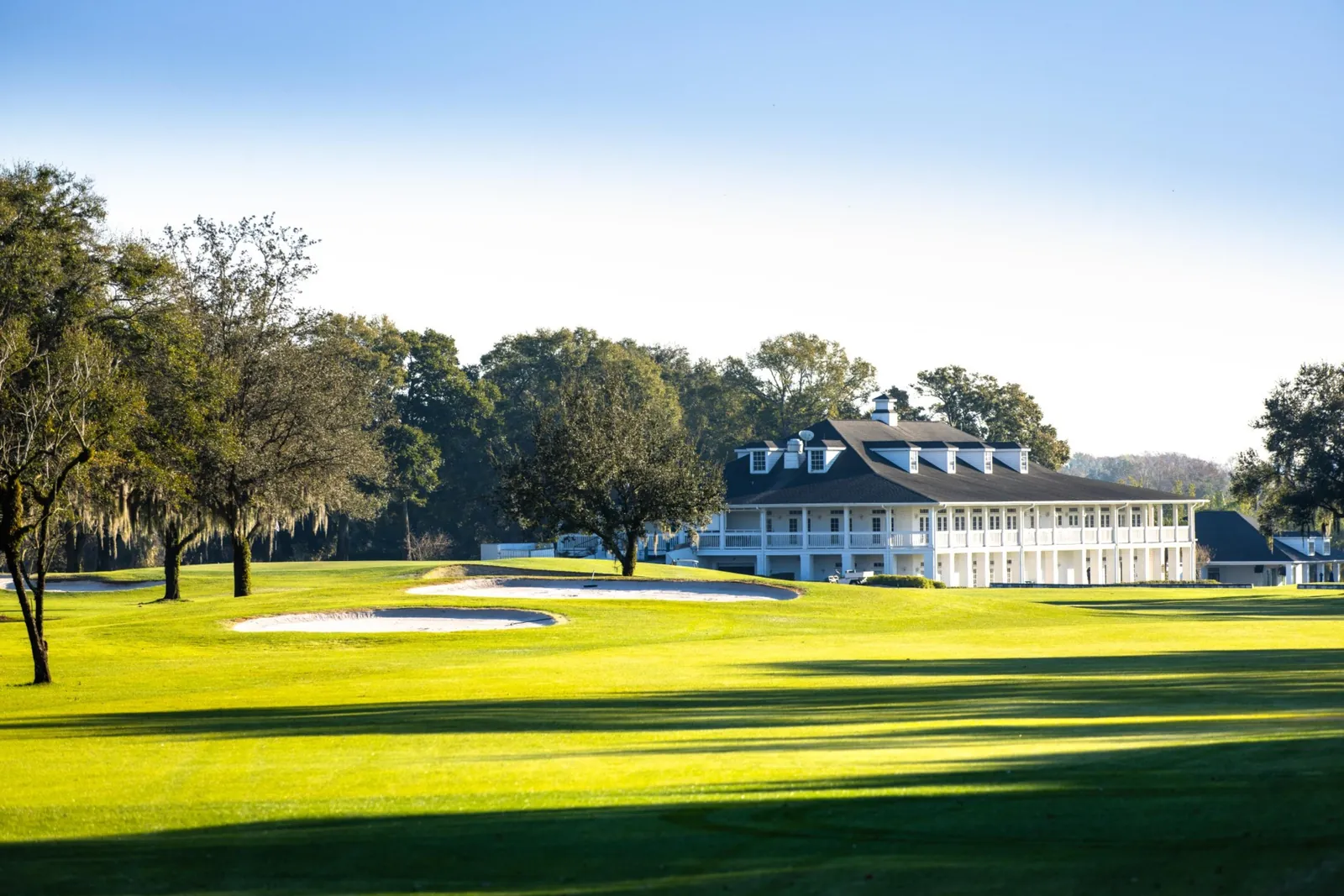
Drive east on State Road 434 through Winter Springs, Florida, and you pass the same name twice — spelled two different ways. A blue monument at an apartment entrance reads TUSKAWILLA, with a K. A mile or so on, the sign at the country club reads TUSCAWILLA, with a C. Same word. Same town. Nobody fixes it, because both are, in a sense, correct.
So which one is right? And how does a place end up unable to agree on how to spell its own name?


The same name, a mile apart in Winter Springs. The apartments, the road, and much of the older signage keep the K. The country club and the community it built keep the C. Photographs via the respective properties.
The name was here long before the golf course

The word is genuinely old. “Tuskawilla” was a Seminole settlement up in Alachua County, in the territory of Chief Micanopy — the town that grew near it still carries his name. The word traveled south in 1865, when an early homesteader named Vincent Lee bought land on the shore of a lake here and, together with his partners George C. Brantley and Daniel Randolph Mitchell, put up a wharf and a store.
Lee called the spot Tuskawilla, after that village he knew to the north. A post office opened near Brantley's store and served around two hundred people scattered through the pines and the orange groves. For a century that was the whole of it: a landing, a store, a lake, a name borrowed from somewhere else — spelled, as it had always been, with a K.

The city that would eventually swallow all of this started badly. In 1959 a developer's company incorporated the surrounding settlement as North Orlando — a name chosen for marketing, not geography. The trouble was that the town didn't actually touch Orlando; several cities and a county line sat in between, and the mail kept getting misdirected down to the city proper.
By 1966 the residents had had enough to hold a meeting about it. They couldn't agree. The suggestions ran to Ranch City, Norlando, Casanolo, Semino — and when the ballots came back, a slim majority voted to keep the name they already disliked. North Orlando stayed North Orlando, for lack of anything better.
The developer who added a letter
What finally changed everything arrived in 1970, in the form of a developer named Bill Goodman. His newly formed Winter Springs Development Corporation assembled around 3,500 acres on the undeveloped east side of town and set out to build something North Orlando had never had: a planned community wrapped around a golf course.
He hired the course architect Joe Lee, whose design opened over gently rolling ground shaded by old oaks draped in Spanish moss. And somewhere in the planning, Goodman's people made a small decision that outlasted everything else they built. They took the old Seminole name — Tuskawilla — and quietly swapped the K for a C.
“All the people who started this development of Tuscawilla in 1971 just decided to add a ‘C’ to provide our own unique nom de plume.”

That is the whole origin of the spelling, in the words of local historian Bob Putnam. Not a translation, not a correction of the old records — a trademark. The C made it theirs: a name you couldn't find on any older map, a brand for a brand-new place dressed up to look three centuries old. The club itself was first called, plainly, the Winter Springs Country Club.
The city that took the subdivision's name
Here is where the small decision turned into a large one. As Goodman's land came into the city in the early 1970s, the council decided to modernize the town charter and, finally, to fix the name. They voted 3–2 for Semoran — a mash-up of Seminole and Orange counties.
The residents revolted again. The town didn't border Orange County; Semoran Boulevard didn't come near it; the name made no more sense than North Orlando had. Fearing the backlash would sink the new charter, the council met again a week later and reversed itself. This time they reached for the one name already on everyone's lips — the name on the entrance sign of the big new development going in on the east side.
In 1972 North Orlando became Winter Springs, after the country-club community. And the community kept the respelled word Goodman's people had invented. The city had, in effect, let a subdivision name it.

And fill in it did. Street by street, for the next twenty-five years, the fairways grew a town around them — something like seventeen neighborhoods and roughly 4,500 homes, home today to more than eleven thousand people. A borrowed word with an invented letter had become the address of a small city.
The one part of it nobody invented
You can respell a name. You can draw a town around a golf course and build it over twenty-five years. The one thing the developers couldn't design, and the one thing none of those eleven thousand people can do without, is the power.
Every fairway Joe Lee laid out stays green on irrigation pumps. Every one of those 4,500 air-conditioned houses, in a place that runs past ninety degrees for months, depends on the current staying on. The pumps, the gates, the refrigerators, the wells — all of it runs downstream of a wire coming in from outside, along poles crossing the same flat pine country the Seminole village was named for.
A name can be made to sound three hundred years old. The power lines that light it are the honest part — and they can come down in an afternoon.
September 10, 2017

Central Florida has seen exactly what that looks like. On September 10, 2017, Hurricane Irma came up almost the entire length of the peninsula and drove straight through the Orlando region. Statewide it knocked out power to about 6.7 million customers — roughly two-thirds of every electric account in Florida, the largest outage in the state's history.

In Seminole County, around 158,000 homes and businesses went dark. Irma pushed down oaks and power lines across Winter Springs, flooded roads, and opened a sinkhole that swallowed a van in an apartment parking lot. Duke Energy, which serves this area, warned that for the hardest-hit parts of Seminole and the counties around it, restoration could run a week or more — power for some streets not expected back until past the middle of the month.

And it comes back the only way it ever does: crews on poles, one truck at a time, spread thin across a broken part of the state. A gated golf community waits in the same line as everyone else. The grid does not read the entrance sign — and it doesn't care which way you spell it.
What you can still read off the signs
The two spellings never got reconciled, and that turns out to be the truest thing about the place. The road and the older landmarks kept the K that a homesteader borrowed in 1865. The country club and the town it grew kept the C that a developer invented in 1971. Drive the length of Tuscawilla — or Tuskawilla — and you can read the whole history off the signs, if you know which letter belongs to which century.
One thing, though, is spelled the same on every one of them, and always has been. The lights behind the signs, the air conditioning in all 4,500 houses, the pumps keeping Joe Lee's fairways green — all of it needs the same current, arriving on the same wire from outside. The name you can't agree how to spell still goes dark the instant that wire comes down.


