Winter Garden, Florida  ·  A Local History

The Town That Ran on Cold


In a part of Florida where it never snows, a town called Winter Garden got rich by manufacturing cold — packing tons of ice around oranges to rush them north before they rotted. For a while it called itself the largest citrus shipping point in the world. Then came the one cold it could never command.

The name is the first strange thing. There is no winter in Winter Garden — not the kind the word is picturing. It sits in the flat citrus country west of Orlando, where July runs past ninety and the air feels like a wet towel, and it was named that on purpose: a promise, printed on railroad brochures, that here you could grow things in the open ground in January while the rest of the country was frozen shut. For half a century the promise held, and the whole town was built to cash it in.
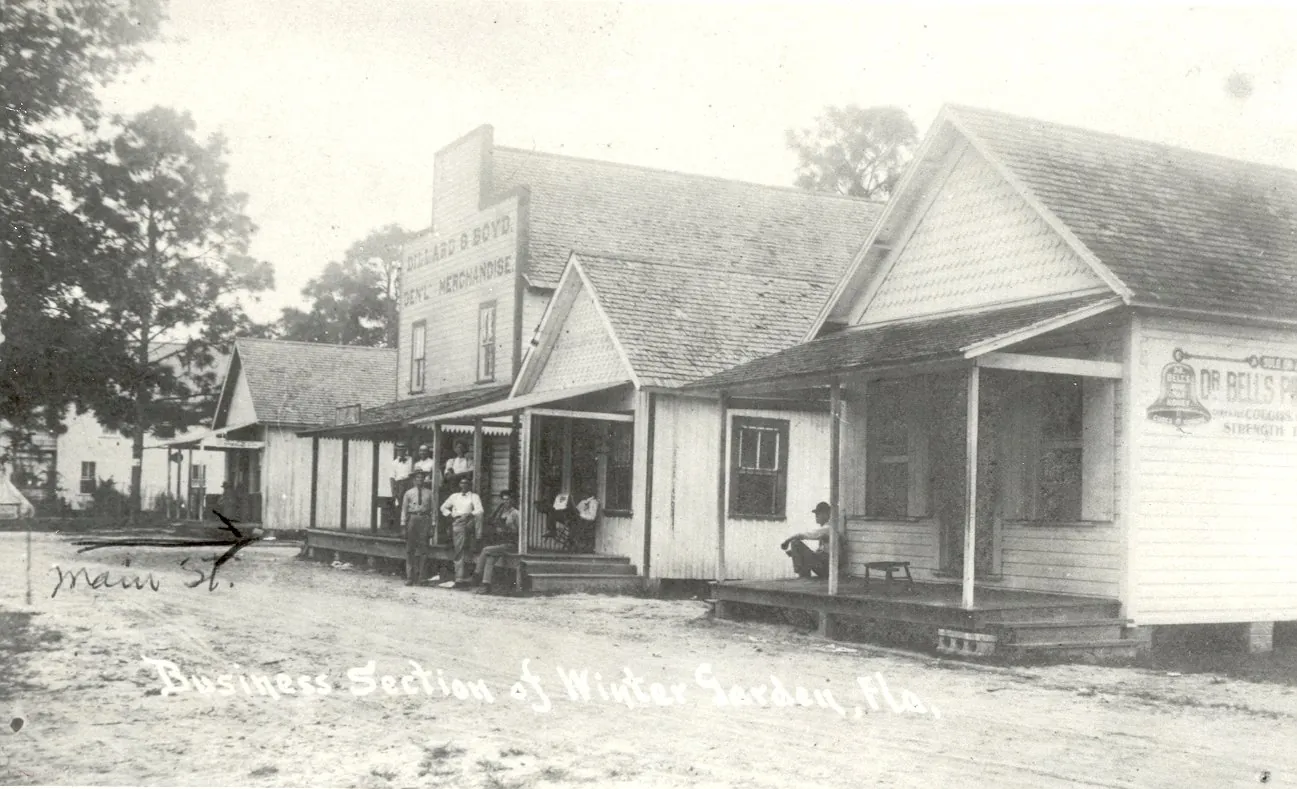
A dirt main street around 1905 lined with low wood-frame storefronts, a few figures standing in the road, and railroad tracks running down the center of town.
The town the oranges built — Plant Street, around 1905
Downtown Winter Garden, looking east along Plant Street, photographed before 1909. The two things that made the town — the railroad and the stores that served the groves — are the whole picture. Photograph via Wikimedia Commons.

A town that grew out of the muck

Settlers had been drifting onto the south shore of Lake Apopka since the 1850s, drawn by the black muck soil at the water’s edge, which grew citrus and vegetables almost without asking. But a few farms on a lakeshore do not make a town. What made the town was the railroad.

A black steam locomotive lettered ORANGE BELT on its tender, stopped on a track beside low trees, pulling a line of dark railcars.
The Orange Belt — the line that made a town
A train on the Orange Belt Railway. The line reached the settlement in 1886; the depot the farmers put up in 1893 is where the name “Winter Garden” was first written down. Photograph via Wikimedia Commons; public domain.

The Orange Belt Railway arrived in 1886, and suddenly fruit picked on Monday could be on a train by Tuesday. A second line, the Tavares & Gulf, came through before the turn of the century, and the little business district grew up in the narrow strip between the two sets of tracks — which is exactly where downtown still is. The place incorporated in 1908, elected a citrus man named Arthur B. Newton its first mayor, and passed a thousand residents by 1920.

A seated man in a dark suit around 1909, posed beside a draped table in a studio portrait, looking slightly away from the camera.
A. B. Newton — first mayor, 1909
Arthur Bullard Newton in 1909, a Florida pioneer who would become Winter Garden’s first mayor when the town incorporated in 1908. Photograph via Wikimedia Commons; public domain.

What grew on that muck and sand was oranges, and it grew in quantities that are hard to picture now. By the 1940s eight citrus packing houses stood inside the city limits, strung along the tracks, and Winter Garden had started calling itself — on its own authority, but not without cause — the largest citrus shipping point in the world.

The problem with an orange

Here is the thing nobody puts on a crate label: an orange is a clock. The moment it leaves the tree it begins to rot, and the markets that paid the real money — New York, Boston, Philadelphia — were four or five days away by rail. A town could grow the finest fruit in the country and still go broke if it arrived brown.

Winter Garden’s whole fortune came down to a single trick: getting a perishable thing a thousand miles north while keeping it cold enough not to spoil on the way.

So the town learned to manufacture cold. The fruit moved in refrigerator cars — boxcars with no machinery in them at all, just insulated ice bunkers at each end, filled through hatches in the roof with several tons of block ice, then re-iced at stops along the route as the ice melted away. In the 1920s growers figured out how to “pre-cool” the fruit before it was even loaded. Great regional ice plants ran around the clock to feed the cars. Inside the packing houses — where the women of West Orange County did most of the sorting, grading and wrapping — the fruit was washed, graded and boxed on powered lines and sent straight out to the waiting ice.

A colorized early-20th-century postcard showing the interior of a citrus packing house: long sorting tables heaped with oranges, overhead framing, and workers moving between the lines.
Inside the machine — a Central Florida packing house
A Central Florida citrus packing house interior on a period postcard captioned “A Modern Packing House, Florida” (shown here for nearby Ocoee, a few miles east — the operation in Winter Garden looked the same). Postcard via a Winter Garden local-history collection.

The fruit went out under a hundred brand names, each with its own gaudy crate label meant to catch a buyer’s eye on a cold loading dock up north. Roper Brothers shipped its fruit as “Ladder.” R. D. Keene & Co. used a bird called “Wren.” The labels are small works of art, and almost the only thing left that still carries the words “Winter Garden, Fla.” from the fruit era.

Three vintage Florida citrus crate labels — 'Ladder' by Roper Bros. Inc. and 'Wren' by R. D. Keene Inc., both of Winter Garden, and 'South Lake' of nearby Oakland — above an aerial view of groves and a packing plant.
Shipped under a hundred names
Crate labels of West Orange County growers — “Ladder” (Roper Bros. Inc.) and “Wren” (R. D. Keene Inc.), both of Winter Garden, Fla. The labels competed for the eye of a wholesaler seeing the fruit for the first time. Images via a Winter Garden local-history collection.

It worked because every link in the chain held: the pick, the pack, the ice, the train, the timing. Break any one — a late train, a warm car, a melted bunker — and a boxcar of money turned into a boxcar of waste. The town had bet everything on its ability to control temperature across a thousand miles. For decades, it won that bet.

The other thing they sold

There was a second boom running alongside the first, and it ran on the lake. Before the pollution, Lake Apopka was the second-largest lake in Florida and one of the most famous bass-fishing waters in America. Anglers came from all over the country and stayed at fish camps ringing the shore — at one point there were close to thirty of them.

A vintage promotional brochure headed 'WINTER GARDEN — fish and play on Lake Apopka, the world's most dependable bass lake,' with photos of boats, docks and strings of caught fish.
“The world’s most dependable bass lake”
A Winter Garden tourism brochure selling Lake Apopka as “the world’s most dependable bass lake.” The word “dependable” did not age well. Brochure via a Lake Apopka / Winter Garden history collection.

The town leaned into it. The Edgewater Hotel opened downtown in 1927 to put the visitors up, and the brochures sold Lake Apopka as “the world’s most dependable bass lake.” It was the same instinct as the citrus business — sell what the land and water gave you — and it would fail the same way, for a reason nobody downtown controlled.

A historic photo of a covered wooden fishing dock on Lake Apopka with a pavilion roof, a man standing at the rail, and the open lake behind.
A fish camp on Lake Apopka, before the green water
A fishing camp on Lake Apopka in its sport-fishing heyday. By the mid-1980s every camp on the lake had closed. Photograph from a Lake Apopka history collection.

In 1941 a levee was thrown across the north end of the lake and some twenty thousand acres were drained to grow vegetables for the war — muck farms that, for fifty years, let their nutrient-laden water back into what remained of the lake. Fertilizer, town sewage and citrus-plant waste fed algae bloom after algae bloom until the water turned pea-green and the bass died with it. The fishing economy collapsed through the 1960s. The lake the town had called “dependable” became, for a time, one of the most polluted large lakes in Florida.

The cold it couldn’t command

And then the thing the whole citrus town was built to beat came back on its own terms.

Winter Garden had gotten rich making cold on purpose — ice in a boxcar, a few degrees, carefully controlled. But central Florida sits just far enough north that every so often an Arctic air mass slides all the way down the peninsula and brings the real thing: a hard freeze, for which there is no roof hatch and no re-icing stop. It had happened before anyone shipped a single refrigerated car — the Great Freeze of 1894–95 dropped Orlando to 18 degrees and killed something like nine out of ten trees in some Central Florida groves, sending ruined growers south.

A single orange still on the branch, sheathed in clear ice with long icicles hanging beneath it, backlit against a dark background.
The cold that didn’t come in a boxcar
Ice on Florida citrus during a hard freeze. Growers could spray and ice the trees to fight back, but a deep, sustained freeze was the one cold no packing house could manage. Representative Florida freeze image.

What finally ended it came at Christmas, twice. The freeze of December 1983 hit the groves hard; growers replanted, and the young trees were just coming into their best years when the December 1989 freeze came through and killed them again, across Orange and Lake Counties. In that one decade Florida lost roughly half a million acres of citrus. The growers who stayed in the business did the same thing their great-grandfathers had done in 1895 — they moved south, to where the freezes mostly don’t reach. The groves around Winter Garden did not come back. The packing houses fell quiet. The town that shipped the world’s oranges stopped shipping oranges.

What the tracks carry now

A town built on one thing, when that thing dies, usually dies with it. Winter Garden didn’t, and the reason is sitting right where the fruit used to load.

A modern brick-and-stucco trailhead pavilion and small plaza on the West Orange Trail in downtown Winter Garden, with landscaping and a paved path running through it.
The rail bed, carrying people now
The West Orange Trail in downtown Winter Garden (modern photograph) — a paved rail-trail laid on the old Orange Belt and Tavares & Gulf right-of-way, running straight down the median of Plant Street. Photograph via Wikimedia Commons.

When the railroads pulled out, Orange County bought the corridor and, in 1994, opened the West Orange Trail — twenty-two miles of pavement laid on the old roadbed, running right down the median of Plant Street through the middle of downtown. The same line that once carried iced oranges toward New York now carries cyclists past the storefronts. The two old brick depots are museums. The Edgewater Hotel still stands. A town that had nothing left to ship reinvented itself as a place worth stopping in, and the historic district went on the National Register in 1996.

Stand on Plant Street today and the name finally makes sense in reverse. “Winter Garden” was always a boast about cold — about a place where winter couldn’t kill what you grew, and where, with enough ice and a fast train, you could ship the proof anywhere. The groves lost that argument to a couple of hard December nights. But the town is still, underneath everything, a place that runs on holding cold in its place — now in a refrigerator, an air conditioner, a pharmacy cooler — all of it hanging on a power grid that an ordinary Florida storm can take down in an afternoon.

A present-day note · GENERasic

Winter Garden got rich keeping things cold. For one house in a storm, that comes down to a single generator in the yard.

The old citrus town ran on an unbroken cold chain — ice, a powered packing line, a train kept on schedule. Break one link and the fruit was lost. A modern home has its own small cold chain, and it runs on one thing: electricity. When a hurricane drops the grid for days — which, in central Florida, is a when and not an if — everything that depends on staying cold or staying powered quits at once.

A standby generator is the home-scale version of making your own cold: wired to start itself the moment the grid drops, whether you’re home or not. In a Florida outage, what it’s protecting is worth being plain about:

Which of those actually apply to your address — your medical needs, how your house is fed, well or city water — is worth pinning down for your own home rather than guessing. That part is yours to check.

You can get an address-specific installed price for standby power — the whole turnkey number, not a callback and a maybe — in one sitting.

Get your installed price for this address→
Sources & Photo Credits

On the history

Photographs

  1. Downtown Winter Garden, Plant Street, before 1909 (hero) — “Business Section of Winter Garden, Fla.”; via Wikimedia Commons (file DowntownWInterGardenEarly1900s.jpg, uploader WMcCoy1999). File: winter-garden-downtown-plant-street-c1905. Commons
  2. Train on the Orange Belt Railway — historic photograph, public domain, via Wikimedia Commons. File: orange-belt-railway-train. Commons
  3. Arthur Bullard Newton, 1909 — Winter Garden’s first mayor; public domain, via Wikimedia Commons. File: arthur-newton-first-mayor-1909. Commons
  4. Citrus packing house interior (Central Florida) — period postcard, “A Modern Packing House, Florida,” captioned for Ocoee (a few miles east of Winter Garden; shown as representative of the identical packing-house work in Winter Garden). Source: a Winter Garden local-history collection (thelocalwg.com). File: ocoee-modern-packing-house-postcard.
  5. West Orange County citrus crate labels — “Ladder” (Roper Bros. Inc., Winter Garden), “Wren” (R. D. Keene Inc., Winter Garden) and “South Lake” (Oakland). Source: a Winter Garden local-history label collection. File: winter-garden-citrus-crate-labels.
  6. Winter Garden / Lake Apopka fishing brochure — “Winter Garden — fish and play on Lake Apopka, the world’s most dependable bass lake.” Source: a Lake Apopka / Winter Garden history collection (via the Orange Observer). File: winter-garden-lake-apopka-fishing-brochure.
  7. Fishing camp on Lake Apopka — historic photograph of a covered dock at a Lake Apopka fish camp. Source: a Lake Apopka history collection. File: lake-apopka-johnsons-fishing-camp.
  8. Ice on Florida citrus during a hard freeze (representative) — a Florida orange sheathed in freeze ice; representative image of a Florida citrus freeze, not a Winter Garden-specific photograph. File: florida-citrus-freeze-ice-on-oranges.
  9. West Orange Trail, downtown Winter Garden — modern photograph of the rail-trail on the old railroad corridor along Plant Street; via Wikimedia Commons. File: west-orange-trail-winter-garden-monument. Commons
  10. Standby generator (representative — not Winter Garden equipment) — an enclosed residential/commercial standby generator on a pad; by Gregsedits, 2011; CC BY-SA 3.0, via Wikimedia Commons. File: standby-generator-set-representative. Commons

The two modern photographs (the West Orange Trail and the standby generator) are identified as modern; the freeze photograph and the generator are labeled as representative and are not Winter Garden equipment; the packing-house postcard is identified as a nearby-Ocoee image standing in for the identical Winter Garden work. Original downloads and a full research record are kept alongside this page in assets/images/originals/ and source-record.md. No image’s factual content was altered — the frames and handwritten notes are CSS added around the photographs, never onto them. Any owner who wants an image removed need only ask.