In the early 2000s, one of the prettiest and richest towns in Florida had a problem that sounded almost too small to matter: nobody’s clocks were right. The microwave, the bedside alarm, the oven — all of them blinking 12:00, because the power kept flicking off and back on. When a group of residents set out to fire the town’s electric company, they put a blinking digital clock on their campaign material. Everyone who lived in Winter Park understood it instantly.
So why would a wealthy town just north of Orlando have some of the worst power in the region? The answer was hanging right over their heads.
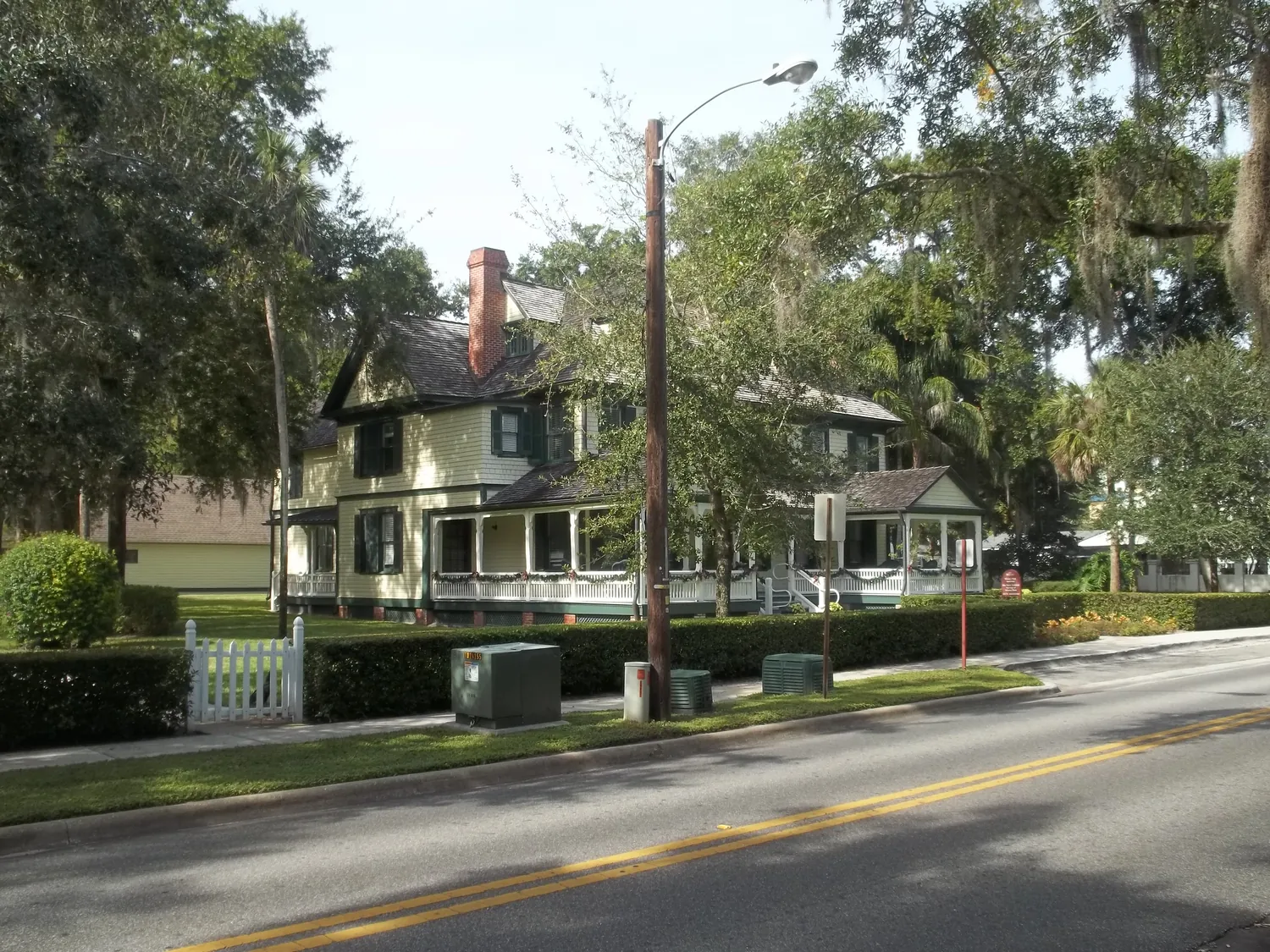
Winter Park sits under a roof. Not a built one — a living one, a canopy of live oaks hung with Spanish moss, arching over brick streets the town has guarded for more than a century. It is the single most recognizable thing about the place. It is also exactly why the lights kept going out: those branches sat in the power lines, and every storm that came through turned a limb into an outage.
A town built to be beautiful
Winter Park was designed from the start as a pretty place. In the 1880s a pair of New Englanders laid it out as a winter resort for well-off Northerners, strung between a chain of small lakes, with a shop-lined spine called Park Avenue and a brand-new college, Rollins, founded in 1885 at the south end of it.

In those first photographs the famous canopy isn’t there yet. The streets are raw sand, the trees are mostly scrubby pines, and the whole thing looks like what it was: a speculative resort scratched out of the Florida flatwoods. The oaks that define the town today were small then, or not yet planted.

What the founders did do was commit to the look of the place — the lakes kept open, the avenue kept walkable, and over the next hundred years a canopy of live oaks grown and protected until it became the whole point. By the time anyone worried about power lines, cutting those trees back hard was close to unthinkable.

The blinking-clock years
Fast-growing Central Florida got its power from big investor-owned utilities, and Winter Park’s came from Florida Power Corporation — which merged into Progress Energy in 2000. For a canopy town, that arrangement had a built-in fight in it: the utility wanted to trim trees away from its overhead lines, and Winter Park wanted its trees.
The reliability numbers were genuinely bad. The average Winter Park customer was losing power for something like 360 minutes a year — six hours of outages, spread across countless flickers and blackouts. “We love our trees in Winter Park,” the city manager, Randy Knight, later put it, “and trees and power lines don’t mix.”
The most beautiful thing about the town was the thing knocking its power out.
The obvious fix — bury the lines — went nowhere. The city wanted the wires underground; the utility, by the residents’ account, would only do it if Winter Park paid the entire cost and the company still owned the result. So the clocks kept blinking, and a quieter idea started to take hold: if the power company wouldn’t fix it, maybe the town should own the power company.
The vote almost nobody wins
Cities almost never take their grid back from a big utility. It’s expensive, it’s a legal war, and the incumbent fights with everything it has. Winter Park did it anyway.
As the decades-old franchise with Progress Energy neared its end, the city commissioned a hard-nosed feasibility study, which concluded that running the utility itself was a genuinely viable business. In September 2003, the question went to the voters: end the franchise, buy out the system, and become a municipal electric utility. It passed 69 percent to 31 — and authorized $50 million in bonds to pay for it. It was the first time in more than forty years that a Florida city had ended its franchise with an investor-owned utility.
Progress Energy did not take it quietly. The company outspent the pro-takeover residents by something like ten to one, and warned the town exactly how this would end: a city utility would answer a major outage with “four guys in a pickup truck,” and the whole thing would have to be bailed out with property taxes.
Buying a grid in a courtroom
Winning the vote was the easy part. Then came the price. Progress put a number on its poles and wires that ran into nine figures; Winter Park argued it was worth a fraction of that, and the fight went into years of arbitration before the city finally took the keys on June 1, 2005. The system changed hands for far less than the utility first demanded — though the legal bills, and a disputed “stranded cost” payment the city later regretted, ran into the millions on top.
And right in the middle of all this, the sky made the town’s whole argument for it.

The summer of 2004 sent four hurricanes across Florida. Charley tore up through the center of the state in August; Frances and Jeanne followed within weeks. Across Central Florida, old oaks that had never felt a real wind came down on the overhead lines, and the lights stayed off for days. For a town in the act of taking over its own grid specifically because trees kept knocking the power out, it was an argument you couldn’t have scripted.
Putting it all underground
Owning the wires was step one. The real promise — the one that answered the trees once and for all — was to bury the entire system.
In January 2008 the city started, funding the first phase with bonds and then pouring something like five to nine million dollars a year into it ever since. It is slow, unglamorous work: trenching street by street, moving every home’s service from a pole to an underground feed, and leaving behind the green metal transformer boxes you now see tucked into Winter Park’s hedges.

By the end of 2024, the city’s own filing to state regulators put it plainly: 101 miles of lines buried, roughly 80 percent of the old overhead system gone underground, and every new house required to connect below ground. The target is to finish the job around the end of the decade — a timeline that slipped a few years when transformers and parts got hard to buy.
Did it work?
It did, and the numbers aren’t subtle. That 360-minutes-a-year of outages fell to under fifty, and more recently under thirty — against roughly 83 minutes for the big neighboring utility, Duke Energy. Winter Park’s rates, the thing opponents swore would require a tax bailout, have run well below Duke’s instead, and the city says it has never once subsidized the utility with property taxes.

The clearest proof came in October 2024, when Hurricane Milton plowed across Central Florida and knocked out power to hundreds of thousands of people. In Winter Park, the city’s electric director reported, only 278 customers lost power — and nearly all of them were back on within twelve hours. A town that twenty years earlier had been a punchline about blinking clocks mostly just… kept its lights on.
What you can still see
Stand on Park Avenue now and the whole story is right in front of you, if you know where to look — or rather, where not to. Look up: there are no wires. The oaks the town fought to keep still arch over the brick, and the grid that used to tangle in them has been pulled down into the ground, out of sight.


The only tell is at knee height: the squat green transformer boxes sitting in the hedges, one per cluster of houses, humming quietly. They are the least beautiful objects in Winter Park, and the town accepted every one of them — because the deal it made with itself was that the trees stay up and the wires go down.
Winter Park started as a town that chose beauty over practicality, a resort of lakes and oaks with no particular reason to exist except that it was lovely. A century later it was handed the bill for that choice, in six hours of blackouts a year. And instead of cutting the trees, it bought the grid and buried it — which is how the prettiest town in Central Florida also ended up with some of the steadiest power in it.


