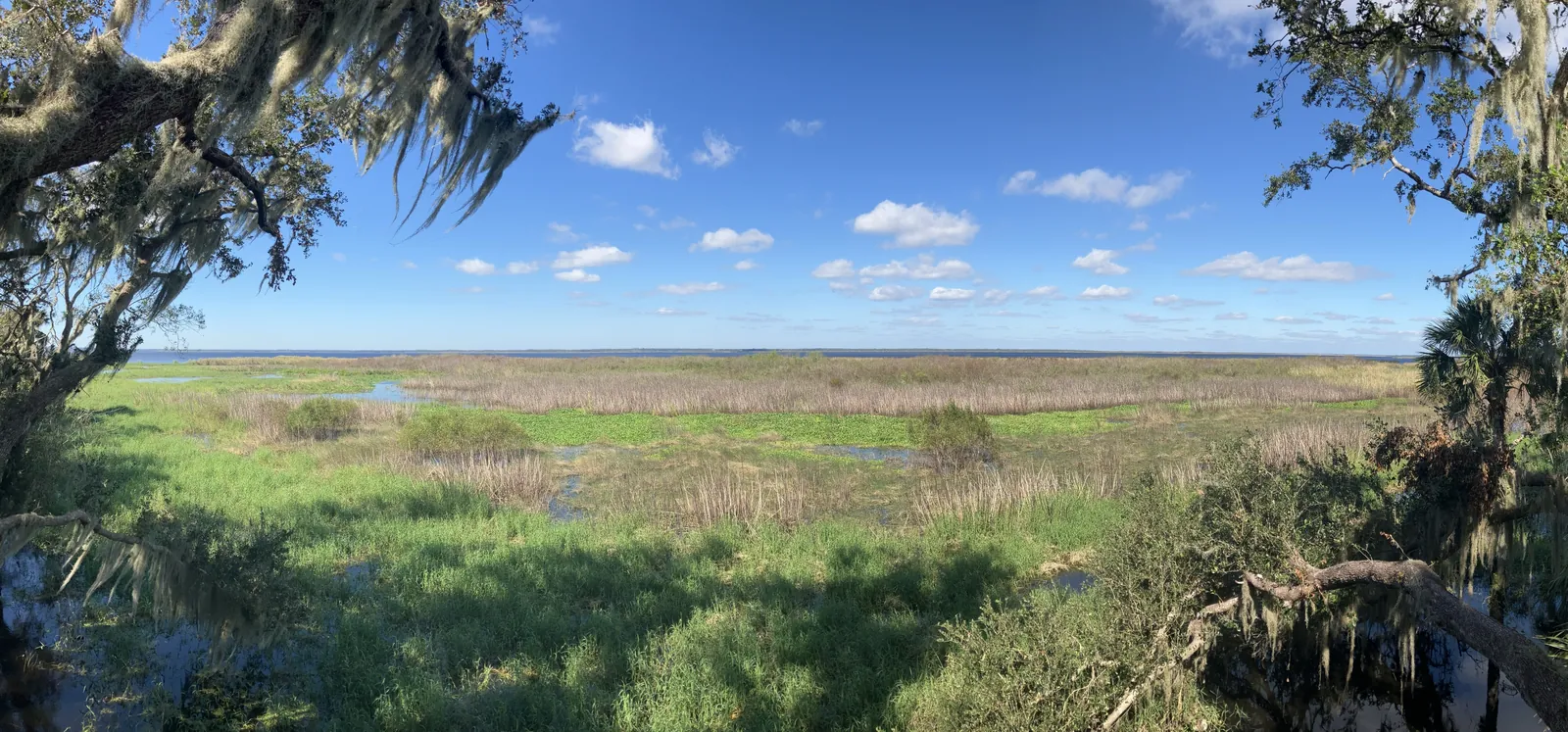
You can cross Lake Jesup in about twenty seconds. The SR 417 toll road vaults over it on a mile-long bridge, seventy feet up, and most of the forty-odd thousand people who live in Winter Springs just below it never give the water a second look. It’s a wide brown sheet full of alligators — state wildlife officials put the number around thirteen thousand — ringed by protected marsh no one builds on. A scenic backdrop. A thing you drive over. But there is a photograph from around 1880 of this exact shoreline with a steamboat wharf on it and a store doing business, because for one short run of years, this lake wasn’t the backdrop. It was the front door.

Before the roads, the water was the road
In the 1870s and ’80s there was no good way to move anything heavy across the middle of Florida. There were no paved roads and, for a while, no railroads this far inland. What there was, was the St. Johns River — Central Florida’s one dependable highway, running south from Jacksonville deep into the interior. Lake Jesup hangs off the side of that river like a wide spot in the road.
That geography handed this shoreline a brief, specific importance: the wharves on the south side of Lake Jesup were about as far south as a steamboat could land freight. From here it went the rest of the way by wagon — to Maitland, to Orlando. If you lived in the whole district and needed to ship something out or bring something in, your route ran through a dock on this lake.

A Jacksonville merchant named Antonio Solary saw the opening first. Around 1872 he built a pier at a spot where the lake bottom dropped away into a deep enough channel for the larger boats to tie up, and ran a general store beside it that sold, among other things, his own bottled sodas. A post office opened in the store. Nearby, the partners George Brantley and Colonel Daniel Mitchell had made their own wharf and store the commercial heart of the settlement — Brantley gave it the name Tuskawilla in 1874, borrowed from an old Indian town down in Alachua County.
What the boats were really for: oranges
Strip away the romance and the lake trade was about one thing. Fruit.
The high ground around Lake Jesup and neighboring Lake Charm had filled up with orange groves, and oranges are heavy, perishable, and useless if you can’t get them to a buyer. The boats carried them north — across the lake, down the St. Johns, on to Jacksonville and the rail connections beyond. Growing the fruit was the easy part. Moving it was the whole game.

And the growers felt it. The northern shipping lines that controlled the long haul charged what they liked, and the freight rates ate into every box. By the early 1880s the men around Lake Jesup had decided to stop paying someone else to haul their fruit and run a boat of their own.

In April 1881 they chartered the Lake Jesup Steamboat Company. The partners read like a roster of the district’s whole leadership: Solary; the storekeeper-postmaster George Browne; Andrew Aulin, the Swede who had founded Oviedo; and Dr. Henry Foster. They bought an interest in the Isis — a hundred-foot, flat-bottomed, iron-hulled steamer already working the St. Johns under Captain Eugene Bigelow — refitted her for cargo, and sent her up to Solary’s wharf for the first time in December 1881.
For a few months, the growers of Lake Jesup owned the boat that carried their own fruit. It was the one piece of the chain they’d never controlled.
The “springs” were real — just not these ones
It’s worth stopping on that word, springs, because a suburb called Winter Springs sitting beside a lake invites the obvious question. The modern name, in truth, is a developer’s choice from the 1960s. But there was a real spring here, and it had a name that traveled a long way to get here.

Down the shore from the wharves, a warm, sulphur-smelling spring fed the lake. A storekeeper named W. G. White opened a landing beside it in the late 1870s, and the place became known as Clifton Springs — after the New York town Foster had come from, a village famous for a mineral-water sanitarium. Starting in 1880, people from Oviedo came out every May to picnic at the spring, the churches planning it together, white and Black residents on separate days — the segregation of the thing written plainly into the arrangements.
So the district really did run on water, in more ways than one: the lake that carried the fruit, and a spring people treated as a tonic. Neither is what gave Winter Springs its name. Both are why the name doesn’t feel like a lie.
The night it all went down
The boat venture lasted less than a year.
On November 6, 1882, the Isis was caught in a hard storm on Lake George, farther up the St. Johns, and sank. Three of her crew drowned. The company’s insurance, it turned out, covered fire but not storm — so the loss didn’t just cost them a boat, it cost them the company. The Lake Jesup Steamboat Company went bankrupt and dissolved. The growers were back to paying the lines they’d tried to escape.
And then the thing that would have killed the lake trade anyway showed up. In the mid-1880s the railroad finally reached the groves — the Sanford and Indian River line ran into Oviedo by 1885 and on to Lake Charm by 1886. A grower could now roll a boxcar right up to the packing shed and never touch the lake at all. A wharf that had been the only way out was suddenly the slow, wet, expensive way out.
The docks fell quiet. The post office on Solary’s wharf closed in 1886. The boats stopped coming, and the lake went back to being just a lake.
The suburb that forgot it was a harbor
It went back so completely that the port left almost nothing behind. When developers chartered a little settlement here as North Orlando in 1959, and when a company called the Winter Springs Development Corporation annexed thousands of acres and gave the place its present name in the early 1970s, nobody was building toward the water. They were building a golf course — Tuscawilla, laid out around 1971 — and a suburb to wrap around it, with its streets and its country club and its back turned to Lake Jesup.

What’s left of the spring is Overlook Park, a Seminole County picnic ground opened on the old Clifton Springs site after 2000. What’s left of Solary’s wharf is a single county historical marker near a lakeside marina — and local historians argue it’s planted in the wrong spot, a thousand feet from where the pier actually stood. The settlement that depended on the lake is remembered by a plaque that may not even be standing in the right place.

The water itself did fine without the town. Lake Jesup is a state-protected wilderness now, its shore left deliberately wild, its gators a genuine hazard rather than a mascot. The one structure that treats the lake as something to get across — the 417 bridge — does exactly that: gets you across, fast, without making you deal with it.

For a few years this shoreline was the one door everything had to pass through — every box of fruit, every barrel of supplies, every letter. Lose the boat and you lost the district’s only link to the outside world, which is exactly what happened, in a single stormy November night and a single arriving railroad. Winter Springs kept a water name and built a town that never needs the water for anything. The lake is still right there. It just doesn’t open for it anymore.


